How to Do SEO for Financial Services: 8 Proven Strategies
SEO for financial services is unforgiving.
In most industries, you can publish decent content, do some link building, and voila: you gradually climb the search engine results pages. In the financial services industry… not so much.
Is it because SEO doesn’t work for finance? No, of course, it does. But it only works under a slightly different set of rules.

You see, search engines treat financial services content as high-risk. And they do it by default. A blog post about planting tomatoes can be inaccurate, but could it be that harmful?
At the same time, a web page about loans, investments, insurance, or taxes can cause real financial damage. Google knows this, users know this, and both respond with skepticism.
So, in this guide, we’ll help you understand how you can take all that skepticism towards financial services SEO and turn it into a successful strategy. A strategy that actually works and brings you organic leads.
Contents
- Before we begin: Understanding Google’s trust model for financial content
- SEO for financial services: What is it all about, really?
- How Google decides which financial content deserves to rank?
- 8 proven strategies for financial services SEO
- When can you expect results from your financial SEO strategy?
- Conclusion
Before we begin: Understanding Google’s trust model for financial content
Financial services happened to be in a category where Google assumes risk first. It doesn’t matter if you’re a large financial institution or a small advisory firm. Your content is evaluated through the same lens:
Could this information influence someone’s financial decisions?
If the answer is “yes” (and in finance it almost always is), then the bar is immediately higher.
Google evaluates financial websites holistically:
- Your existing content and how consistently you publish it,
- How topics connect across web pages,
- Who links to you,
- How users interact with your site,
- And whether your brand appears credible beyond your own domain.
So, even if you have one strong article, it can’t compensate for other thin posts, outdated financial services content, poor site structure, or weak off-page SEO signals. Maybe it could work for some other businesses, but definitely not for financial services companies.
That’s why E-E-A-T (experience, expertise, authoritativeness, trust) is so important in SEO for the finance industry.
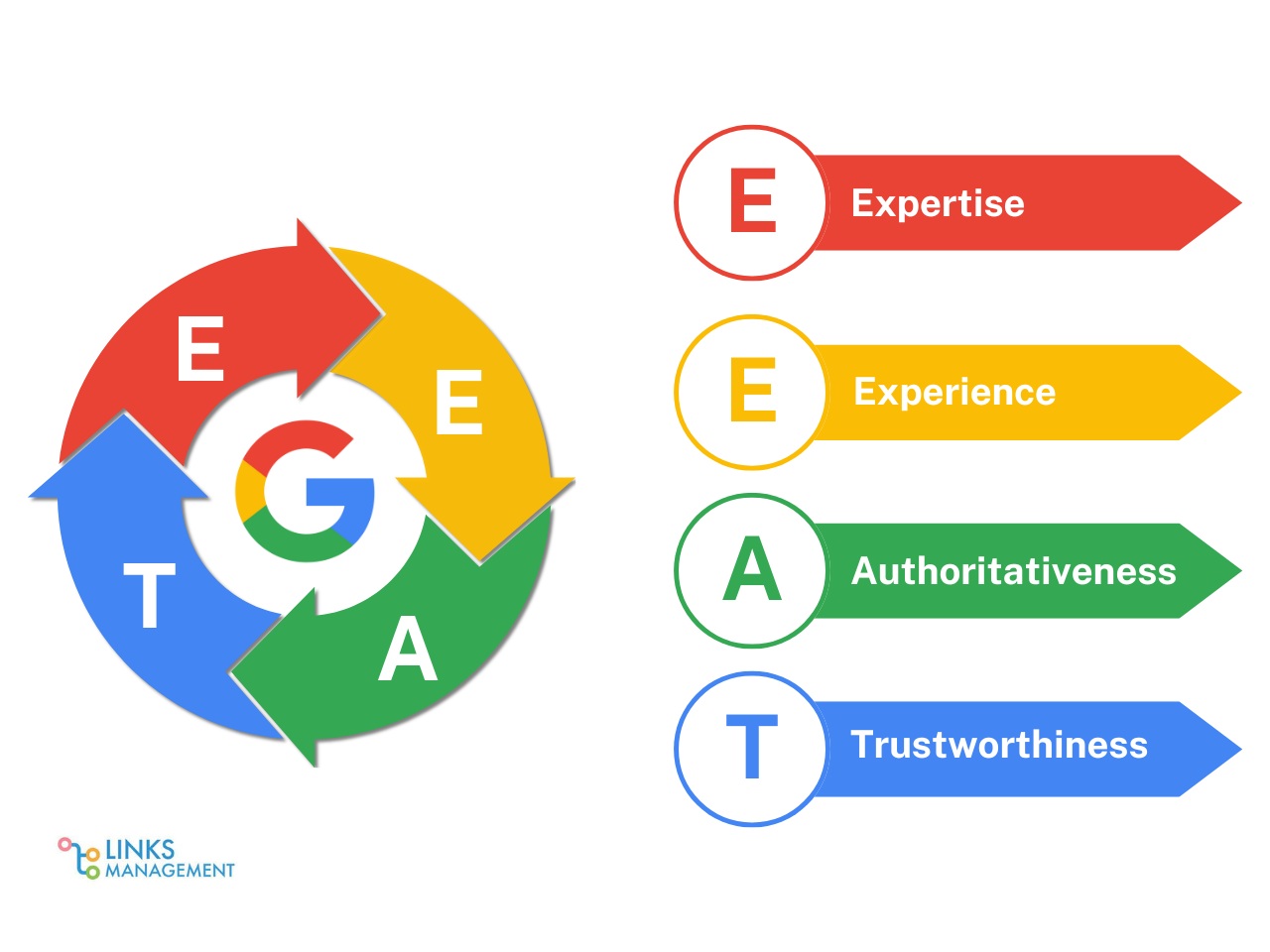
When you read anything SEO-related, at some point, you’ll definitely come across the E-E-A-T concept. It is a framework Google uses when evaluating and ranking content.
This “policy” matters across industries. But when it comes to SEO for financial services, it should be something that goes without saying. It’s your website’s foundation.
Google’s algorithms look for evidence that:
- The content creator understands the financial topic deeply.
- Your company has real-world credibility in the financial services sector.
- And all the information you share is verified and presented responsibly.
This doesn’t mean every article needs credentials attached to make it look better (but it actually helps). It does mean that anonymous, generic financial content will be harder to rank, no matter how well optimized it is.
SEO for financial services: What is it all about, really?
When most people hear “search engine optimization,” they think of keywords and climbing the search engine rankings. Nothing wrong with that.
Yet, in the financial services sector, these aren’t the first things you should care about.
The thing is, SEO for financial services is not that much (or not only) about being found in search engines. The main goal is to be trusted when you are found.
In the financial industry, trust determines everything, whether:
- Google shows your web pages in search engine results,
- Users click through from search results,
- People stay on your site and engage with your content.
Finance SEO is different because every search query might carry serious implications.
When someone types “how to choose a retirement plan” or “best small business loan options,” they’re actively searching for guidance with potential financial consequences.
Search engines recognize that, and their algorithms respond accordingly.
That’s why Google has a specific “category” for these topics called “Your Money or Your Life” (YMYL). And it clearly states that for these topics, they give “more weight to content that aligns with strong E-E-A-T.”
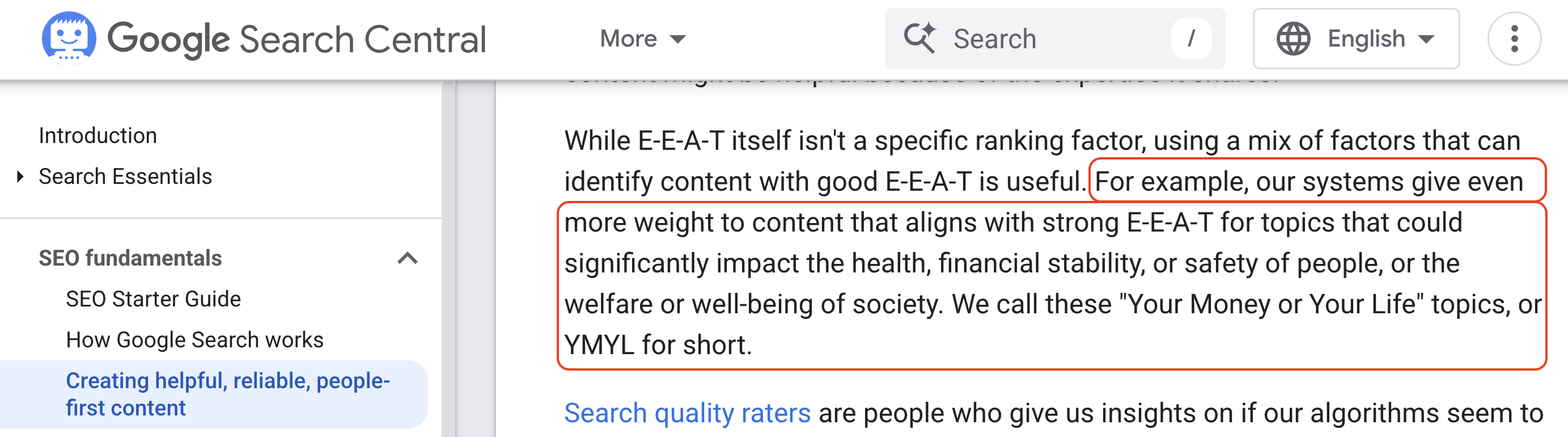
Source: Google
How Google decides which financial content deserves to rank
If Google had EQ, its main emotion about financial content would be suspicion. It is mainly preoccupied with only one thing: Is this content safe to show to users?
Of course, all the other ranking factors also apply to the financial niche. But topical authority and content quality are especially important here.
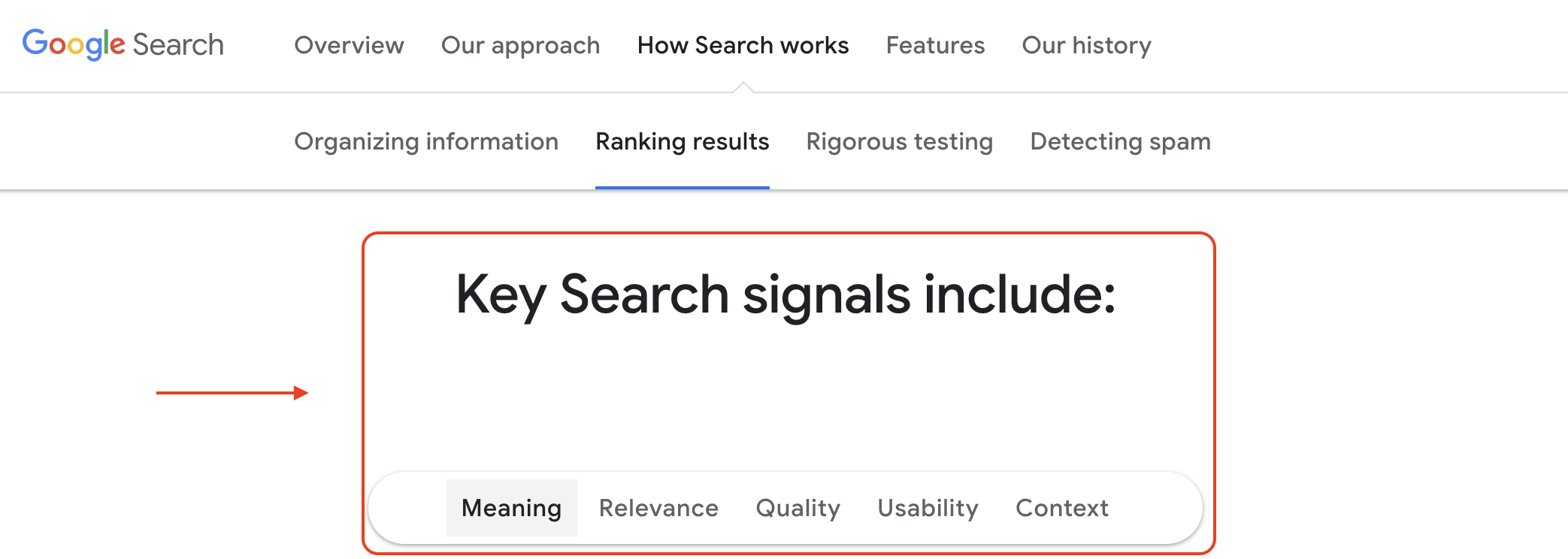
Source: Google
What is even more important to understand is that Google evaluates whether your content ecosystem makes sense as a whole:
- Do your web pages reinforce each other?
- Are topics covered consistently or randomly?
- Does your site feel like it belongs in the financial services industry or like it’s passing through it?
A website with ten highly expert and deeply connected pieces can easily outperform a site with fifty random, fluffy SEO pages.
Why? Well, one word: coherence. Google loves it and takes it as a credibility signal.
So, in your digital marketing strategy, make sure to focus on quality rather than quantity. You don’t need to cover all the relevant keywords in your niche and publish “whatever has search volume.”
Instead, your SEO efforts have to be very well-planned and specialized.
That’s why when you check websites like Investopedia, you see in-depth educational content where all the claims are backed by data from reputable sources.

Source: Investopedia
What adds even more trust is that every piece not only has the name of the author, but also the names of reviewers and fact checkers. Isn’t this reassuring? Well, for what we know, they definitely know their SEO game.

Source: Investopedia
But let’s consider one more thing.
Search engines these days reward content that clearly answers questions. When it comes to financial services, people tend to have endless question lists. Still, when you respond to them in your publications, you have to make sure that every post is:
- Legally compliant,
- Free from unverified claims,
- And defensible if audited.
This will likely change how you create content, phrase your explanations, and handle recommendations.
In other words, apart from being SEO-friendly, your content has to be safe to publish.
If users bounce quickly or keep searching after opening your article, this obviously means uncertainty for Google. And uncertainty is exactly what Google tries to avoid when delivering financial search results.
8 proven strategies for financial services SEO
Now, let’s get to the most important section of this guide and understand what exactly you can do to get better search rankings and more organic website visits.
1. Build trust first
So the first insight: financial services SEO is not only about optimization. It’s largely about trust.
You’re competing with banks that have existed for decades, financial institutions with massive brand equity, and companies that have massive marketing budgets. These are already doing well in search engine rankings because they’ve had years to earn that position.
For newer financial service providers, ranking for even low-volume, long-tail keywords is often quite hard.
Who succeeds, then?
Those who have an SEO strategy that is on the same page with how people actually search for financial information. And, no less important, how search engines evaluate it.
That means understanding:
- Why search intent matters more than raw traffic,
- Why keyword research in finance is so different,
- Why quality content beats frequency every time,
- Why link building must be slow, selective, and reputation-driven,
- And why SEO efforts in finance should support long-term lead generation.
And these are all the things we’ll cover in the next steps of this section to help you build an effective SEO strategy in financial services.
2. Focus on search intent
Someone seriously searching for financial information is not just casually scrolling Instagram or TikTok. They’re often uncertain or cautious. That emotional context makes the search intent for the financial services industry different.
We all know that 99% SEO strategies treat intent as either:
- Informational,
- Commercial,
- Transactional,
- or Navigational,
You’ll also face each of these when writing your content. But the issue is that ranking for them won’t be the same.
If say you were selling running shoes, sure, you’d have very strong competitors like Nike or Adidas. But with the best SEO practices and some time, getting into the top 10 for “buy running shoes for men” (transactional search intent) would be more than doable.
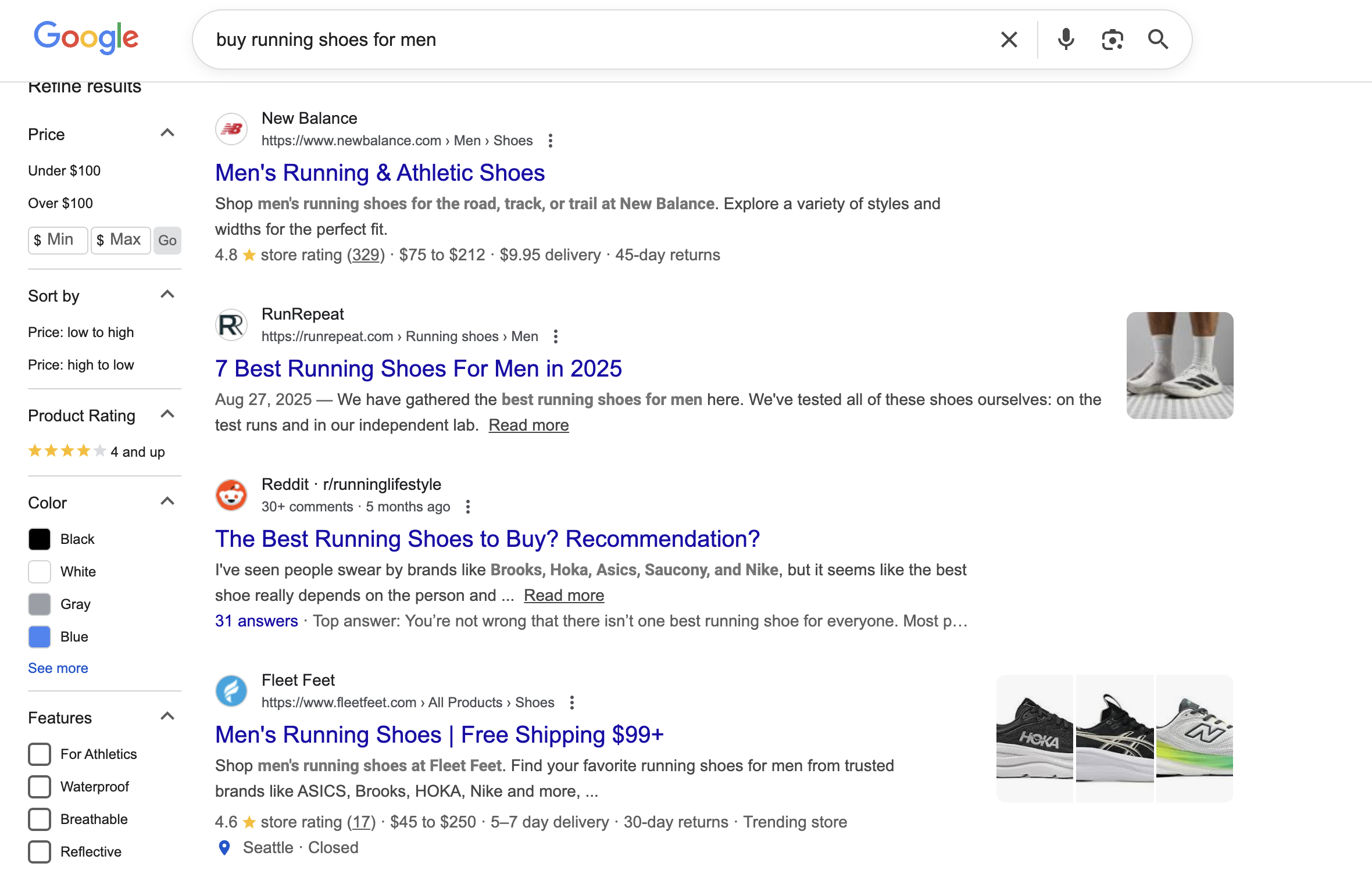
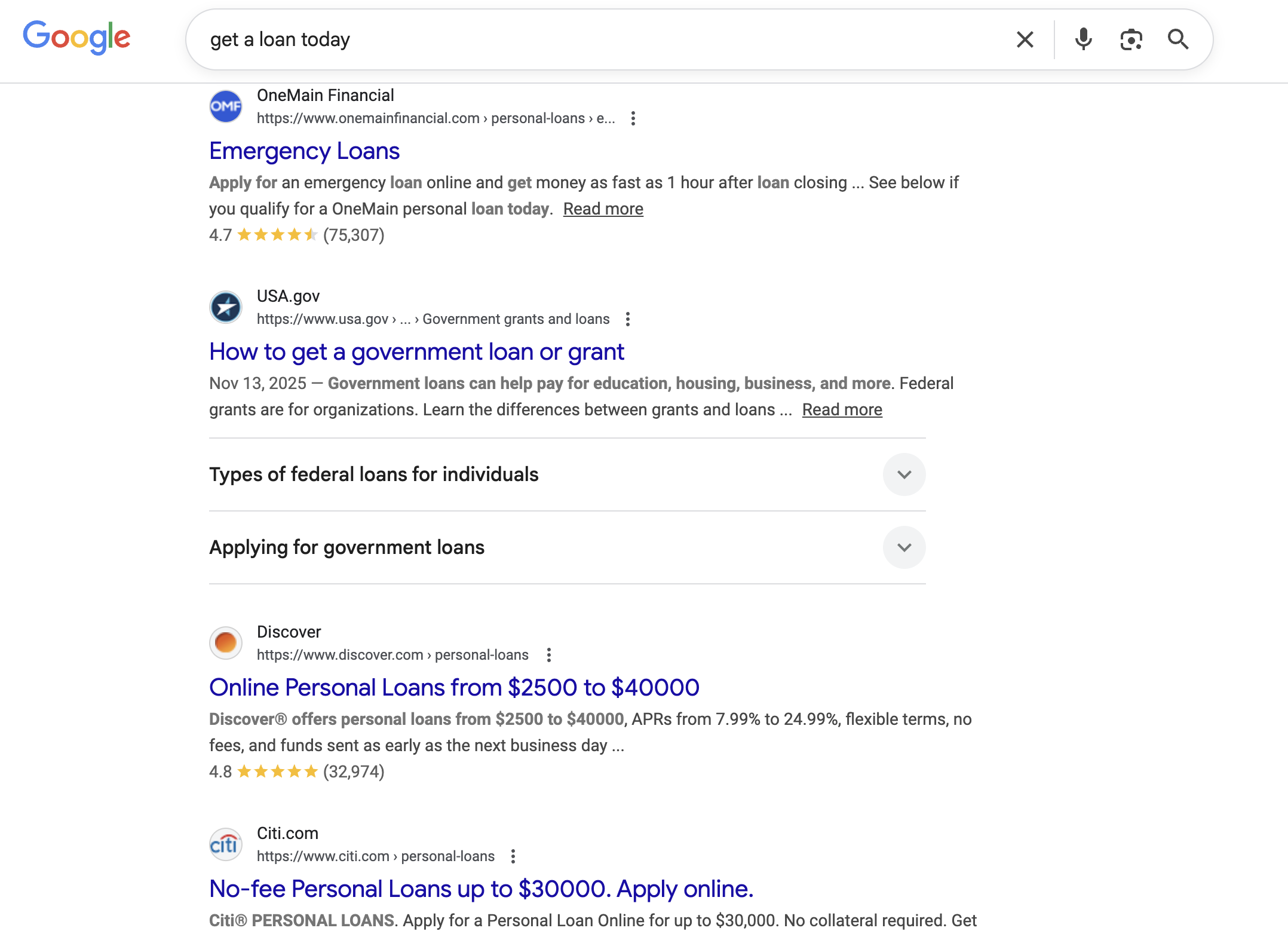
But if we take the same transactional intent in the financial sector with a keyword like “get a loan today,” ranking for it would be much harder. After all, you’d have to compete with the US government and financial institutions founded several decades ago.
Doesn’t sound like an easy task, does it?
So, what can you do?
You’ll still have to follow the usual SEO process:
- Take a keyword research tool you prefer,
- Find keywords with decent search volume,
- Evaluate difficulty and group them into clusters,
- Then, create content around them.
This is a basic flow you need to use for any optimization strategy, including financial services SEO.
But in your case, you can pretty much forget about high-volume keywords because competing with all those banks and legacy institutions is nearly impossible.
So, instead, target specific search queries that reveal true intent. These include long-tail keywords, very particular questions, comparison queries, etc.
When you find those topics, focus on the journey, not random search terms. Think like your user. For example, they could:
- Start by searching for “how does a mortgage work” (informational, top of the funnel),
- Then go to “fixed vs. variable mortgage risks” (informational, consideration stage, middle of the funnel).
- And many of them will end up with “mortgage advisor near me” (transactional, very much going towards the bottom of the funnel, where local SEO could help a lot).
So, if you have a bunch of isolated pages without guiding the user forward, it won’t work.
But if your site supports intent progression, links pages internally, and guides users through their journeys, you are already doing some decent SEO for financial services.
3. Map keywords to the financial decision journey
We’ve already touched on this in the previous step. But it’s really important, so we have to go deeper here.
SEO for the finance industry isn’t only about what the user is searching for. It is also about where the user is and what they would logically want to read next.
Once you understand the journey, your site structure needs to show it. A good financial services website:
- Groups related topics together,
- Links educational content to evaluative content,
- Introduces action-oriented pages only after establishing trust.
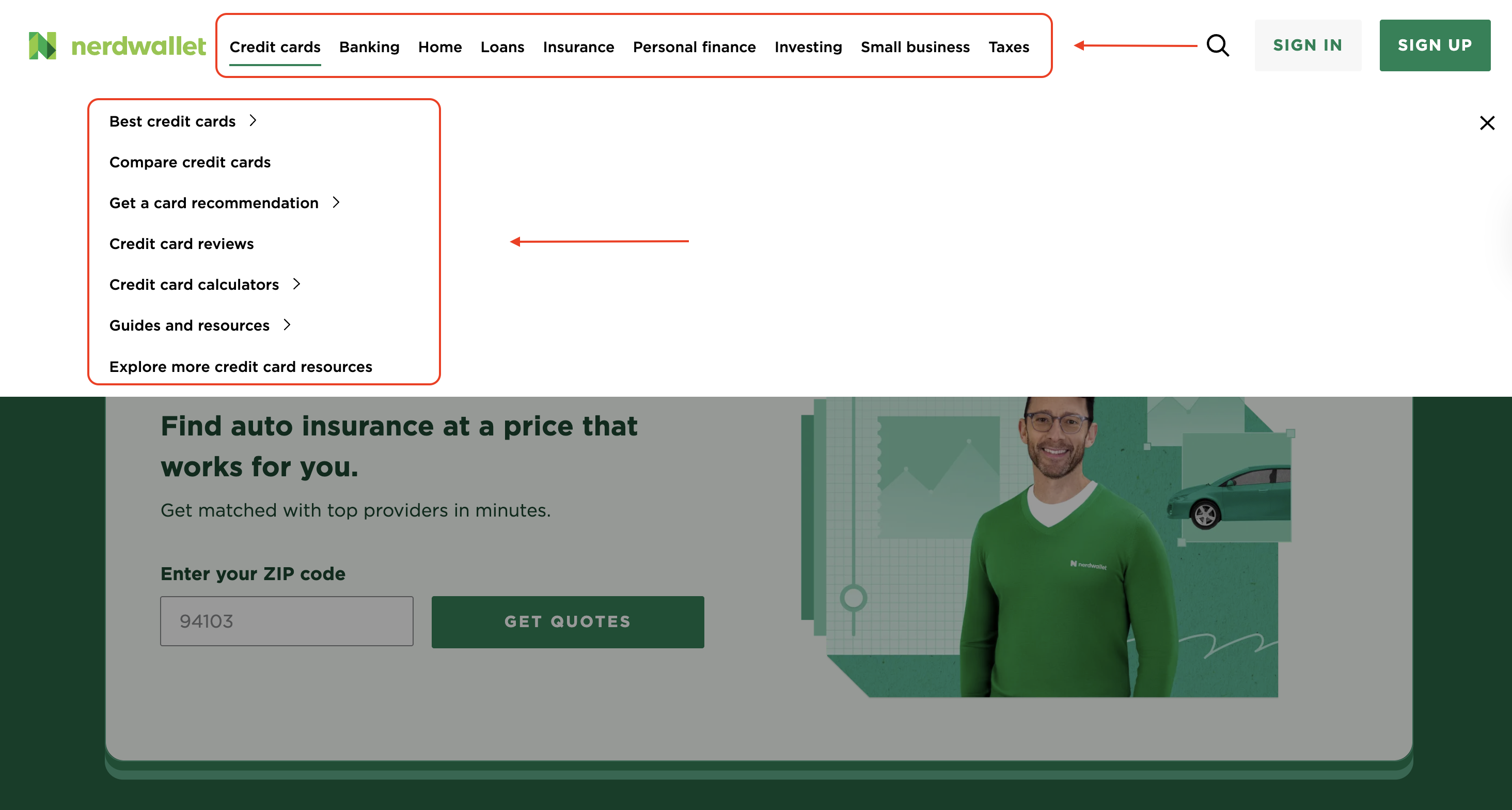
A website like NerdWallet is a great example. Of course, they’re a big name in the industry. But if you want to get some inspiration, just go to their website and take notes on how they structure their categories, position their content, etc.
Source: NerdWallet
The simplest thing you could start with is intent-aware linking. For example:
- An educational page explains how a financial product works.
- That page links to a comparison or risk-focused article.
- Only then does it introduce service-related pages.
So, to put it simply, if your SEO strategy follows the same path as the way financial decisions are made, you’re doing great. Because that’s how you start building real search presence.
Distinguishing “education” vs. “pre-decision” terms
There’s a meaningful difference between education and evaluation (aka pre-decision) in finance. And you need to target both if you want to convert your website visitors.
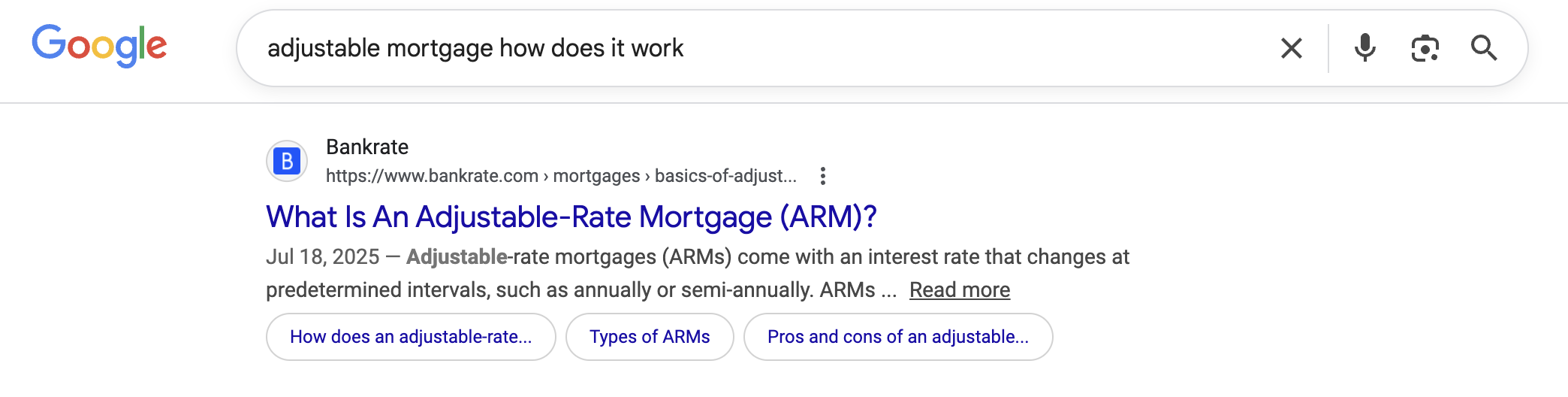
Educational queries are quite obvious. They would normally include phrases like:
- “What is,”
- “How does it work,”
- “Basic explanation,”
- “Definition,” etc.
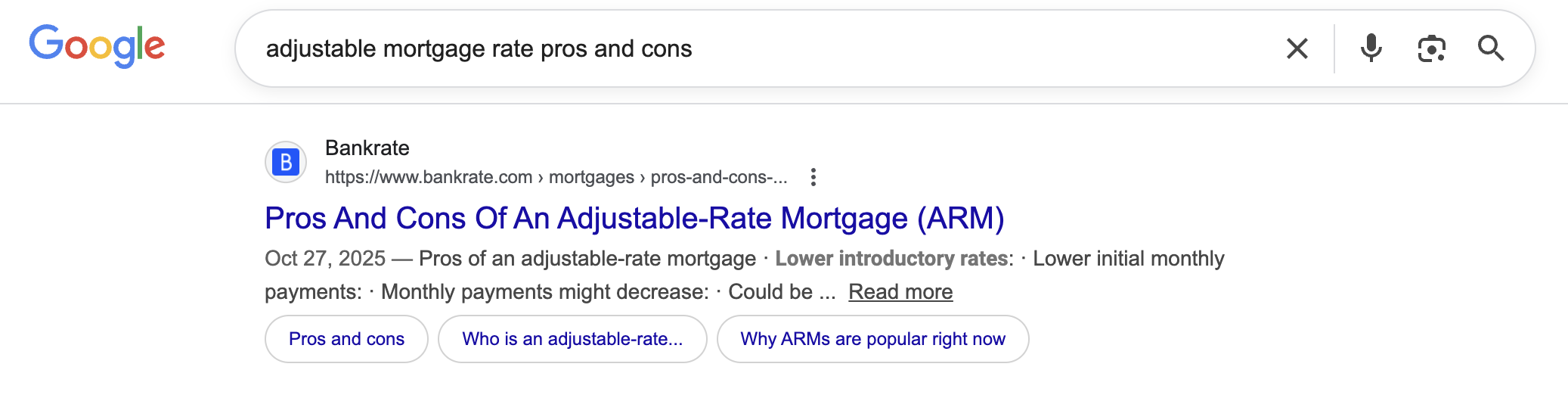
Pre-decision keywords might often look like educational ones, but they aren’t. These search terms target people who already understand the basics, but they are still not quite ready to decide.
Some of the examples could be:
- “Is it worth it,”
- “Pros and cons,”
- “Best option for,”
- “Who should use,”
- “When does it make sense,” etc.
In the second group, you really want to show that you’re an expert and start introducing your products/services. These queries are all about structured reasoning to build trust and make readers stick with you.
That’s where many finance websites fail: they take these keywords and start selling as if there is no tomorrow.
But what people want first is the genuine answer. Your solution is secondary here.
Bottom line: when doing keyword research for financial services companies, pay special attention to pre-decision terms. Yes, they often have lower search volume. But they are absolutely crucial in lead generation and further conversions.
4. Write quality content that builds trust
We can talk all we want about trust, but while it is essential, you won’t move the needle without quality content. And ultimately, content is what will make people believe you in the first place.
So, this is a step you’ll want to polish until it sparkles. Overall, there are a few things your financial content should have:
- Acknowledging trade-offs,
- Explaining consequences,
- Avoiding jumping to conclusions.
For example, if you say, “This option is ideal for…” that would be a bit promotional and not exactly true.
However, if you say, “This option tends to work best when…” you’ll sound reasonable and not salesy in a black-and-white kind of way.
Another thing that matters is what you don’t say.
Over-optimized financial content often uses keywords aggressively. And while it could have worked 20 years ago, now it signals either a lack of actual expertise or that you are just being evasive. None of which is good.
Real expertise should be precise and sort of inviting (for lack of a better term). True specialists don’t loudly advertise their expertise. They confidently share it in a very subtle way.
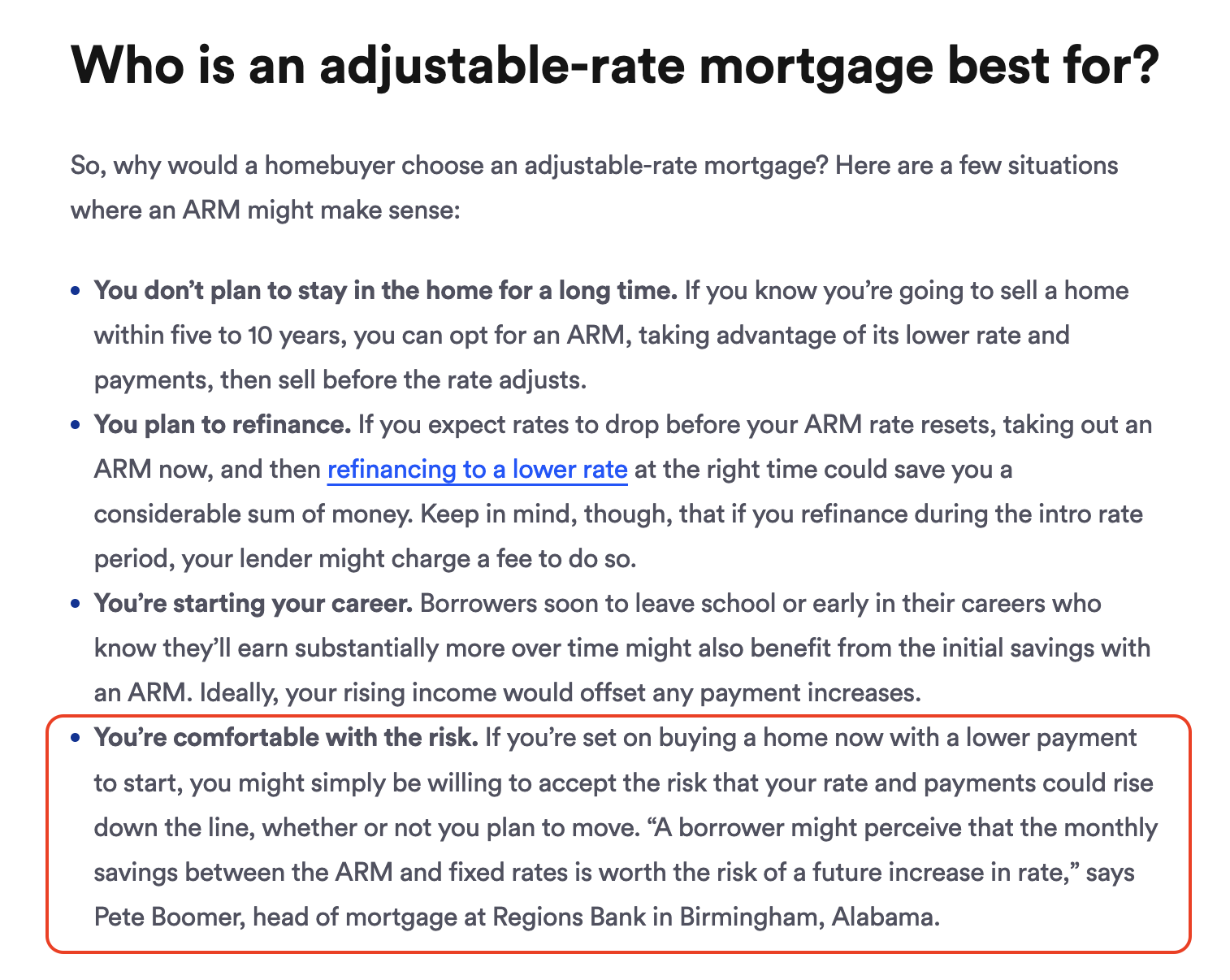
Also, make sure to explain the risks in your content.
Any financial decision has some level of risk. And good, trustworthy financial content always mentions it. What do we mean here?
Here are two scenarios:
- If you explain benefits without constraints, what will users do? They’ll just keep searching.
- If you explain both benefits and downsides, there’s no need to search anymore.
Source: Bankrate
This doesn’t mean you have to be an alarmist. You just have to be honest about the uncertainty of this or that financial segment.
In a way, it usually even calms your readers because you know how it goes: forewarned is forearmed. And this is also something that will inevitably help your SEO and behavioral marketing.
This is a real paradox of financial services SEO: content is more likely to rank when it addresses potential risks and downsides of any approach. So, don’t try to pretend like they don’t exist.
Structuring in-depth financial educational content
You know how everyone keeps telling you to make your content skimmable? People have shorter attention spans, you need to add more lists… well, you know that narrative.
While readability best practices are a good thing, they might not always work best for financial service providers.
Content in finance is rarely skimmed casually, because people tend to care about their money. So they’re often serious about it. Reading about investing and a new scandal in Hollywood are two very different reads. And they involve very different things at stake.
Still, here are a few structural tips that you can use to make your content more digestible for both people and search engines:
- Break explanations into bullet points or numbered lists,
- Avoid long, uninterrupted walls of text,
- Illustrate complex concepts with visuals,
- Use multiple H2 and H3 headings that reflect real questions people have.
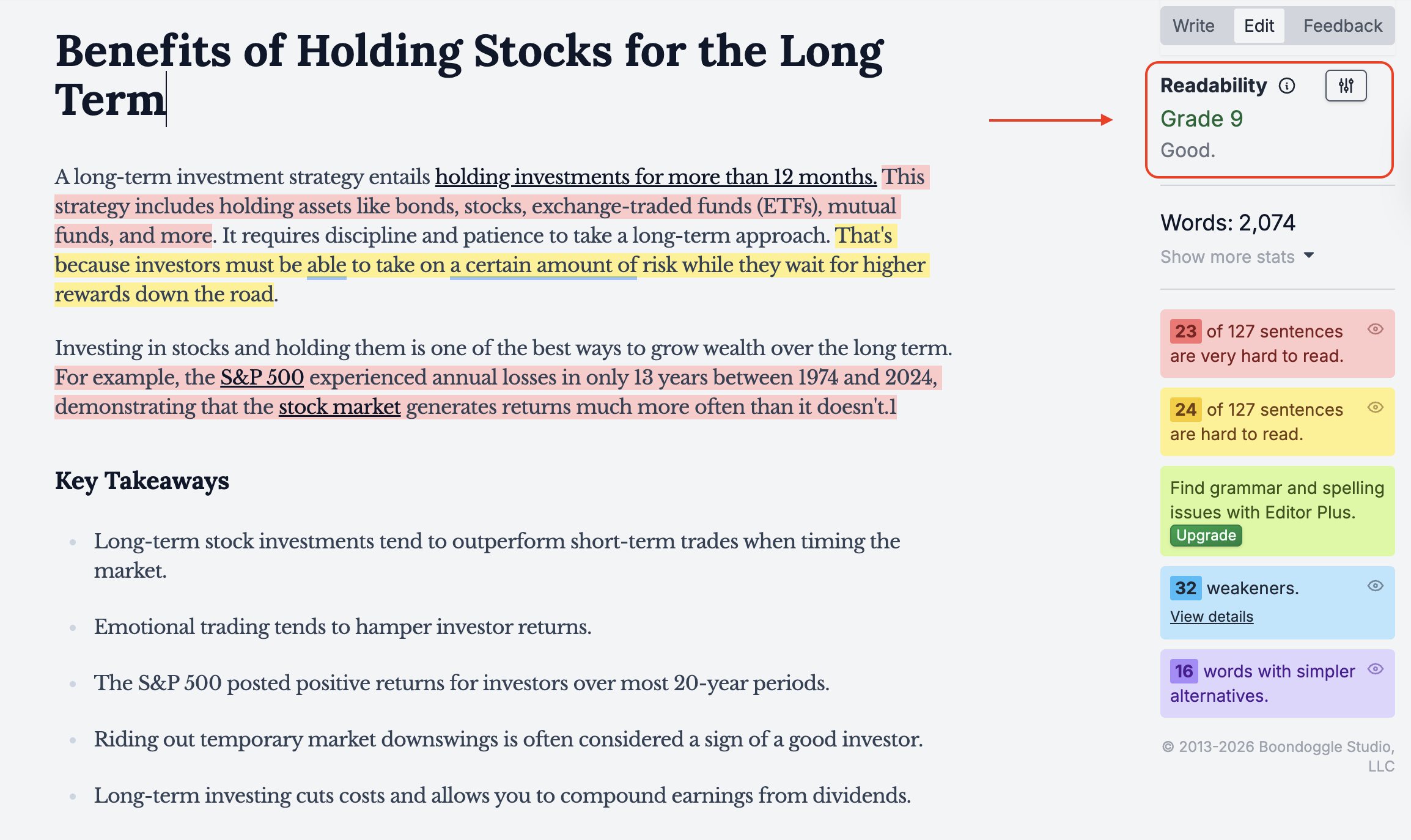
But still, you don’t have to obsess about extreme readability levels. For example, in most niches, you would aim for a score of 5-7. Yet, here is an article by Investopedia that has a score of 9. And it is working great for this topic.
Source: Hemingway Editor
Another thing you have to pay special attention to when it comes to your content is internal links.
Ideally, you want to:
Add all the relevant pages as regular internal links.
Suggest similar content that complements the topic.
Highlight other articles that can move your readers down the funnel.
Importantly, try not to introduce your service pages too soon. Of course, your main goal is to convert, but don’t rush it.
If someone is still clarifying some basic concepts, a service pitch would simply feel too salesy and out of place. Besides, it’s almost guaranteed that you’ll have higher bounce rates.
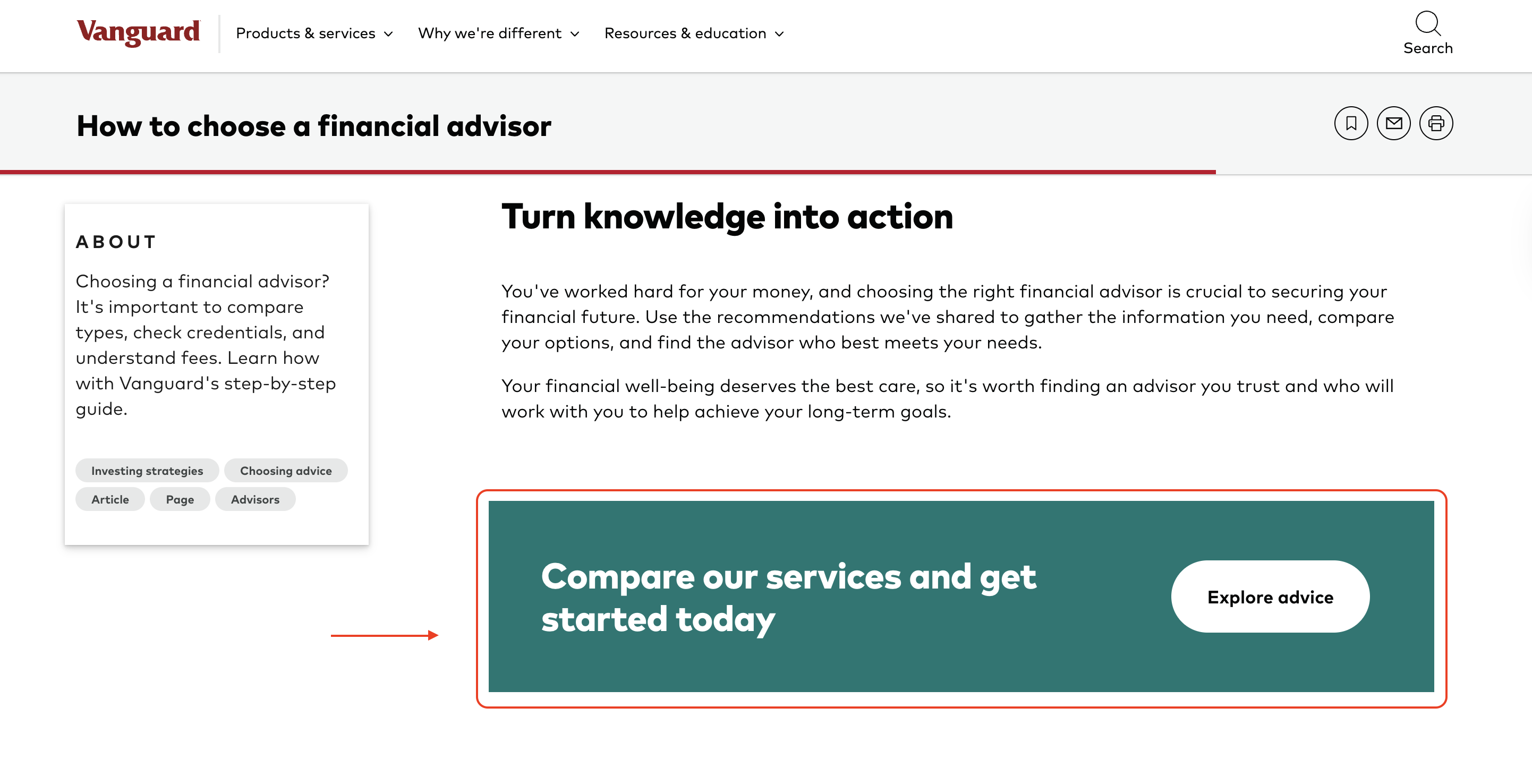
Here is, for example, a CTA in a Vanguard article titled How to choose a financial advisor. When people already think about choosing one, it’s only logical to offer them to “Compare their (Vanguard’s) services and get started today.”
Source: Vanguard
5. Take your on-page SEO seriously
If you apply on-page SEO mechanically, without thinking about how search engines interpret financial pages, then… it likely won’t work. The thing is, in this industry, on-page SEO should contain the signals of intent and responsibility.
So, your titles shouldn’t chase clicks. Aggressive headings may work in other industries, but in finance, they trigger nothing but skepticism.
And that’s very natural: people don’t need any trigger words when it comes to financial information.
Titles that work tend to:
- Describe exactly what the page covers,
- Hint at some specific nuances,
- Avoid any exaggerated promises.
Just look at the titles that rank on the first page for “how to build a diversified portfolio.” They are predictable and maybe even slightly boring. But they are also descriptive and clear without any nonsense.
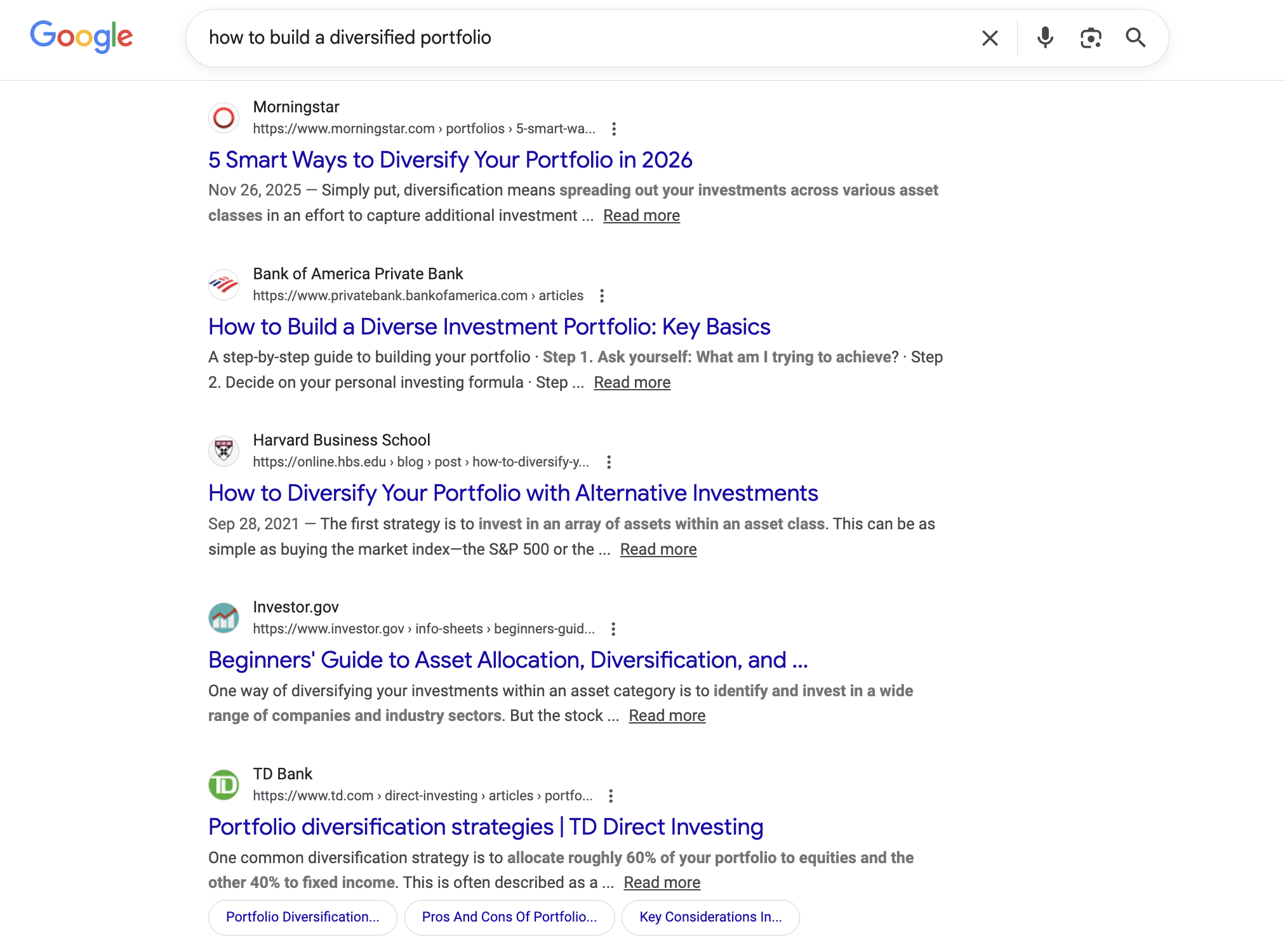
Search engines notice how users respond to titles. If people click and stay, the title did its job. If they click and bounce, what is the point of optimizing your article in the first place?
So, basically, it’s better to play it safe here because that’s what your target audience expects.
URL structure and page focus
Your whole website architecture should be very easy to understand. If someone looks at a URL or breadcrumb and can’t tell where they are in the broader topic… that’s a problem.
A good structure helps search engines see a clear topical hierarchy.
It also gives users an understanding that the content is part of a coherent system. And they will often click back and forth between different categories and read more.
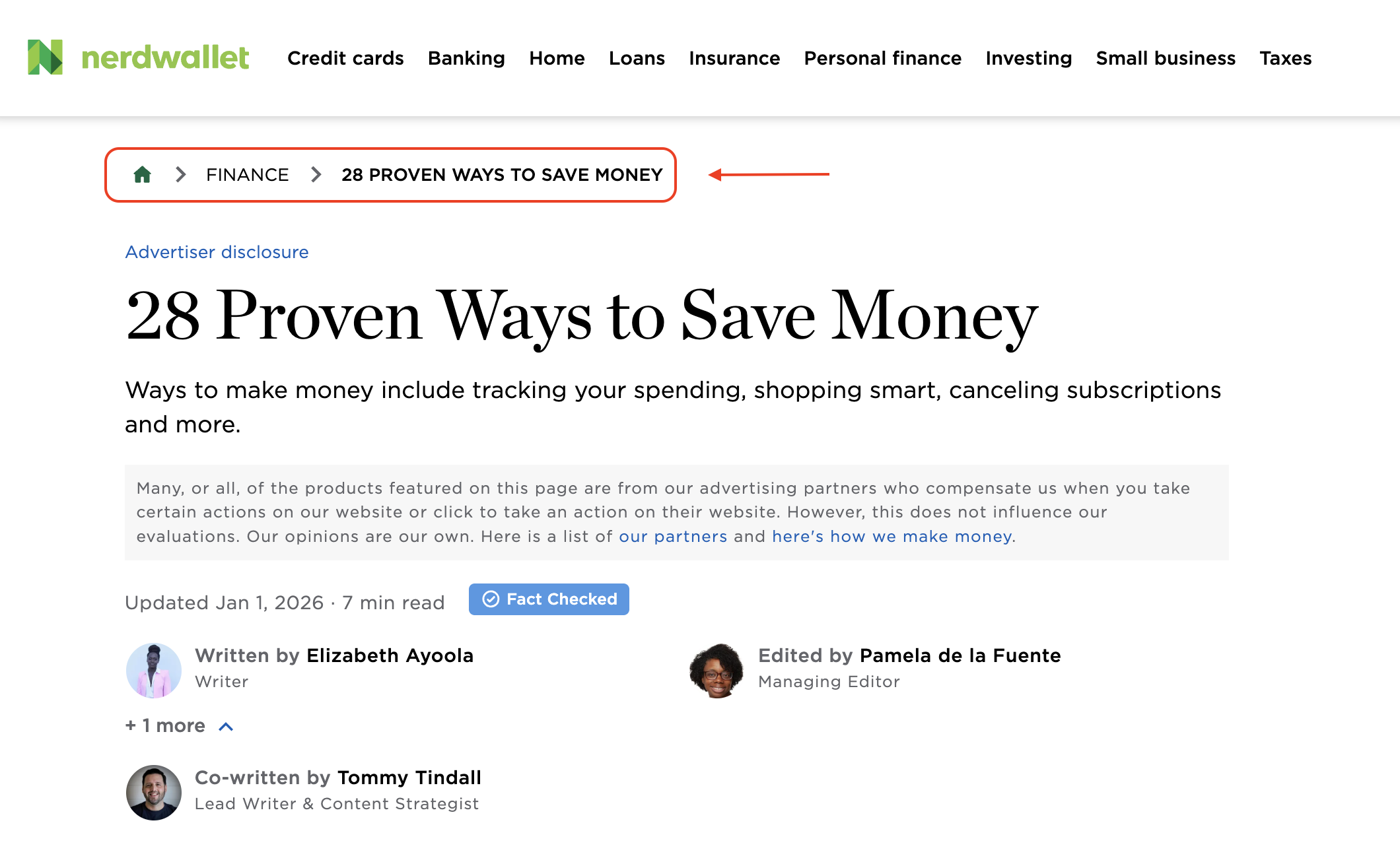
Source: NerdWallet
Disorganized structures often correlate with disorganized content. And search engines make up their “mind” based on that faster than most teams expect.
6. Cover technical SEO
In other industries, technical SEO improvements can sometimes help achieve rapid gains. Fix crawl issues, clean up duplication, improve site speed, and… congratulations, you see your search traffic jumping.
In the financial services sector… it isn’t that easy.
If you want the most fitting metaphor, we would have to say that technical SEO here works like plumbing. When it’s done well, no soul will notice. When it’s done badly (or even slightly badly), everything suffers.
Search engines, as we have mentioned already, approach financial websites cautiously. And if you show any technical inconsistency, that caution will only grow bigger.
Why? Because it seems careless, which is not something Google wants to associate with financial content. Or any content, to be honest.
Site speed is not about performance scores
Yes, site speed matters. But not for the reasons most SEO audits care about.
Financial pages are often read slowly, and if the page is sluggish during those moments, it breaks concentration. And it’s simply annoying (let’s not forget about this).
From an SEO perspective, a few things happen:
- Slow-loading pages increase abandonment,
- Abandonment increases uncertainty signals,
- Uncertainty has a bad impact on rankings.
Here’s the thing: you don’t need a perfect score. It’s not about that. You need a site that performs well while someone is reading the content you’ve been crafting so carefully.
You can easily check it in a free Google tool, PageSpeed Insights:
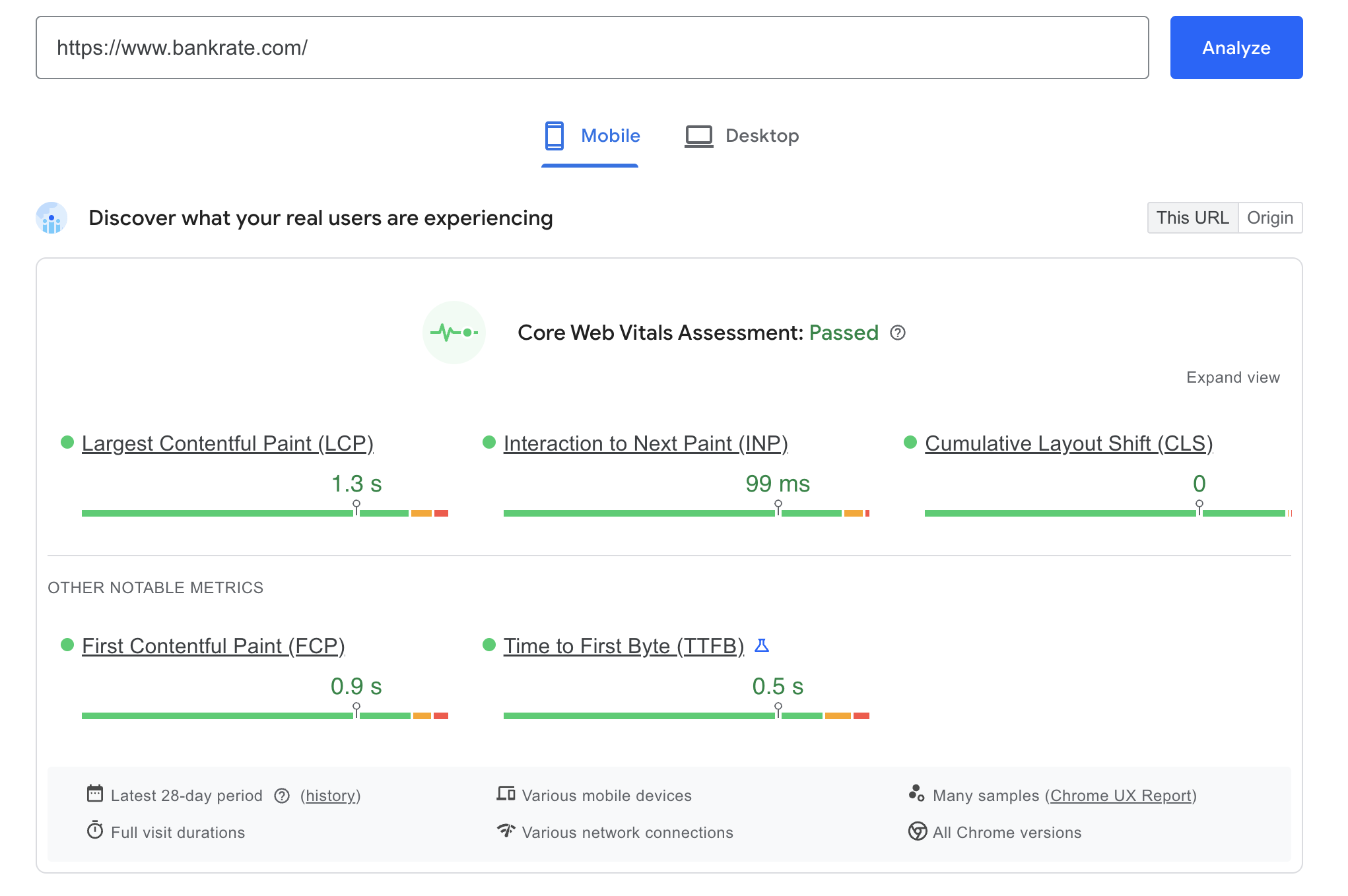
Source: PageSpeed Insights
Mobile optimization and financial decision-making
Mobile optimization is most usually discussed in terms of responsiveness. And that makes sense. But in finance, you need something a little bit more specific. Usability under stress, to be exact.
Many financial searches happen on mobile devices during moments of urgency:
- Comparing options,
- Checking implications,
- Confirming assumptions.
If content is an endless wall of text or buttons are tiny, well… it’s not going to work well for users. Search engines won’t approve that either.
While you can check this in PageSpeed Insights, you also have to do regular usability tests. Ask your team to open your website and click around, checking how it really works.
You have to aim for an easily readable website that doesn’t interrupt a user flow.
Indexation and crawl efficiency
Indexing is a major part of technical SEO. Because if your pages aren’t indexed, they simply don’t exist in search engine results pages.
So, it’s really important to monitor this constantly. You can check this one for free as well. Simply open your Google Search Console and go to Indexing > Pages.
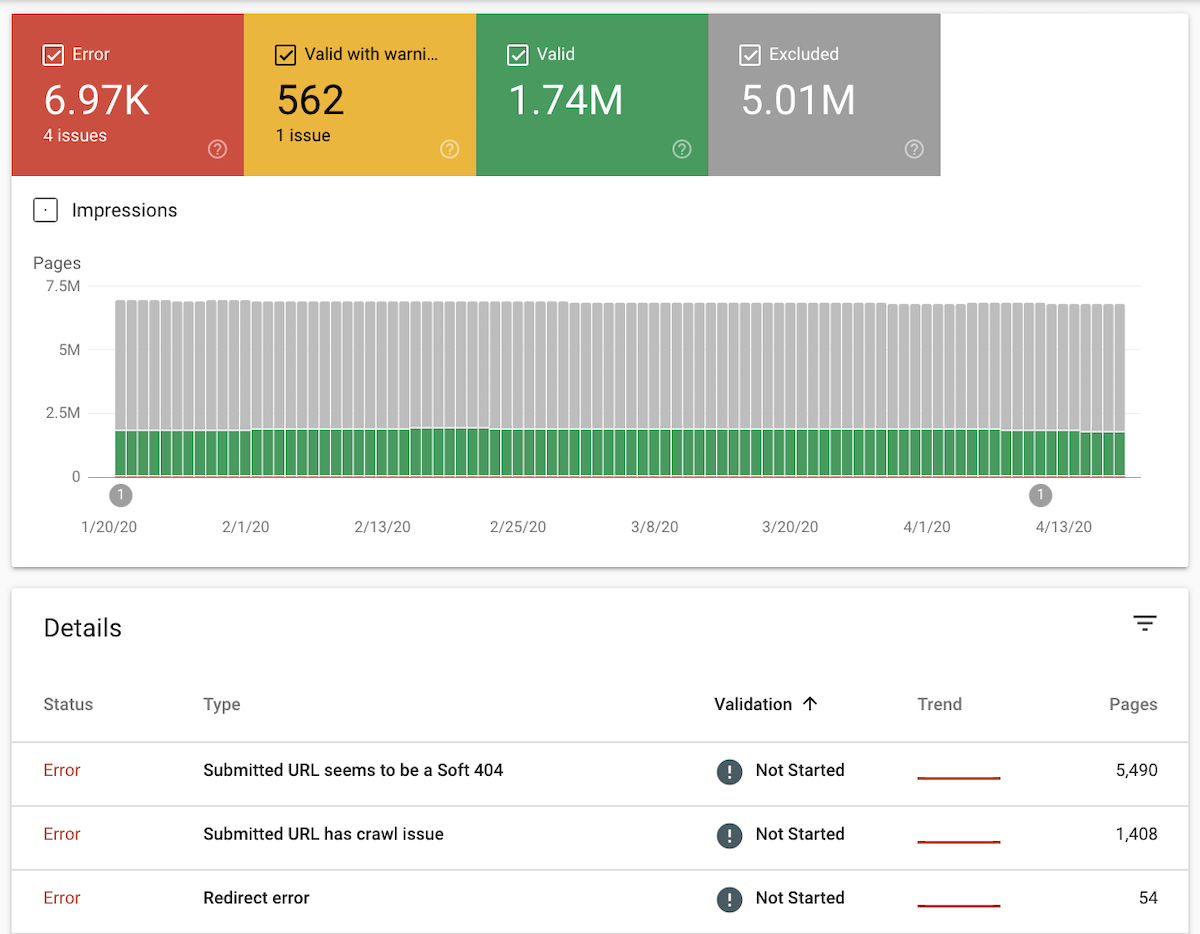
An important detail, though, is that you don’t need search engines to crawl everything. In fact, indexing unnecessary pages can simply waste your crawl budget. So, make sure you don’t index anything like:
- Thin tag pages,
- Internal search results,
- Duplicate or nearly similar pages.
7. Do relevant link building and off-page SEO
Link building is the place where so many SEO strategies become conservative to the point of uselessness. And for some companies, they’re aggressive to the point of self-sabotage.
You don’t have to be a magician to understand that none of those extremes work.
In the SEO for financial websites, links aren’t “popularity signals.” Rather, they are treated as endorsements of credibility.
In most industries, links are directional signals. Enough of them, from enough websites, can positively affect your rankings. But in finance, you have to be quite careful with the links you get.
Search engines pay less attention to how many sites link to you and more to who does, why, and in what context.
A single mention from a reputable finance publication or a professional site is more vital than dozens of generic links. Of course, it’s best to have only high-quality links in every niche. But in YMYL industries, it’s a must.
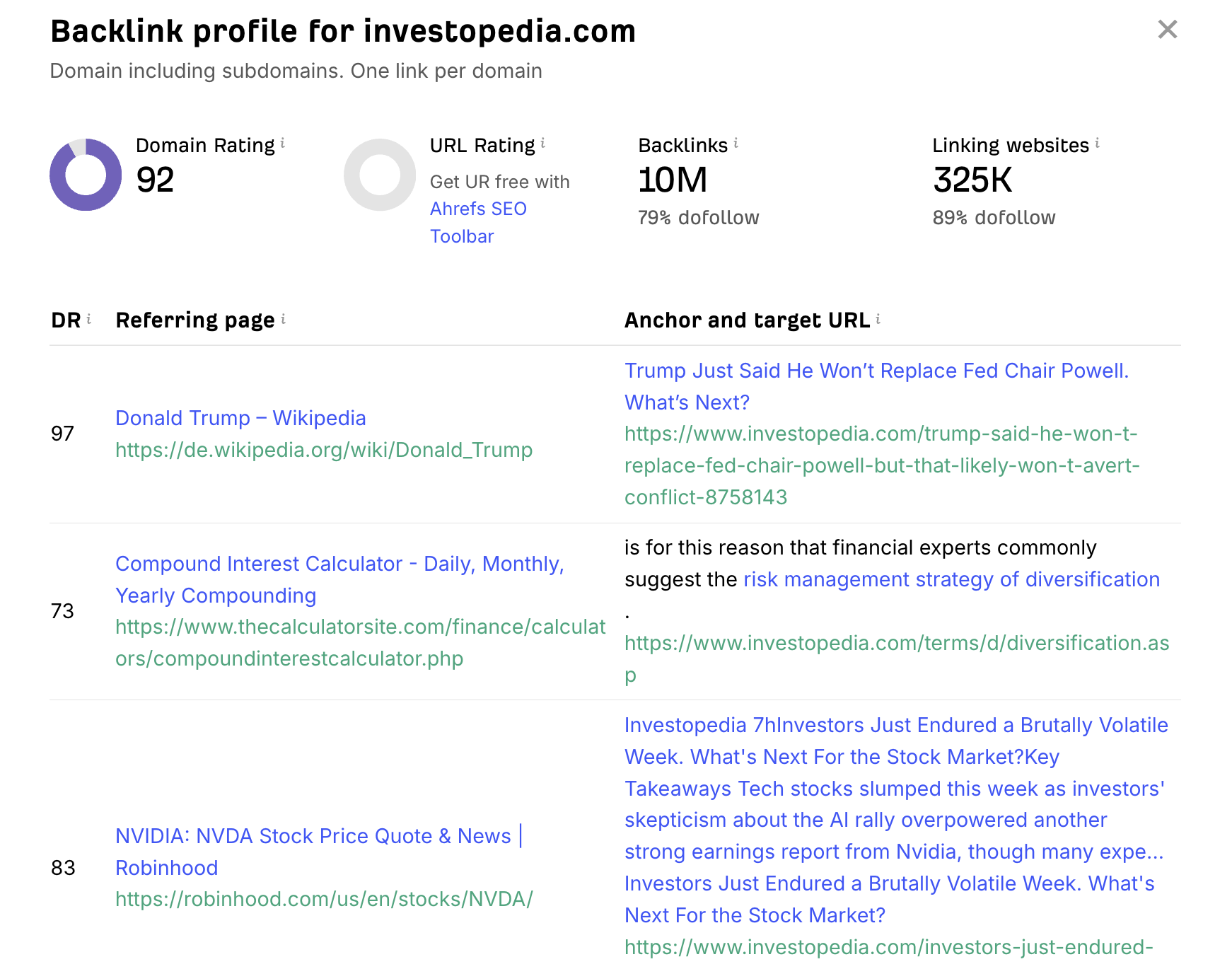
Source: Ahrefs
What valuable backlinks actually look like in finance?
By definition, a valuable backlink in the finance industry has three characteristics:
- Relevance: The site linking to you is meaningfully connected to finance, business, or anything similar.
- Context: The link is not isolated from everything. It exists inside content that makes sense. It’s not forced and not templated, but it is part of an explanation or reference.
- Reputation: This is one of the most important things, no matter how you look at it. The site that links to you must be credible. If it’s simply built for SEO and looks more like a PBN, it’s a no-go.
Of course, these links are not easy to acquire very quickly. It’s actually normal to get them rather slowly, no matter what link-building tools you are using.
This leads us to a very important insight: in finance SEO, speed in link acquisition might be considered a red flag. So, it shouldn’t be your success metric, for sure.
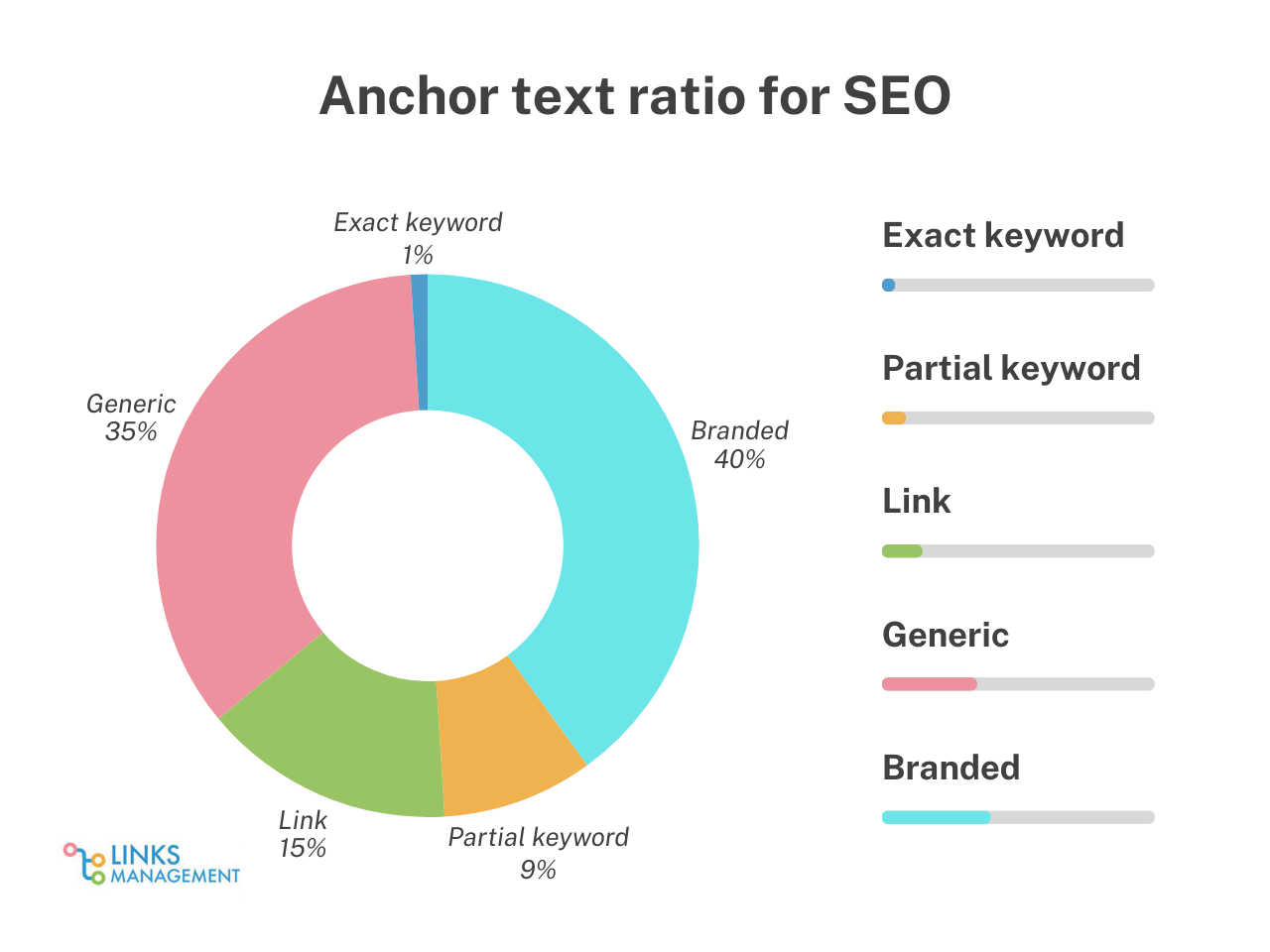
Also, your anchor texts should be natural.
Search engines know pretty well that natural mentions don’t use exact-keyword phrases. So, if you decide to over-optimize your anchors… it will simply look suspicious, that’s all.
Again, it’s best to play safe here and stick to the following ratio:
What to avoid at all costs?
Some tactics can be ineffective, and if you apply them, you just waste time. However, there are also really dangerous ones, like:
- Getting links from low-quality, spammy blogs that write about everything,
- Generic financial directories with no editorial standards,
- Pages that have clear patterns of a link farm.
Of course, you may see short-term movement thanks to these. But they often trigger long-term issues.
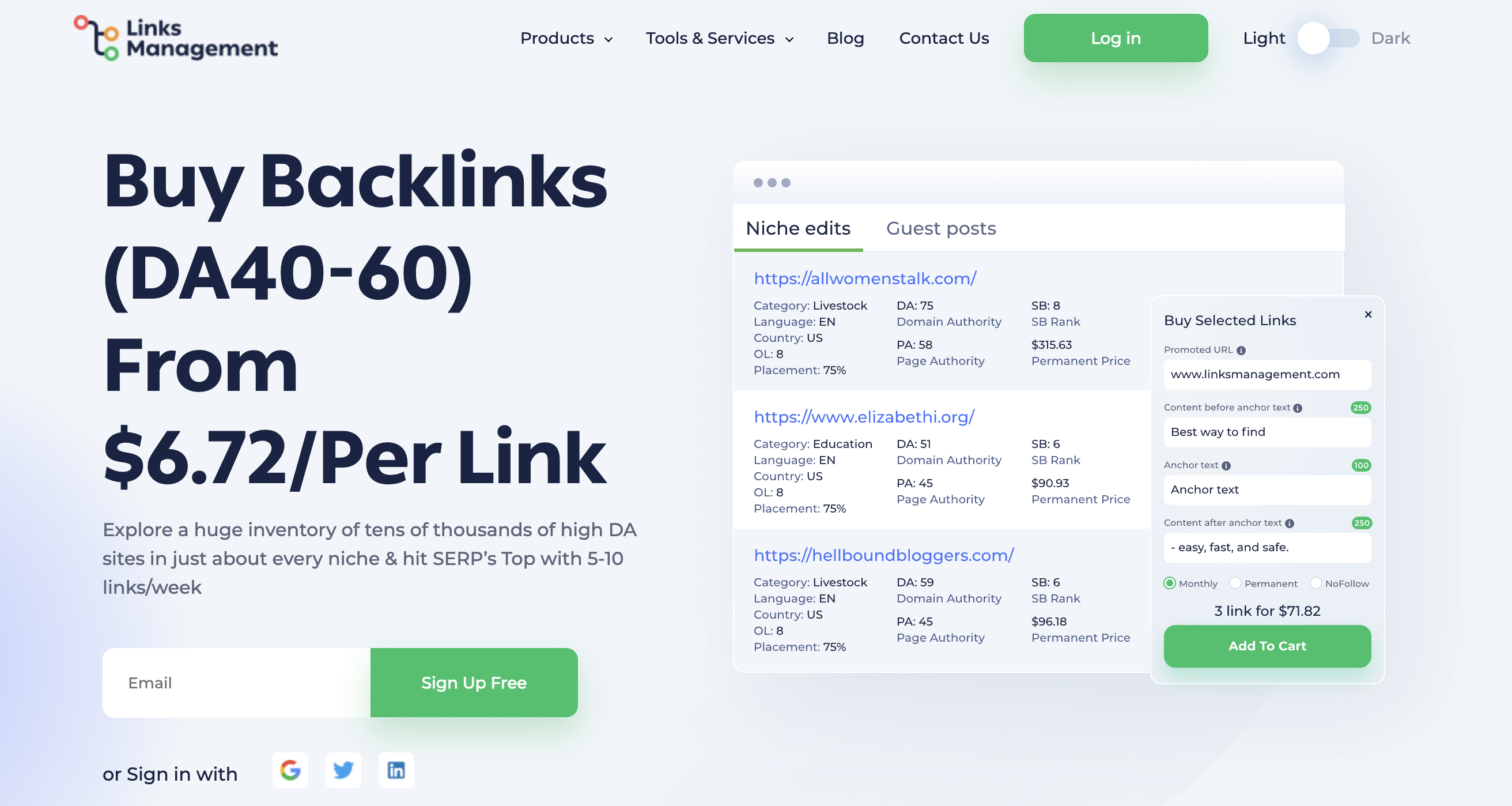
If you don’t know where to find high-quality websites for link placement, you can always start with LinksManagement. Just filter out your niche and any SEO metrics you wish.
8. Track your results
In most industries, SEO success is very often misunderstood. But in financial services, it isn’t just misunderstood, it’s also often mismeasured.
Traffic screenshots and ranking reports look great in documents. But:
- Do they tell you whether SEO is actually helping your business make money?
- Do you see if you build trust?
- Or maybe you have shortened your sales cycles?
None of that.
So, the first thing you have to make sure of is that you measure meaningful search traffic, not just any organic traffic.
A blog post ranking for “what is inflation” may bring tens of thousands of visits, but… zero commercial value. Because it’s just too broad. And frankly, useless in the business sense.
At the same time, a page ranking for “independent wealth management advisor US” might have 200 visits a month but drive six-figure deals.
Traffic volume isn’t always the best goal. You have to do everything to generate meaningful clicks.
What is meaningful traffic, though? It’s the one that:
- Comes from users with real financial intent,
- Belongs to high-trust search terms,
- Matches your actual service offering.
High traffic with low intent only looks good in your SEO charts. But when it comes to the actual business value, it fails. Just something really important to keep in mind.
What key performance indicators matter?
If traffic is not the best website KPI, what is? While you should still check traffic, focus on other metrics, too, such as:
- Time on page (especially on service and comparison pages),
- Scroll depth (on long-form advisory content),
- Return visits (from branded and non-branded search).
Low engagement often signals one thing: the content feels unsafe or generic to your readers. Users usually bounce because they don’t trust what they’re reading. As simple as that.
When can you expect results from your financial SEO strategy?
SEO timelines are different for different companies. So, giving you any exact estimations would be wrong. But let’s cover some basic timelines you could expect.
First of all, when creating your SEO plan, set realistic expectations.
SEO for financial services is slow by design. But don’t consider it as some kind of flaw. Because if anything, it’s a feature.
Unlike e-commerce or SaaS, authority in finance compounds gradually:
- Each trusted page strengthens the domain,
- Every credible mention affects expertise,
- Clean backlinks have more meaning than volume.
But once it does, everything gets easier. And by that time, you also already know what your target audience actually needs. vUsually, you see some very notable SEO growth after 12-24 months. Of course, you’ll notice the first signs before that. Still, the real outcome will come in around a year.
This is when you’ll get:
- Stable rankings with lower volatility,
- Increasing branded search demand,
- Better performance of new content,
- More conversions from organic traffic. etc.
Slow growth in finance, as you understand, is completely normal. So, don’t get discouraged along the way. Just keep writing your high-quality content, getting relevant external backlinks, and you’ll be fine.
In your first year, celebrate any growth signs. And try to learn from your mistakes.
Remember, Google does not rush trust. It is especially true when money, financial risks, and serious regulations are involved.
Conclusion
To sum things up, we can only say that SEO for financial services companies is a strategic asset, not just another marketing channel.
It takes time and effort. So, if you need new leads next month, it isn’t the best choice. But if you’re ready for long-term growth and actual industry leadership, there is no better option out there.
Shortcuts won’t scale in the finance industry, but actual expertise and patience will.
Related Posts

Published Oct 15, 2025

Published Feb 11, 2026

Published Sep 23, 2025

Last updated May 20, 2022 | Published Sep 10, 2015

Last updated May 8, 2025 | Published Mar 18, 2025
Enter URL & See What We Can Do Submit the form to get a detailed report, based on the comprehensive seo analysis.