Webinar Promotion: 8 Best Practices (With Exact Steps to Follow)
Whether you’re in B2B or B2C, you’ve definitely heard about how effective webinars are. It might not be the hottest topic these days. After all, AI and LLMs have stolen the spotlight.
But webinars are still a popular workhorse that actually delivers.
According to some sources, the average conversion rate of a webinar is 61.7%. That’s an impressive number by any means. Yet, here is where it gets not that impressive: to achieve these results, you have to become an expert at promoting webinars.
And this is definitely easier said than done.
That’s why in this article, we’ll cover the most efficient tactics that can help you make your online events successful.
Besides, we’ll list the exact steps to bring these ideas to life. Let’s start.
8 Proven Tactics for Marketing a Webinar
These are some of the most effective tips you can use to get more signups for your online event. Feel free to use all of them, or just start with a couple of those that feel most natural to your business.
1. Create a proper webinar marketing strategy (not just a single post)
First, let’s address the obvious. If you want to get lots of registrations, simply publishing a couple of social media posts won’t work.
What is the typical way to promote a webinar we’ve all seen hundreds of times?
It would be something like this: “Join us for a webinar on XYZ with XYZ speakers on XYZ date.” Then, you’ll add a couple of discussion points, maybe even a hook, and a typical image. That’s pretty much it, right?
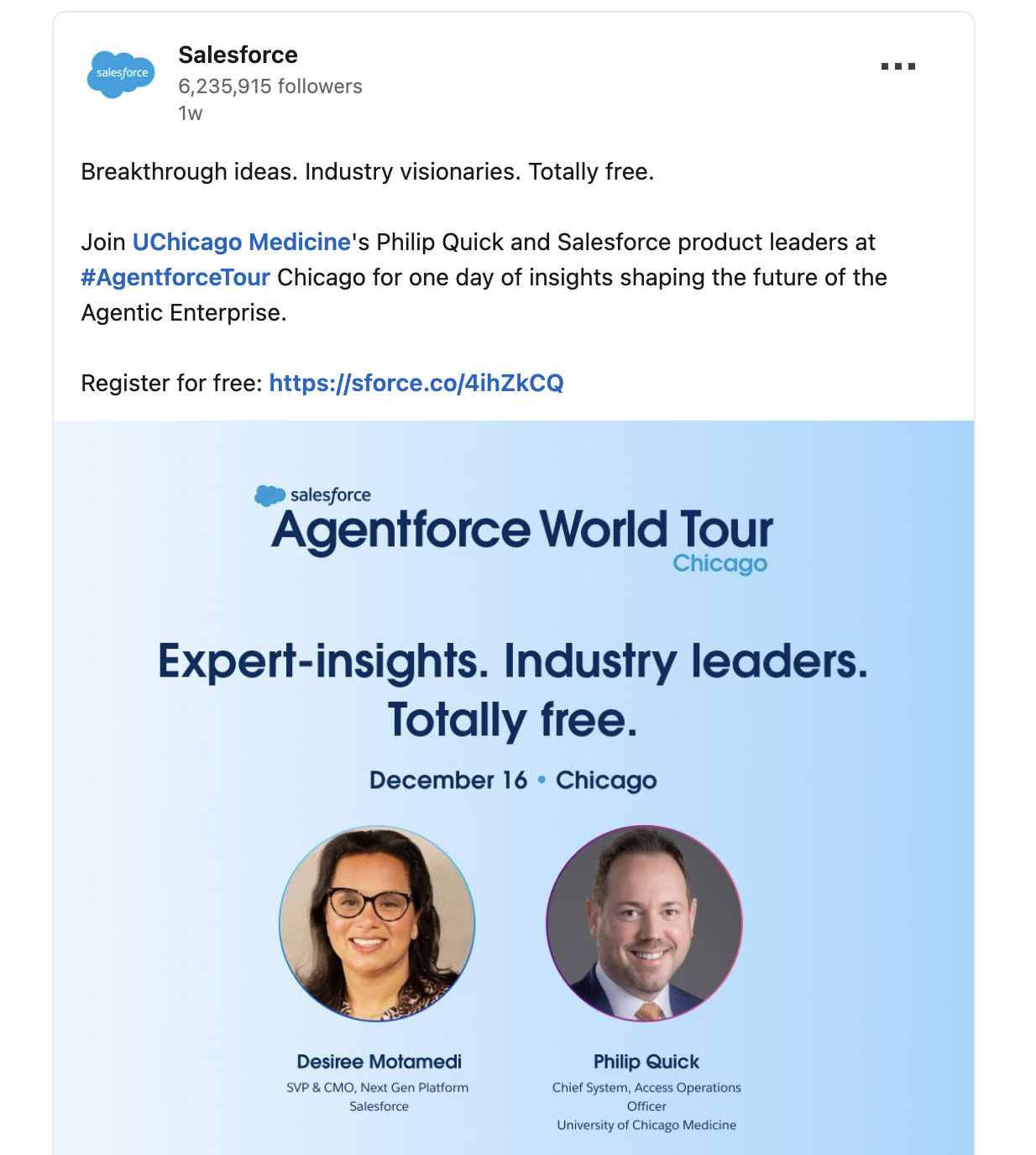
Source: LinkedIn
When you’re Salesforce, it’s okay, you can afford it. You’ll still get your attendees.
But when you’re a smaller business, writing a generic post and distributing it on several platforms is not enough.
So, here is a different idea. What if you treat your webinar marketing as a separate product campaign? How would you approach it then?
You’ll likely build a strategy for its promotion.
Here, we don’t suggest creating more documents with plans and tactics. Instead, we just offer to change your mindset and advertise your webinars like they are actually important.
Here are the exact steps to make it work:
- Analyze your audience. It will likely be different for different webinars. You can create personas or simply write some basics to keep in mind. Either way, it’s fundamental.
- Understand where you can find that audience. Sometimes, it’s less obvious than you think.
- Think about the best-selling points of your current event. From here, brainstorm your hooks, work on pain points, and think about how you can communicate that properly.
- Write copy that actually clicks for your target audience. If you’re very serious, you can even test your webinar titles with a small budget in PPC. Here is an interesting example of how The Diary Of A CEO does that for their videos.

Source: Marketing Examples
- Give more than just an announcement. The typical approach is to simply announce a webinar and let it go. But in reality, you’d want to give some value to get people hooked. If they find something useful in your promotional posts, they’ll be more likely to join.
- Leave some time to promote the event. Of course, most of us have really tight deadlines. But when you can, try to give yourself enough time to distribute all your content.
2. Make your communication style special
This is another major point.
Look, you might have the best tactics on hand. But if your communication feels fake or off, all the best practices make no sense.
If you’re an established business and your marketing strategy works well, great! Probably you wouldn’t be reading this guide, though, if you were 100% satisfied, but that’s another question:)
Overall, if you’re still trying different things, consider:
- Testing different hooks (value-based, controversial, surprising, etc.).
- Playing around with design.
- Making your copy more conversational.
- Trying something apart from “register for our webinar today”.
Because, frankly, if you look at most webinar communications, they’re just… boring. But it doesn’t have to be like that.
Let’s take a look at some great webinar promotion examples.
You can experiment with something slightly controversial (if it makes sense). As you see in the image below, it could work even for serious businesses.
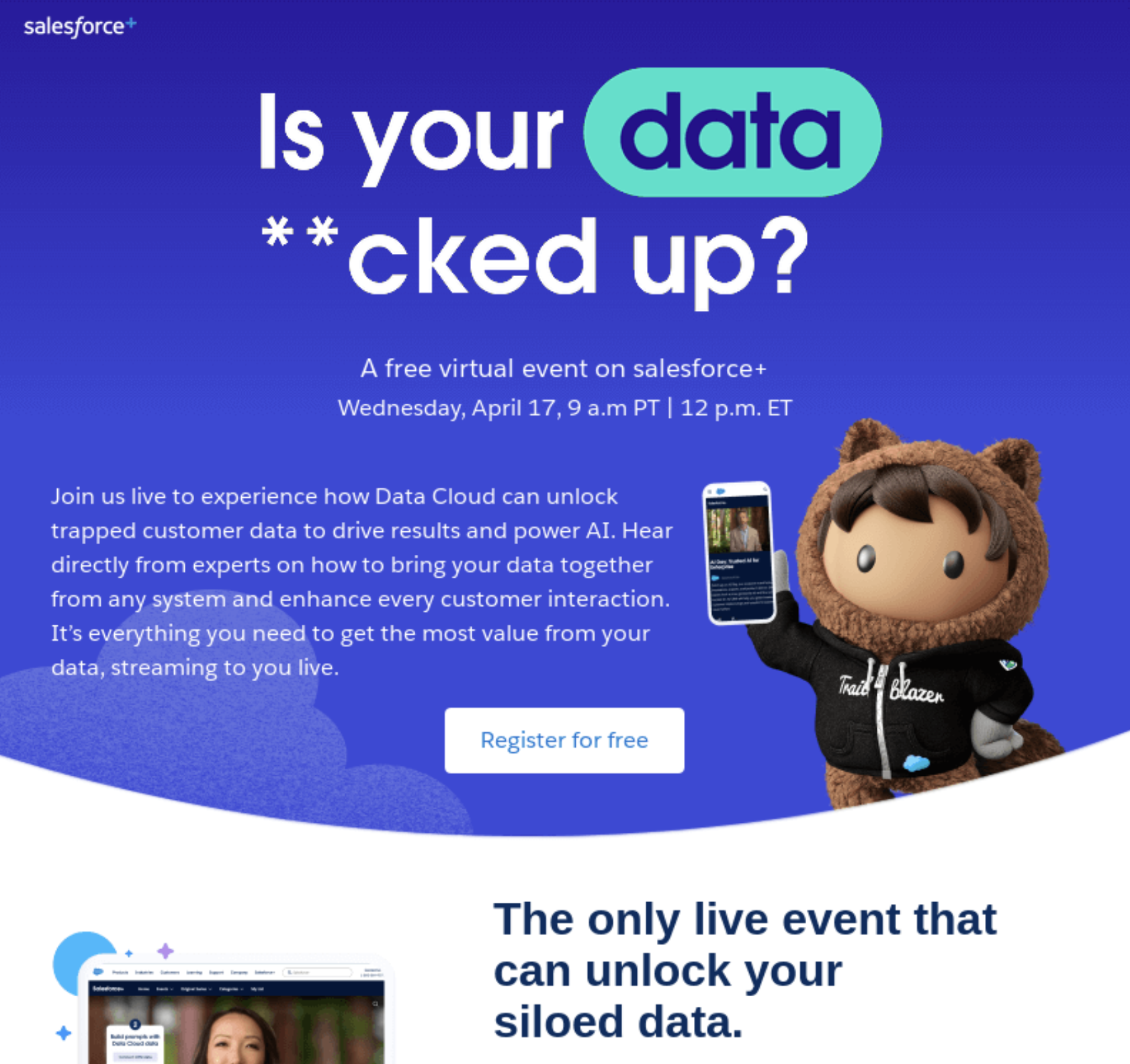
You can make your copy more relatable:
- Use real-life examples,
- Add situations that your audience can identify with,
- Use friendly language that doesn’t feel like “another business trying to sell you something”.
But don’t use em dashes at this point (Ifynyk 😉).
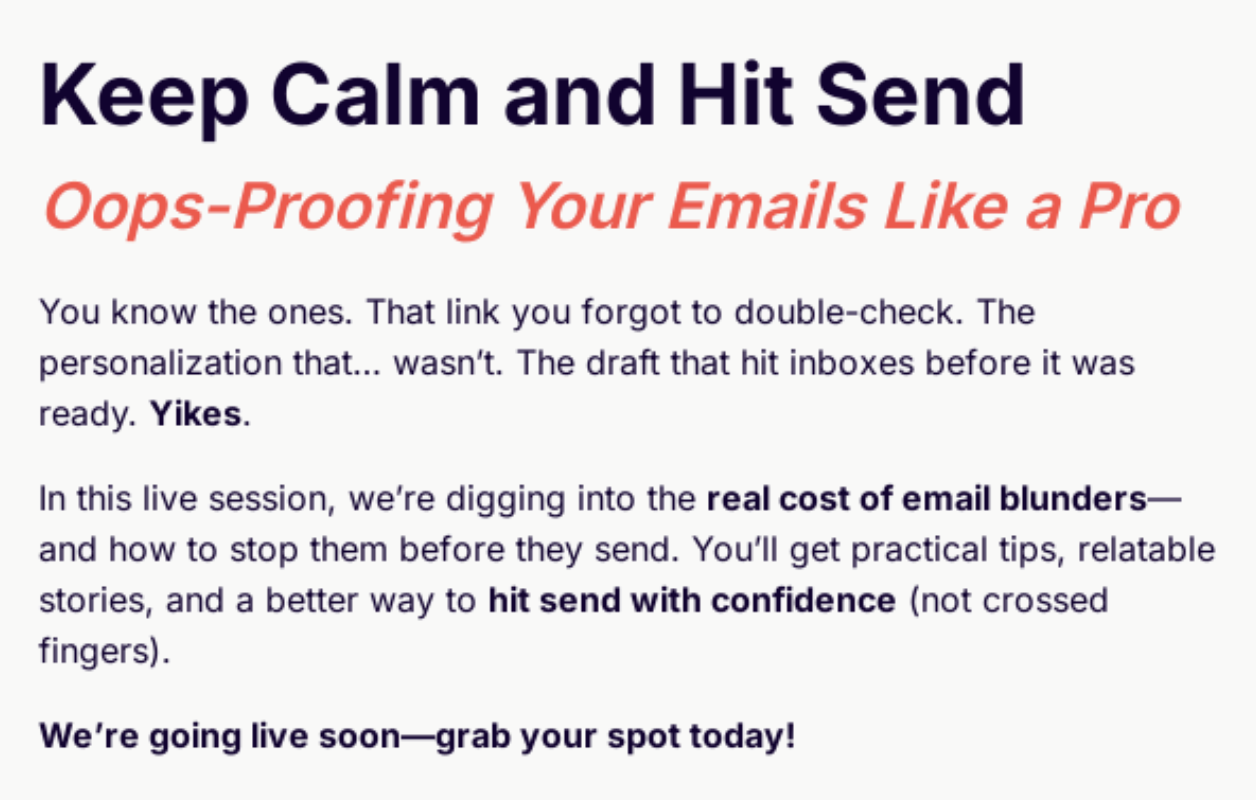
Lead with stories, real cases, or data. All these things tend to feel more credible. No one wants to listen to some random theory that ChatGPT can generate in seconds.
People want to see examples and real experiences.
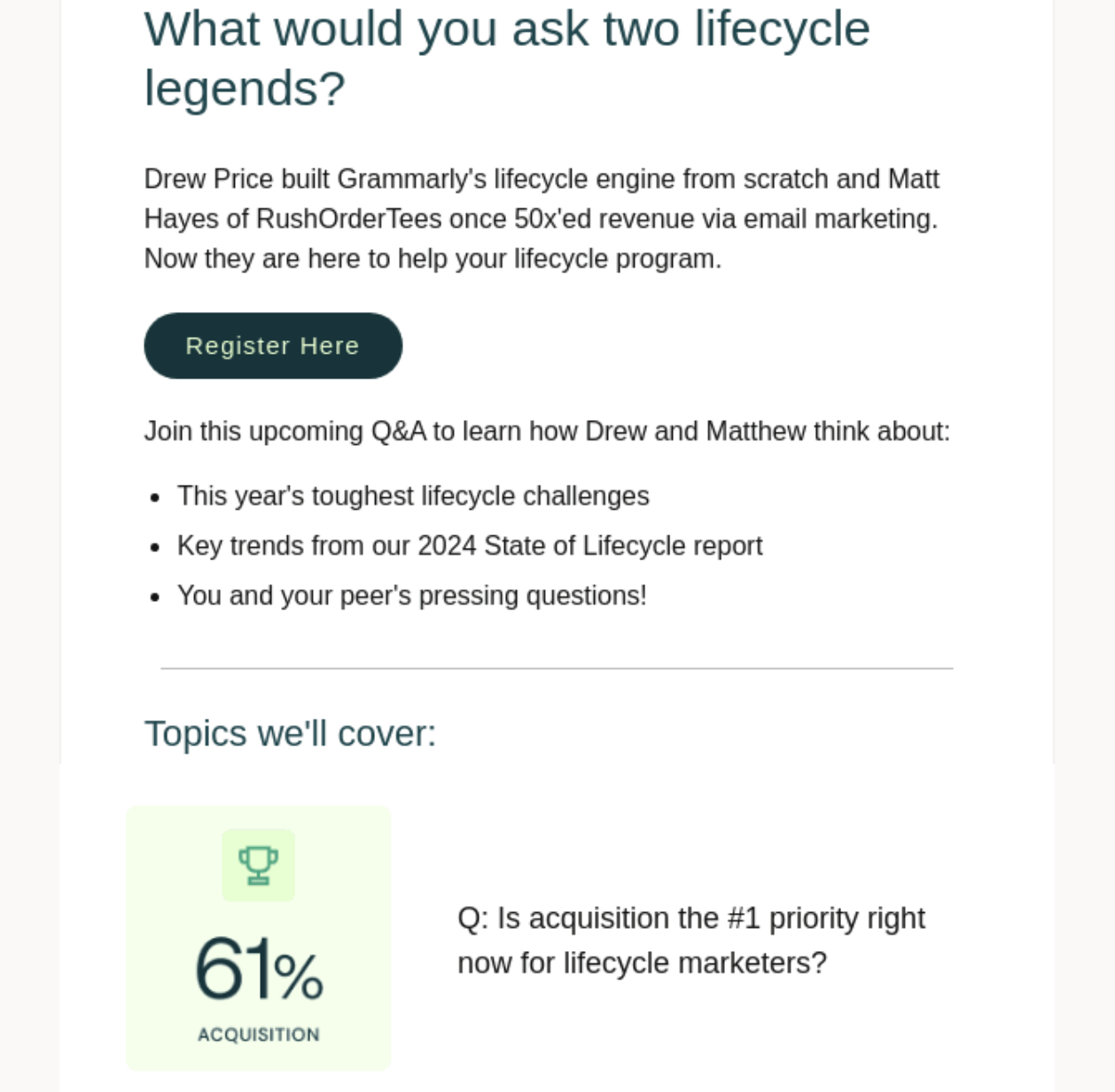
Even memes could work. It all depends on your tone of voice and style.
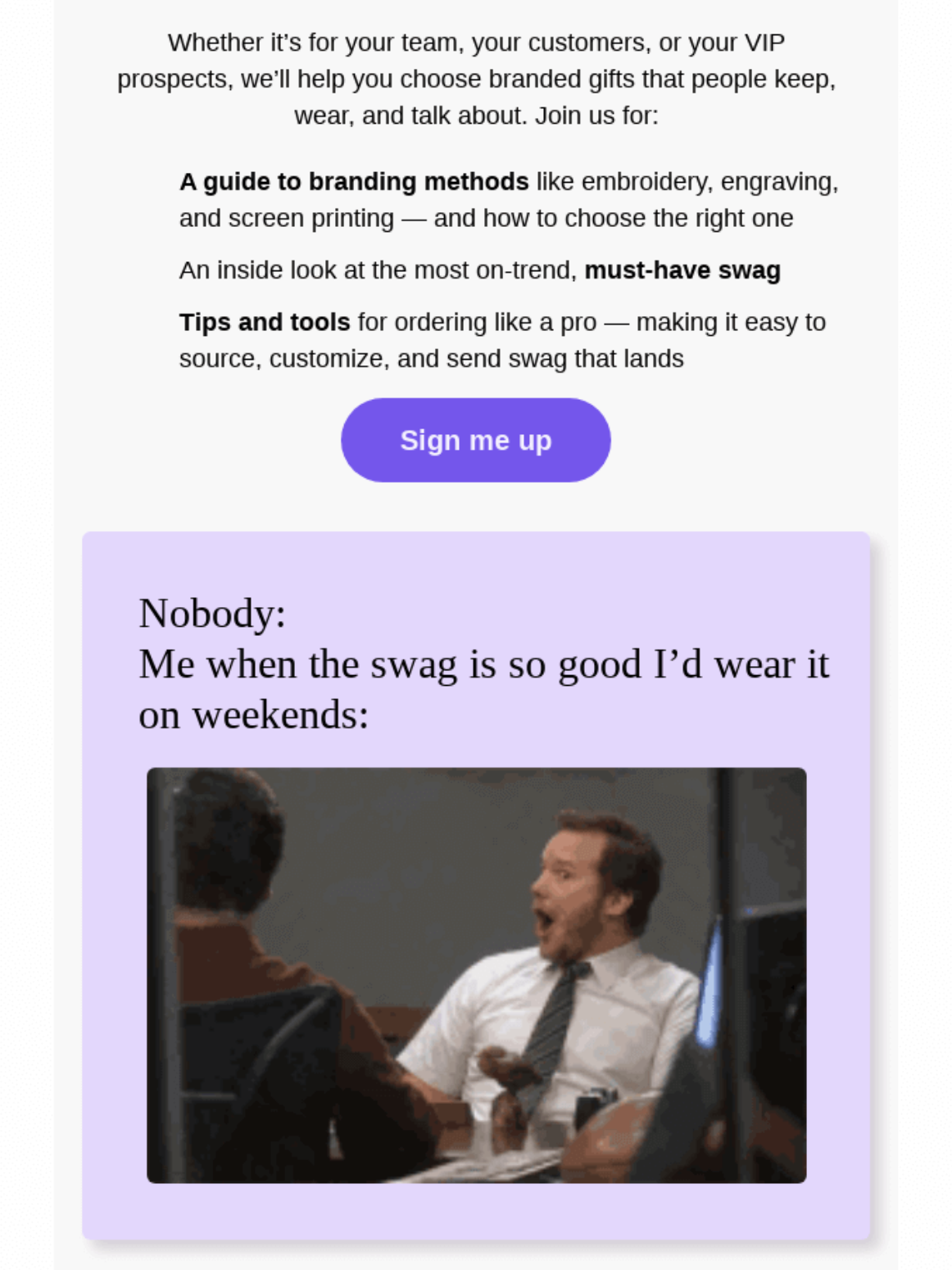
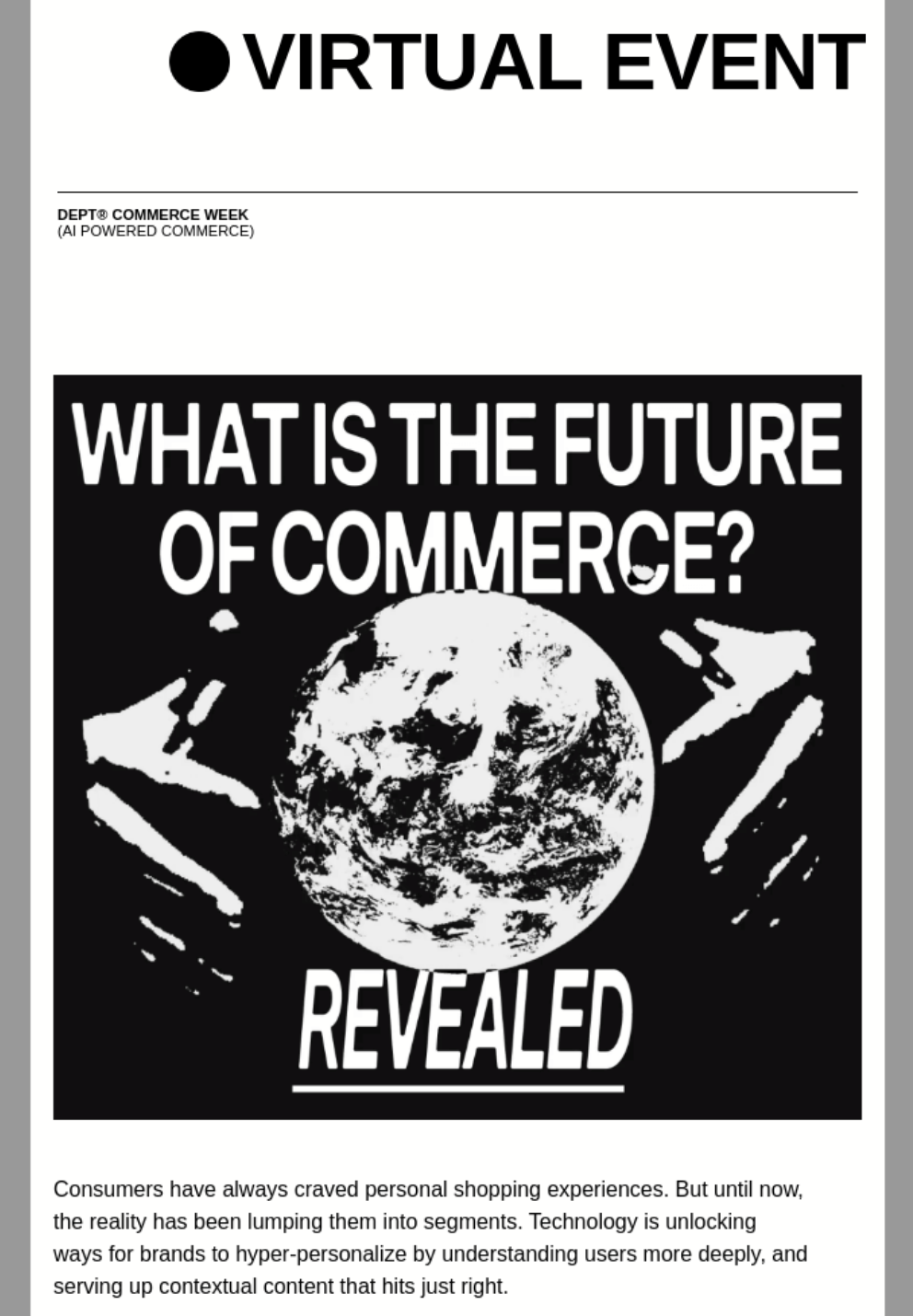
You can also design your visuals and emails in a slightly atypical way.
This is a good way to catch someone’s attention. Still, of course, it has to be paired with great copy.
Here are the exact steps to make it work:
- Take a look at your current communication style. Do you have a clear tone of voice now? Does it feel like your company? Does it communicate your values well? If you said “no” to any of these questions, you can still improve your ToV until it feels genuine.
- Understand how people perceive your brand. This is a tip that will help far beyond just webinars. Knowing what your audience actually thinks of your business is a must. You can use social listening tools for this, just browse through socials, or even create a focus group. Regardless of the strategy, it’s important to know how others see you.
- Check what your competition does. Understanding how other brands communicate can help you sound more unique. Because unless you know what they’re doing, you have no point of reference.
- Tweak your style to stand out. If you feel like you sound too generic, like thousands of other businesses, create a different ToV. This can’t be done in a day. But the more you pay attention to that, the more special your communication will become.
3. Start with warmer audiences
When it comes to the webinar marketing strategy, the best thing you can do to make your life easier is tostart with your already existing contacts.
This includes your email list, your product/service users, past leads that didn’t convert, community members, active social media following, etc.
They are your warm audience, so they are much more likely to register for your event because they’ve already interacted with you somehow.
Here are the exact steps to make it work:
- Take the audience you already have. Only consider the ones that make sense for your current webinar topic.
- Segment it well. People who’ve already checked your product or pricing pages and the ones who just read your newsletters from time to time are very different crowds.
- Create email sequences or community announcements that deliver value. Again, one post alone won’t work. Write something creative and useful, and turn it into a small series.
- Make the signup process easy. Ideally, you should aim for one-click registration.
4. Try LinkedIn Event Ads
If you’re in B2B, this is one of the paid channels worth exploring. Why? Well, at least because of this data:
- 60-70% of LinkedIn event attendees aren’t your followers. This means that you can actually attract an absolutely new, relevant audience.
- LinkedIn Event Ads can help reduce cost per registration by up to 40%. Of course, this will depend on your business. Still, these numbers look very promising.
And there is more to it:
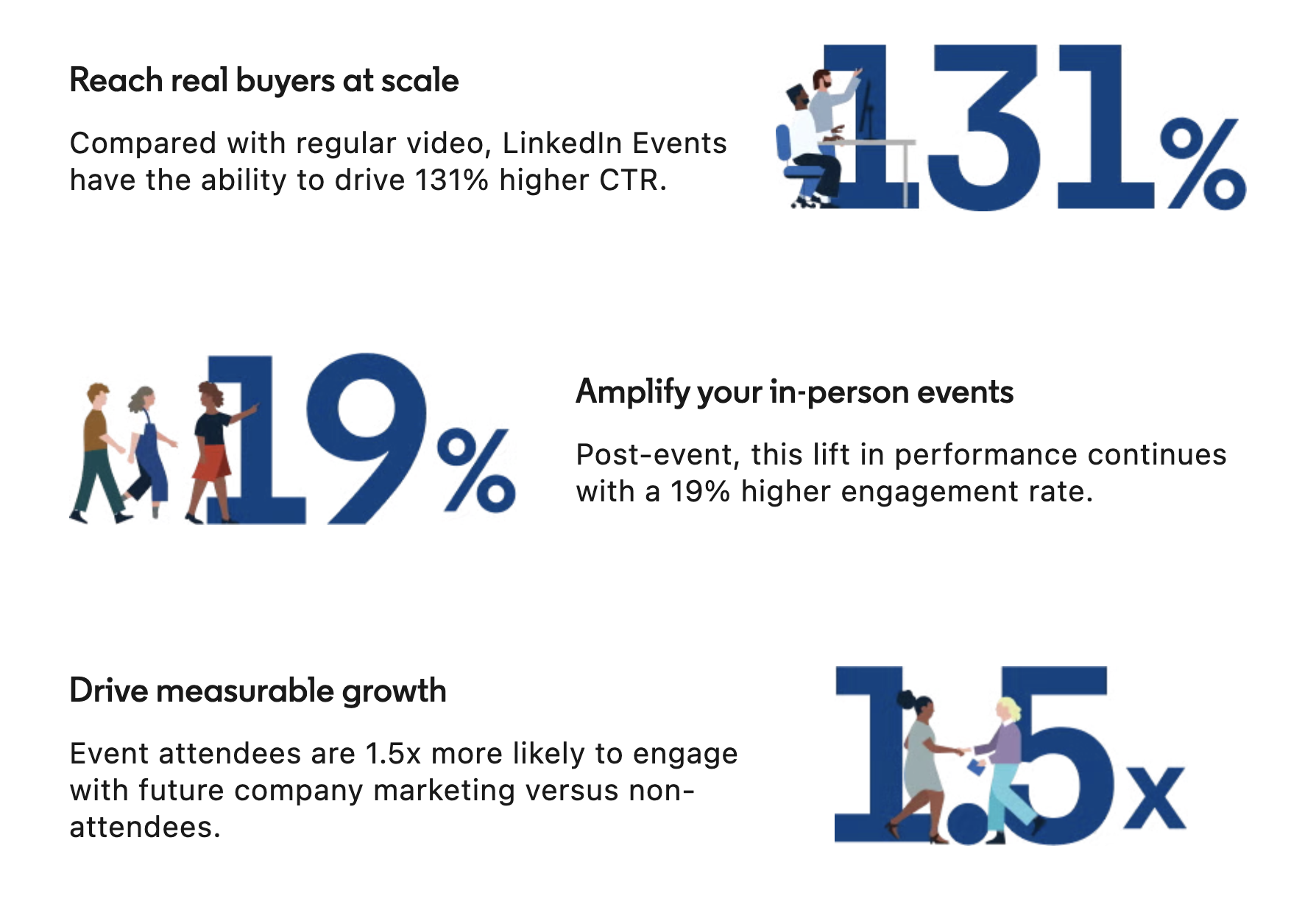
Source: LinkedIn
Here are the exact steps to make it work:
- Create a LinkedIn event. It’s very important to nail this one. So, make sure you have a great hook, event title, image, speakers, benefits, etc. Check some already published events for inspo.
- Run Event Ads. Ideally, you should start at least 2 weeks before the actual webinar. The process here is relatively easy, just target the audience properly (industry, job title, region, etc.). Plus, test different CTAs and titles if needed.
- Use Lead Gen Forms for fast registration. The more registration steps you create, the more people will drop off. Lead Gean Forms allow people to sign up in 1 click (literally). So, it removes unnecessary friction.
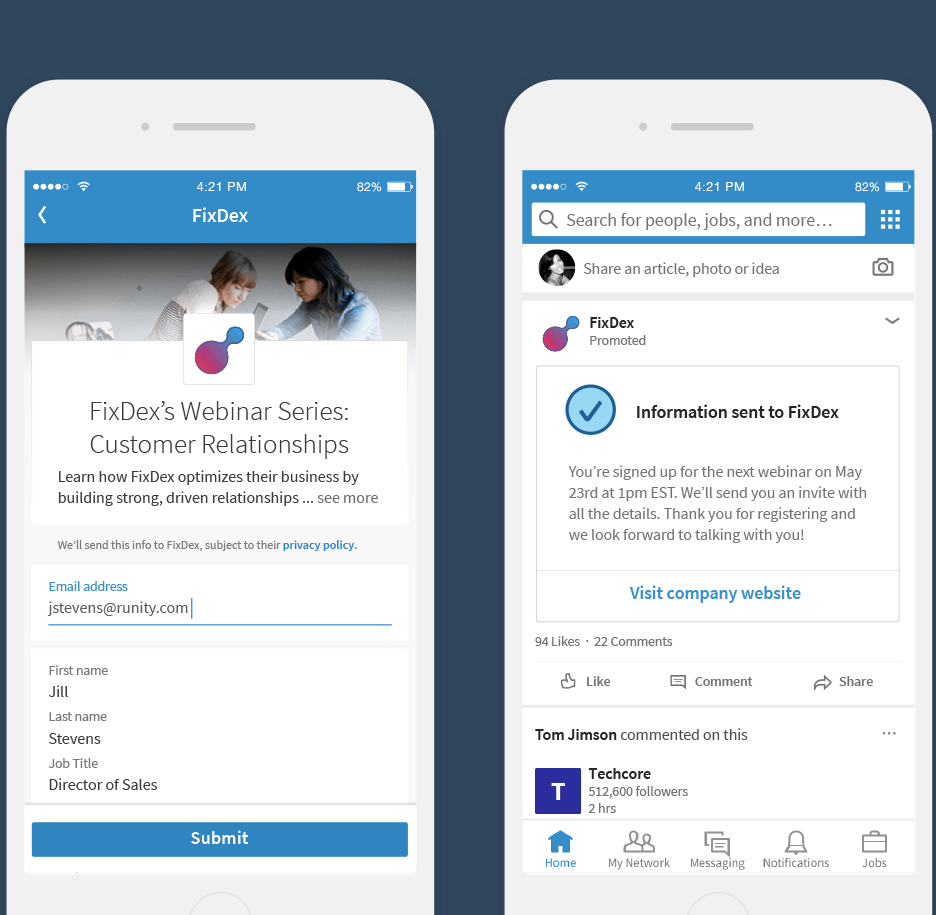
Source: LinkedIn
- Continue organic promotion. The fact that you run event ads doesn’t mean you should forget about the “value-focused strategy” we’ve mentioned above. So, keep your regular posts up and running to make your webinar more visible.
5. Use retargeting
You know how they always say that you need 5, 7, 8, or even more touchpoints to actually make a sale.
Of course, this number will differ for every lead. But the fact remains: most people won’t do anything (including signing up for your webinar) the first time they see you.
That’s where retargeting can be extremely helpful.
We’ve already mentioned that it’s really effective to start with warmer audiences. And this point adds on to that.
The idea is simple: you target your ads to people who’ve already interacted with your content in some way. It could be anything, from reading a blog post related to your upcoming event to dropping off halfway through your trial signup form.
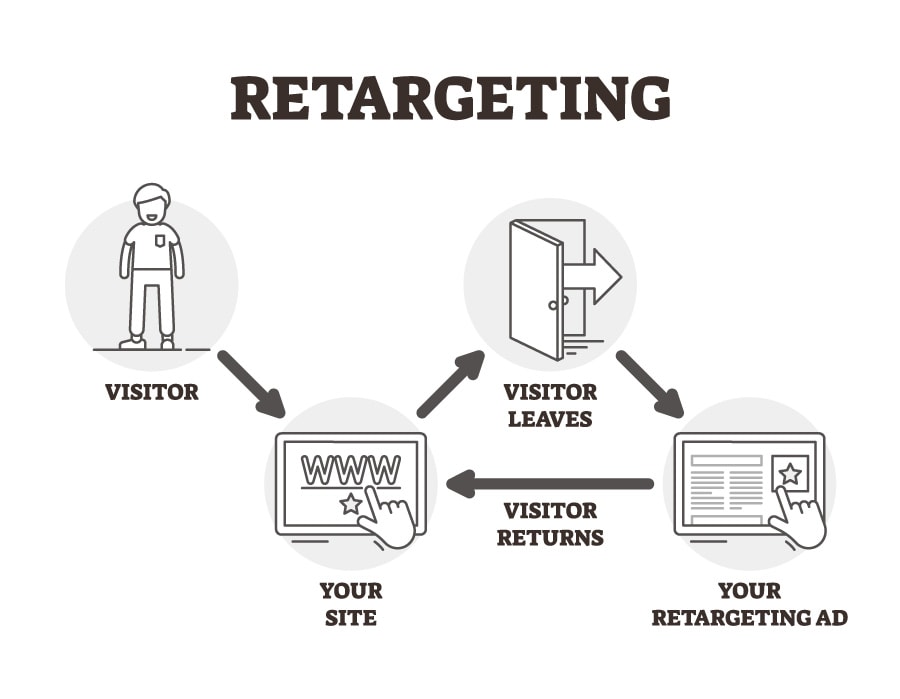
Source: Unbounce
Here are the exact steps to make it work:
- Create audiences that make sense for your event. Here, you can even create different segments. For example, people who were already one step away from trying your product and those who just engaged with you on social media.
- Try different ad formats and angles. If you’ve already done lots of testing before and you have a high-performing control, go for it. But if you don’t, it would be wise to try different formats (videos, carousels, etc.) and messaging (last call, value-driven, scarcity, etc.).
- Exclude those who already registered (as much as you can). You don’t want to waste your budget on people who are already in. So, it’s an important point to keep in mind.
6. Add banners and pop-ups on your website, platform, or app
If you organically get people onto your website, app, or any other platform you own, it’s fantastic. Because generally speaking, inbound lead generation is cheaper. And the audience you get is often warmer.
So, if somehow, these people already know you and visit “your space,” use it.
The easiest way to do this for webinar promotion is to add some banners or pop-ups.
The main rule here, though, is to make them as non-annoying as possible.
If a user gets to your website from mobile and sees a full-screen pop-up that they can’t close, it’s an absolute no-go. Remember: user experience should be above anything.
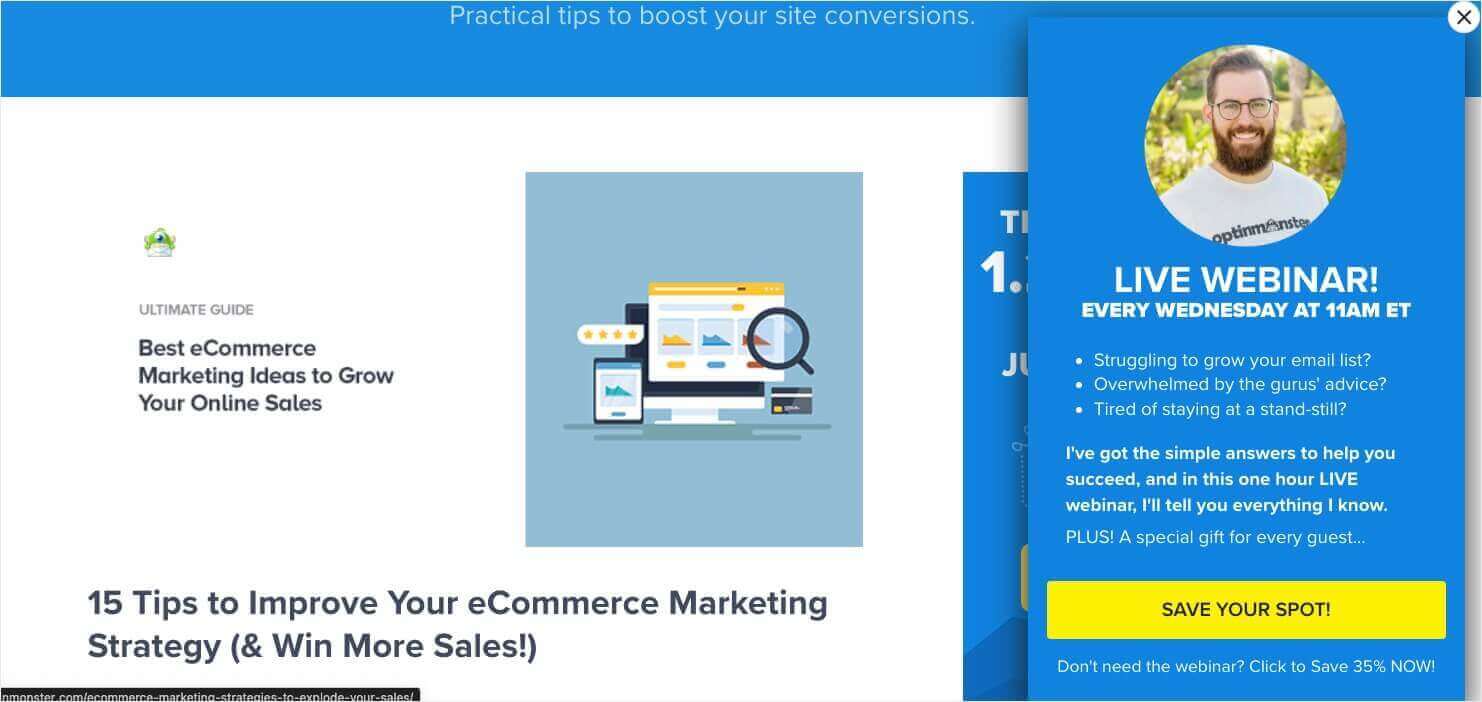
Source: OptinMonster
Here are the exact steps to make it work:
- Decide where a pop-up makes sense. Sometimes, your event topic will be useful for the majority of people who land on your website or app. But other times, you might only want to promote it for some very particular blog posts and case studies, or when a certain functionality is triggered.
- Make your banners as subtle as possible. Ideally, your webinar promo shouldn’t add any discomfort to your users. The best idea is to add a very small sticky banner on top with just 1 or 2 lines of text and a button that leads to a landing or registration page.
7. Consider partnershipsp
Of course, this one had to be on the list. Collaborations and some influencer integrations are a big thing for a reason. If you find the right person, it will be extremely effective.
And this doesn’t necessarily have to be expensive, you just have to be creative:
- Talk to your business partners. Maybe you can promote their webinars, and they will post announcements about yours.
- Co-host online events with other businesses. Same here. These companies will care about this event as you do, so it’s a great opportunity.
- Invite some guests who have a relevant following. Guest speakers could be a fantastic chance to get more registrations. Because when they participate in your event, it’s only logical for them to spread the word.
- Go through your product/service users. If you have some clients who are quite well-known in your niche, offer them a good discount or some free add-ons, etc., in exchange for a post or something.
Now, let’s check some real-life webinar promotion examples that used partnerships.
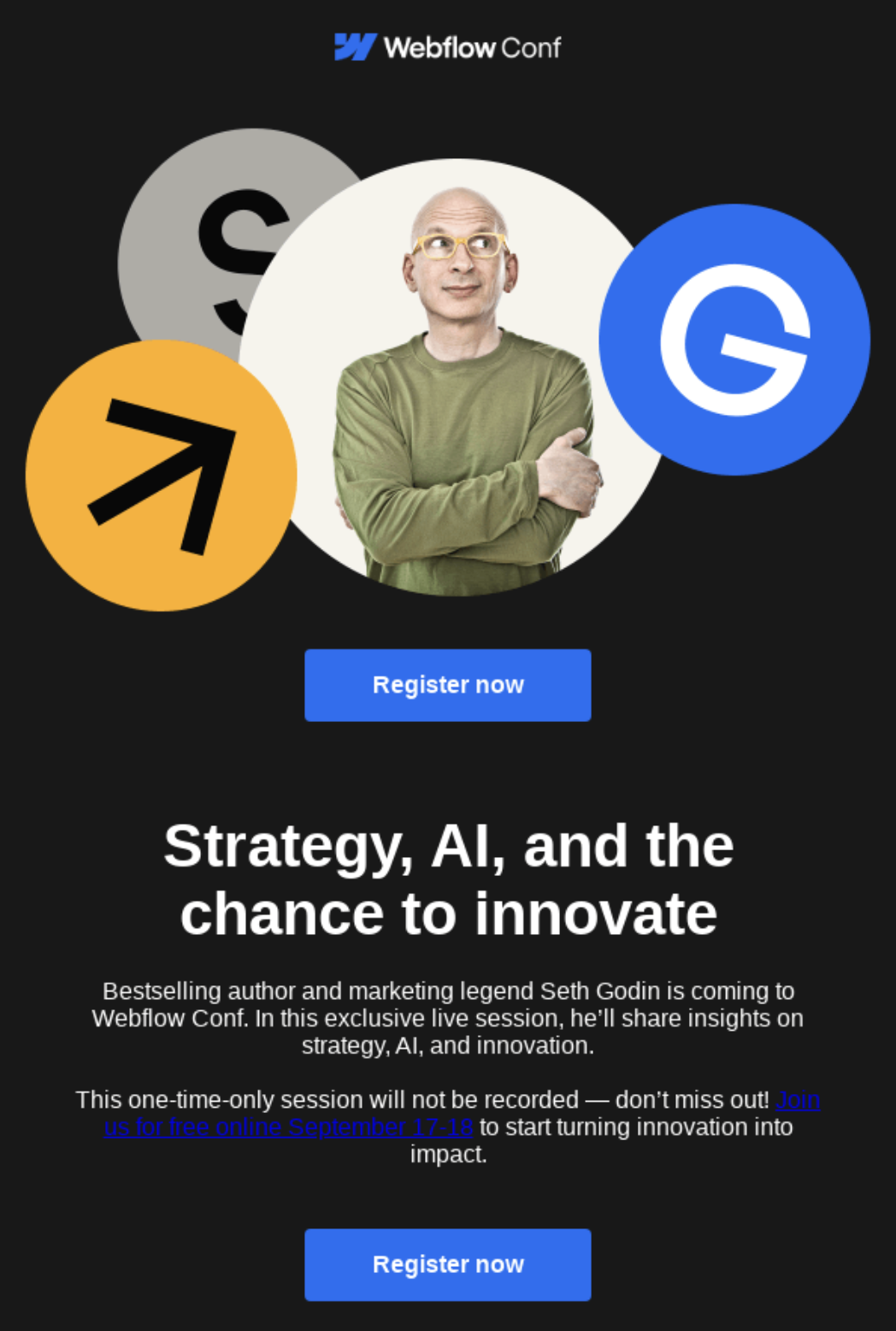
One of the options is to partner with someone whose voice carries a lot of weight in your industry. Sometimes, your best-selling point could be the speaker you invite.
For example, here, during the Webflow conference, the event with Seth Godin was a “one-time only session” with no recording.
Even the way they position it is a great way to boost attendance.
Tip: You could also record any special event and offer it as a bonus for one of your products or a lead magnet later on. Of course, you’d have to double-check this with your guest.
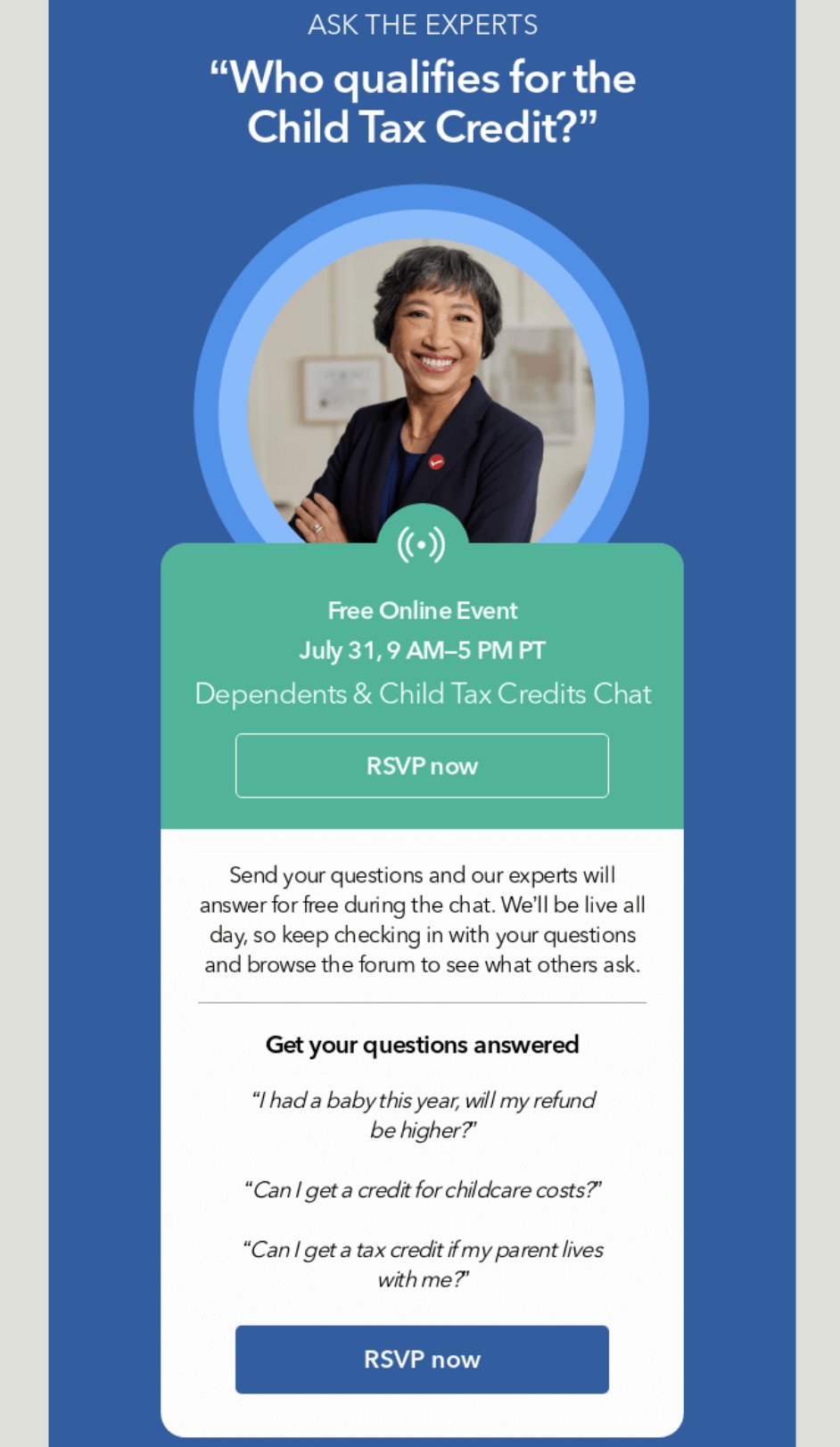
You can also go further and offer your audience the opportunity to send their questions when promoting your webinar.
Of course, you can do this with a simple Q&A session during the event. But when you do this before the actual event, it can boost attendance because people will be waiting for their answer. Besides, it just feels much more collaborative.
This is a great example by Intuit:
Here are the exact steps to make it work:
- Think of potential collabs. First, list everyone who could be a good fit for your partnership. This will depend on the importance of the event and its topic.
- Offer partnership opportunities. Reach out to different businesses and people, and have some incentives prepared. It has to be clear what’s in it for them.
- Prep promotional materials. It’s really helpful to prepare different images (maybe even videos) and some basic copy. You can just send it to your partners as an option. Of course, some of them will tweak the text, but others can just copy-paste the benefits and add your visuals.
- Interact with their posts. If it makes sense, repost their content or at least engage with them. It’s always a nice touch.
8. Try community promos
It seems like there is no marketing blog lately that doesn’t mention communities. But the reality is, they matter.
And if somewhere there is a community that has a big chunk of your target audience, you have to be there (together with your webinar).
What options do you have?
- Sponsor a newsletter. If there is a successful newsletter in your niche with a high open rate, it’s a great opportunity to add visibility for your event. Just choose a brand or person that feels natural for your image.
- Post in social media groups. This is a whole different world, and your choice here is endless. It can be anything from LinkedIn and Facebook groups to Slack and Discord chats. Just make sure you follow the rules of each of them.
- Use Reddit. Here, you can find a subreddit on pretty much any topic. So, no matter what your niche is, you’ll have people interested in your event. Just don’t be salesy, and if possible, ask moderators whether you can post the announcement.
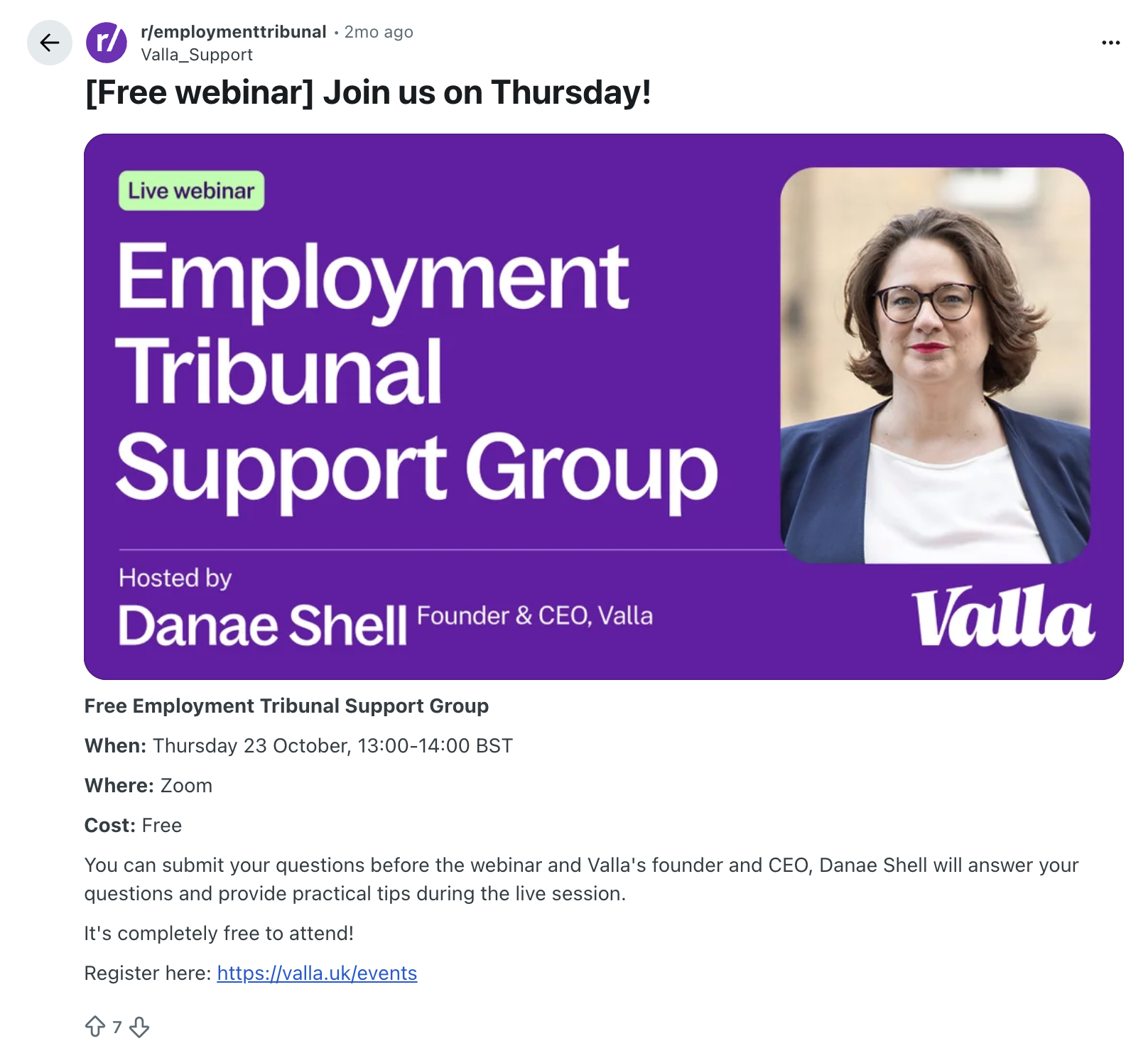
Source: Reddit
Here are the exact steps to make it work:
- List all the potential communities. This list will be very useful for your future marketing, so it’s best if you spend some time on this one.
- Read each community’s rules. We can’t stress this one enough. You don’t want to be that business that just ruthlessly spams everyone.
- Prepare value-based posts. Make your announcements actually useful and add some unique style (what we’ve already discussed above).
Webinar Marketing Plan After the Event
Your promotion doesn’t have to stop once the event is over.
You can keep generating leads (and even sales) long after you’ve said “bye-bye” to attendees and sent the replay emails.
But how do you make it actually efficient? Let’s take a look.
Evaluate your eventmos
Alright, this might be a little controversial. But hear us out.
Of course, in an ideal world, we’d all love to release extraordinary content every single time. But in reality, it doesn’t always work like that.
Sometimes the webinar is just okay. Nothing more than that. Maybe you were rushing to meet a burning deadline, had some budget restrictions, or something simply went wrong.
No matter why it happened, you might not want to beat a dead horse and keep promoting a so-so event.
That’s why every time the event is over, ask yourself: “Is marketing this webinar any further worth the effort?”
It’s okay if the answer is “no”. Life is life. Just close that chapter and move on.

Sometimes, we try to compensate with heavy marketing for an average product (a webinar, in this case). But it barely makes sense. You can spend that energy on something far more useful.
Do you have your answer? Perfect, now is the time for the next steps.
Send replays (an obvious one)
While it’s an obvious point. You can get at least a bit more creative.
For example, instead of just sending a replay link, you can sum up some key ideas, share some speaker quotes, interesting stats that came up during the event, etc.
Here is how beefree, together with Really Good Emails, did this:

Repurpose smartly
Your webinar can become one of the best content sources if it’s a good one.
Think about it: you prep it for quite some time, you invite expert speakers, you get great questions from your audience. It is like a bottomless box of chocolates:) Or at least it could be.
So, what can you do with your great webinar’s recording?
First, we’d recommend you try one of the AI tools that can cut your long-form recording into short clips based on what you’re saying there.
It could be a great place to start because the algorithms can help you choose the moments that are more likely to get viral or at least resonate more with the audience.
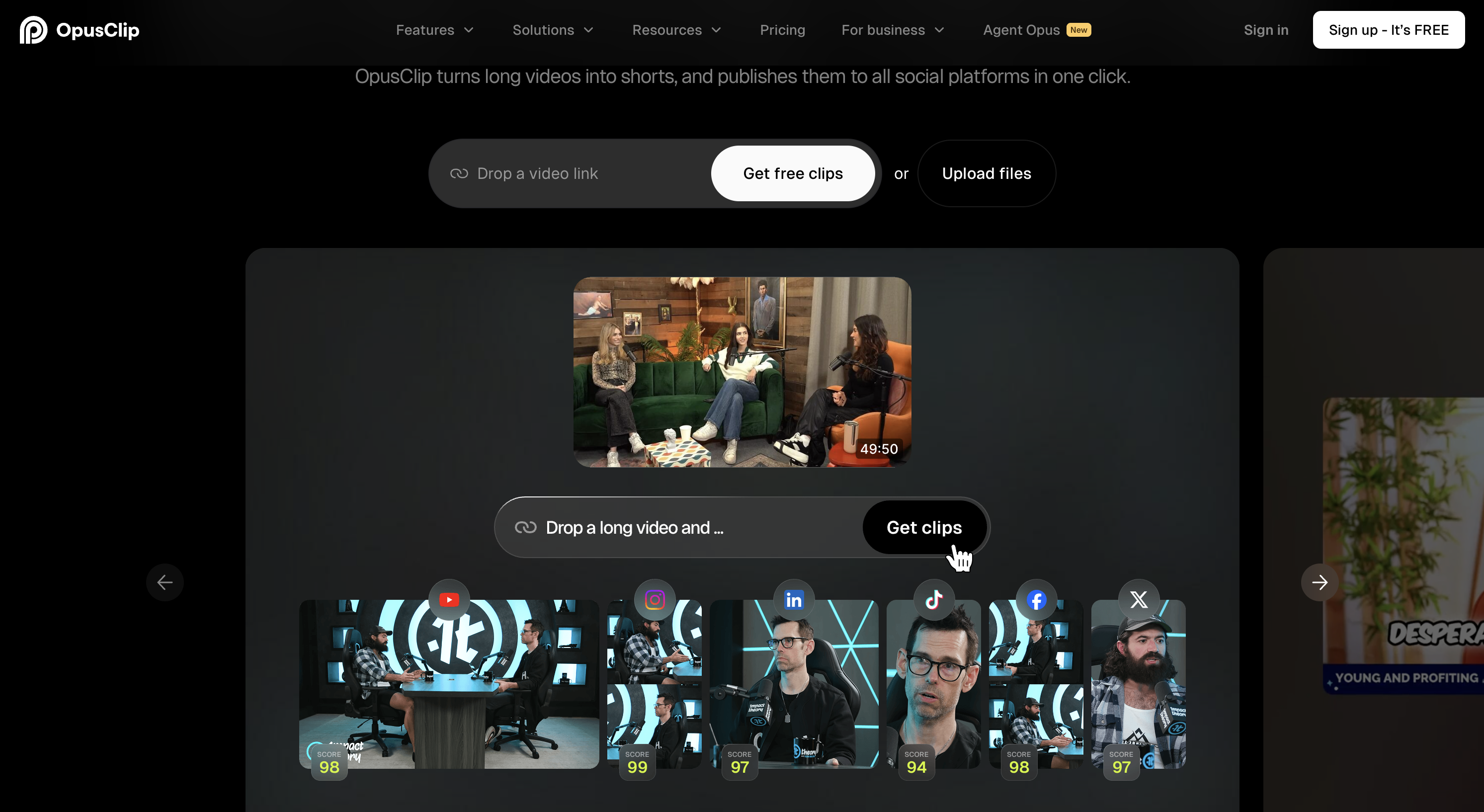
Source: OpusClip
But you don’t have to use any tool for this if you don’t want to. You can simply take some notes with major points and then repurpose those.
You can turn this content into:
- Image quotes for socials, maybe even carousels.
- Short Reels, YouTube Shorts, TikTok, LinkedIn videos, etc.
- Emails and newsletters, where you can additionally promote your product/service.
- Whitepapers, checklists, or something similar (if it was really data-rich).
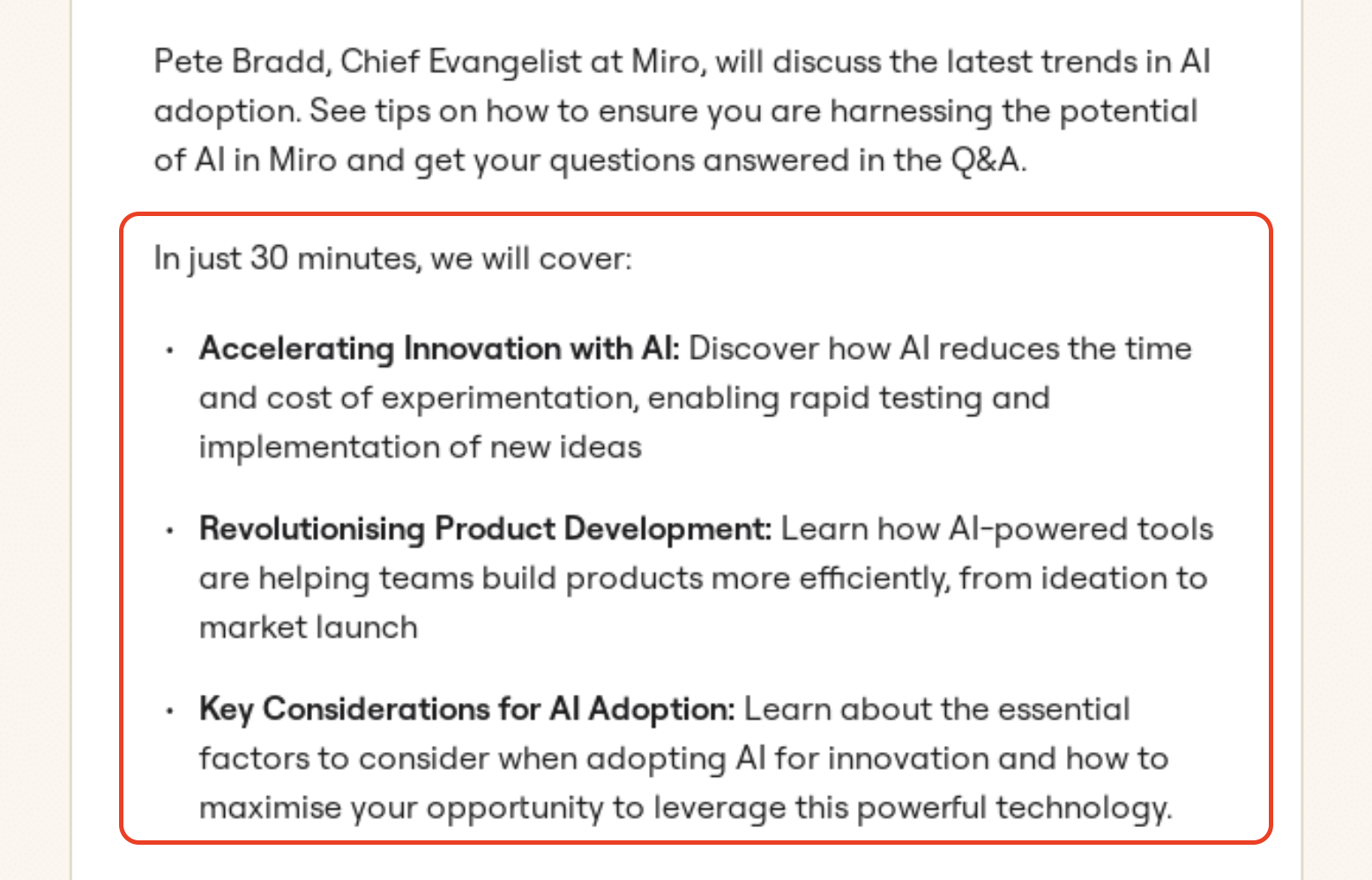
Even simply creating a short version of the recording and saying something like “In just 30 minutes, we’ll cover…” is a great option.
Because everyone knows that webinars are at least 1 hour long. And who has that time these days? So, when you deliver value in a shorter time, you’re a winner.
This is exactly what Miro did:
But if your webinar was particularly good, we encourage you to turn it into a lead magnet that will keep on giving.
The idea is simple:
- Take your webinar and edit it if needed. It would be really nice to edit out some technical parts, the moments when you were waiting for people to join, and other useless things like that.
- Find the most selling points of the event. Even the best webinar won’t bring you any results if the copy promoting it is weak. So, brainstorm this a lot and understand clearly what pain points this video addresses.
- Create a landing page (or use an existing one). Just add your webinar as a lead magnet there. It should be very easy to access without tons of fields to fill in. It can even be a non-gated piece to get people to know you.
- Promote it further. You can literally build a complete funnel off your webinar. And this is what our next point is all about.
Build a whole funnel
If you were looking for some creative ways to promote a product, this could be it.
If your webinar was truly good and was selling your product/service, you can turn it into a full-scale marketing campaign.
How? Well, there are tons of options.
But today, let’s take a look at a basic funnel you could use:
- Create a landing page that sells your service or product. Ideally, it should be just one (maybe with a couple of tiers). This offering should be tightly connected to the event topic.
- Write an email sequence. You can start with something basic. For example, the first email is your webinar, the second one is your offering with another guide, playbook, etc., and the third one is your product/service with some special price for a limited time.
- Run ads. This will require lots of testing with smaller budgets. But at some point, you’ll find that perfect spot that will convert well. That’s where your whole funnel will start to generate leads and sales continuously.
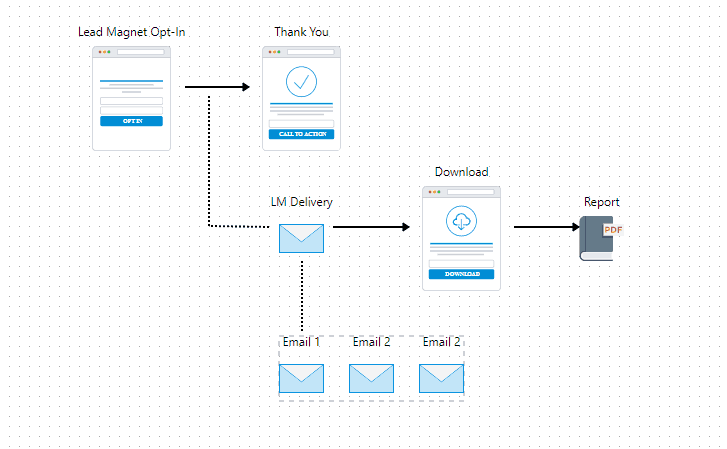
Source: Funnelytics
Of course, this is a very simplified explanation. And depending on your business, this funnel will differ.
For example, if you have a longer sales cycle, maybe you could pitch your freemium model, free trial, demo, etc., instead of selling a product. But the basic idea will remain.
Besides, you can also use other traffic sources (apart from ads).
This could be referral marketing, organic promotion (SEO, YouTube tutorial, etc.), or anything else that makes sense for your niche.
Conclusion
The whole strategy of promoting webinars might seem complicated. But in reality, once you do it a couple of times, you’ll see that it isn’t that hard.
Sure, it will require lots of trial and error. But overall, it’s just a matter of understanding your audience and knowing your tactics. The latter is already taken care of after reading this guide.
So, just make sure you create events that are valuable for your audience and never stop experimenting. And this is the true recipe for success.
Related Posts
Published May 27, 2025
Published Jul 17, 2025
Published Aug 26, 2025
Last updated Mar 31, 2022 | Published May 27, 2021
Last updated May 8, 2025 | Published Apr 9, 2025
Published May 13, 2025
Enter URL & See What We Can Do Submit the form to get a detailed report, based on the comprehensive seo analysis.