SEO Affiliate Marketing: How to Drive Revenue Without Hurting Your Rankings
Every affiliate marketer is always looking for new ways to get more eyes on their links and codes. And while there are many options, most of them require you to constantly work on them, because once you stop, the traffic stops too.
That’s where SEO affiliate marketing can help. While it takes time initially, this is a tactic that actually compounds, bringing you clicks even after you stop investing in it.
But excited by all the opportunities, many creators make costly mistakes that can hurt their rankings, traffic, conversions, and future potential.
So, today, we’ll cover everything you need to drive revenue with affiliate SEO without hurting your website, including:
- What this tactic really is and why it’s effective
- How affiliate marketing can influence SEO (hurt it or help it)
- How to handle your links to avoid any issues,
- And the tips to get the most out of your SEO affiliates.
Contents
What SEO affiliate marketing actually means
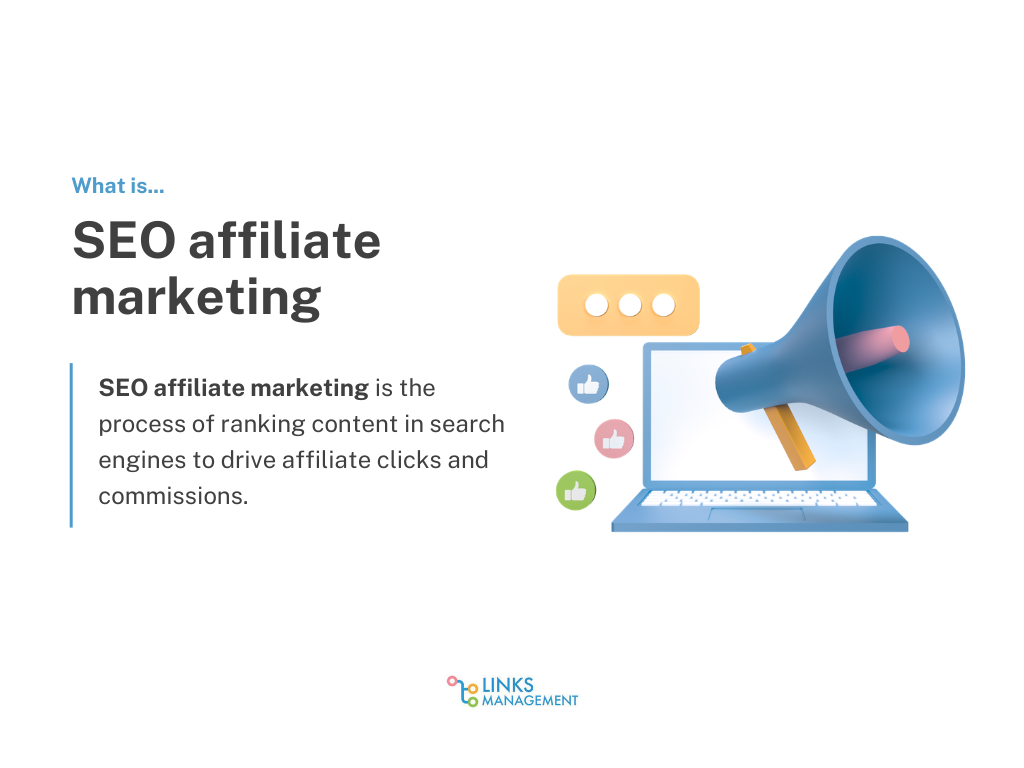
Affiliate SEO marketing is the practice of earning commissions by promoting products or services through search engine optimization.
If you’re still confused, let’s break it down. This term obviously consists of two parts: SEO and affiliate marketing. And to understand what it is, defining each of them is helpful:
- SEO (aka search engine optimization) is a set of tactics aimed at helping you become more visible in search engines like Google, Bing, Yahoo, etc.
- Affiliate marketing is the process of promoting someone else’s product or service through affiliate links or codes and getting a commission for any successful sale.
And when you connect the two, you get search engine optimization that attracts traffic, and affiliate marketing that helps you earn money.
How different is it from regular affiliate marketing?
This is easy: the only difference is basically the source of exposure, traffic. It can be SEO, social media, paid ads, email marketing, etc.
- So, if you promote your affiliate links through social media, it’s social media affiliate marketing.
- And if you promote them through SEO, it’s…? Right, SEO affiliate marketing:)
And of course, the traffic source will determine your promotional strategies, content types, budgets, timeline, etc.
Why SEO is one of the best channels for affiliates
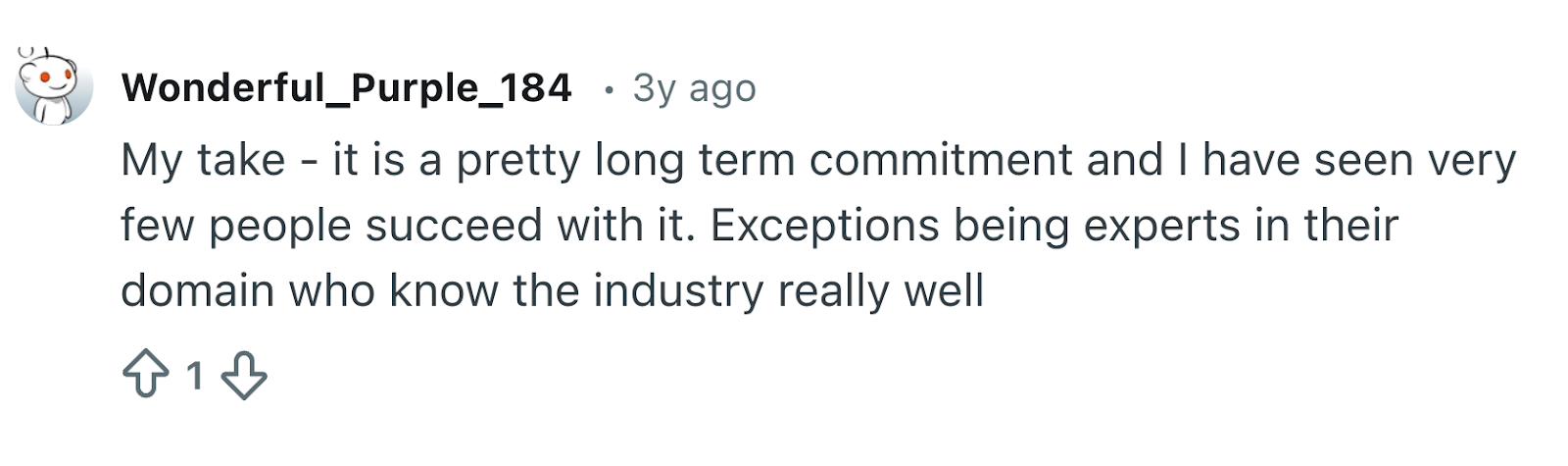
If you google whether SEO is a good channel to promote your affiliate links, you’ll often see people saying that it’s slow.
Source: Reddit
And you know what? They’re right. It does take time. But the outcomes you get are also worth it. Because unlike PPC, SEO won’t stop bringing you traffic once you stop paying.
So, like anything in life, it’s really a double-edged sword. Yet, many successful affiliate marketers still choose SEO as one of their channels because they know that, in the long term, pretty much nothing can beat it. Here’s why:
- Higher trust: If you rank your money-making pages high enough to get organic traffic, you’ve likely already gained some trust from both search engines and people. When users find you in organic search, they tend to see you as more credible than just another intrusive ad.
- Lead qualification: Because you choose what keywords to rank for, you can target commercial intent from the start. This means that most people who land on your website are already ready to buy. And it’s hard to reach this cluster of users through any other channel.
- More budget-friendly in the long term: SEO compounds over time, meaning that whatever you invest in can yield even better results later on. And even if you stop optimizing, you’ll likely still keep getting traffic for some time, sometimes even years.
So, yes, while you won’t get immediate results, SEO and affiliate marketing work very well together if you know what you’re doing.
Do affiliate links hurt SEO, help it, or do nothing?
By default, affiliate links don’t hurt or help SEO. But there are some nuances that, as always, depend on what you do and how you do it.
So, let’s review this in detail.
When affiliate links do not hurt your website
Affiliate marketing can’t hurt anything when it’s natural and helpful. What do we mean by that?
- Your content should be valuable: You can’t just create some random AI or plagiarized articles and hope that it’ll work because who needs it? ChatGPT has a free version. So, what’s the point?
- Your links should make sense: If you look like an irrelevant spammer, well, you can’t expect that content to convert and work in the long run.
- User experience should always come first: We get it, you want to make money. And it’s great, go for it. But the issue is that you have to first care about UX if you want to use SEO for your affiliate marketing. So, no disturbing ads or pop-ups, junk content, slow loading speed, etc.
- Clear disclosures and link tags: Google knows that sponsored links are a normal thing (there is proof below). But you have to make it clear to Google and your users by adding an affiliate disclosure note and sponsored or nofollow tags to your content (more on this later).

Source: Google
What actually causes problems
You only get issues with affiliate links and SEO when you try to fool the system and find some shortcuts, this includes:
- Useless content only meant to attract clicks and make money,
- No trust signals to your website,
- Anchor text that isn’t related to the actual link,
- Aggressive spam, like in an example Google offers below:

Source: Google
Do affiliate links help SEO, then?
Well, not really. At least, not directly.
An affiliate link, as such, isn’t a direct ranking signal.
But let’s look at this question from both sides: an affiliate marketer promoting a product and a brand running an affiliate program.
- If you’re an affiliate marketer and you use affiliate links to make money, they can indirectly improve your SEO by helping you earn natural links if your content is good. And if you earn well through affiliate marketing, you can also invest more in optimization, which can again indirectly help you achieve your SEO goals.
- If you’re a brand running an affiliate program, you will likely get a lot of links pointing to your website. But even if those links come from super high-quality pages, they usually won’t improve your authority. Why? Because they’ll likely be tagged with nofollow or sponsored, which don’t pass link juice. And below, we’ll get into this in more detail.
Do affiliate links count as backlinks?
This question has two answers: technical and realistic.
- Technically, they are links from one site to another, which makes them “backlinks” by definition.
- But in reality, they aren’t the backlinks that can help you improve your domain authority, trust, or rankings.
So, if you’re thinking about making affiliate marketing a part of your link-building strategy, it isn’t a good idea because it won’t work.
If you want to get backlinks that realistically matter to Google and can improve your visibility, you have to focus on guest posting, link insertions, linkable assets, etc.
How to handle affiliate links the right way for SEO
This basically comes down to two major elements:
1. Proper link attribution
2. And proper disclosure.
Now, let’s see what this even means.
Link attribution
If you do SEO, you know that after each link in code, website editors usually add rel=”noopener,” rel=”nofollow,” etc.
This is actually the correct thing to do, according to Google itself. This way, you signal to search engines that they shouldn’t process these as your usual links.
You basically need it to avoid any spam issues.
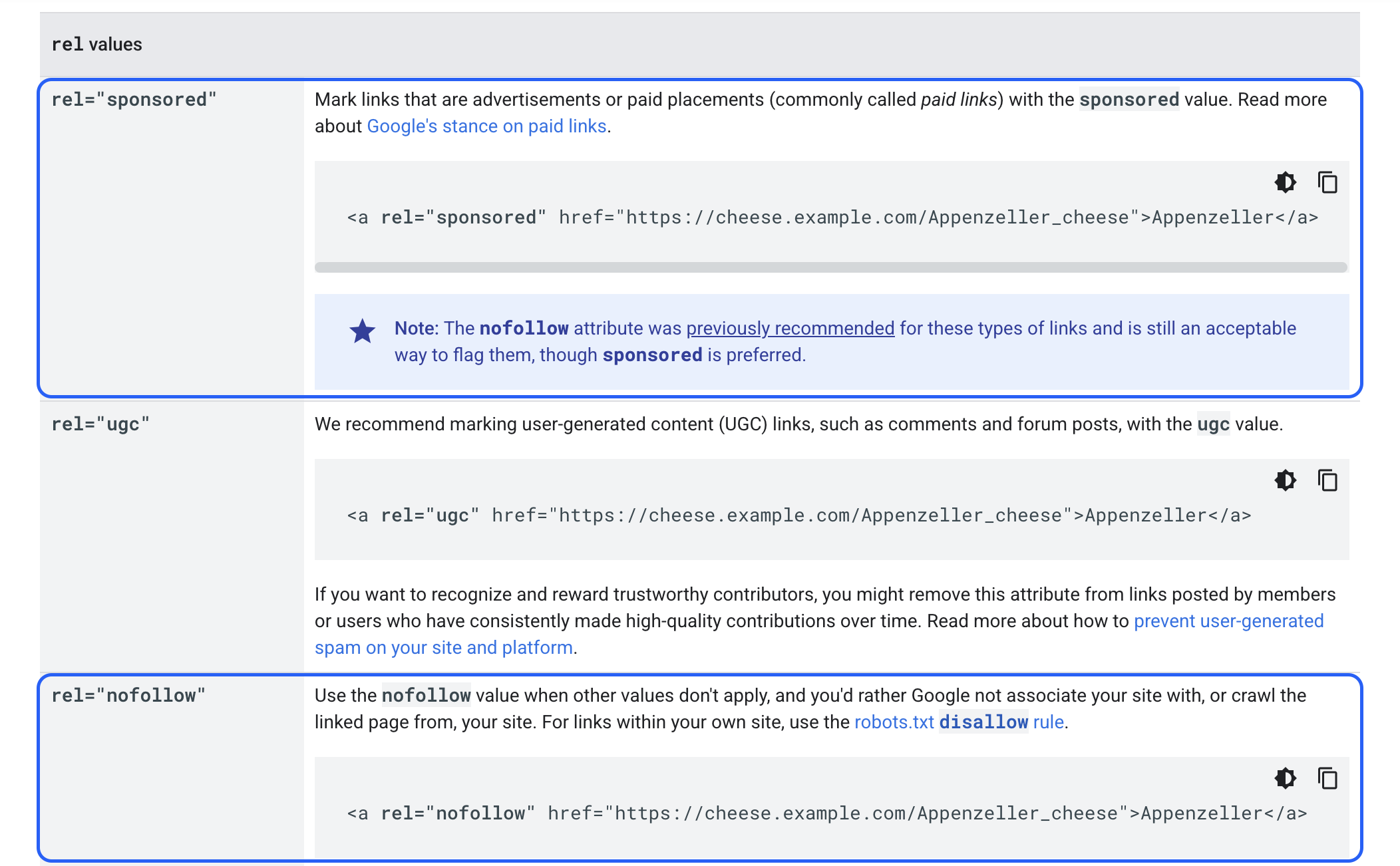
When it comes to affiliate SEO links, we’re particularly interested in two types of rel values:
- rel=”nofollow”: This one was previously the tag you’d use for any type of paid content. And nofollow affiliate links are still what many brands add.
- rel=”sponsored”: It’s a relatively newer way to mark any types of ads and paid links.
You can use any of these or even both. This doesn’t really matter much, and Google accepts both of these versions.
Source: Google
Disclosure
When you earn anything from what you post online on any platform, including your website, it’s always advised to mark it as an ad or sponsored content.
If you’re operating in the US, you can read the Federal Trade Commission (FTC) guidance on this. But no matter what country you live and work in, there is most likely some similar regulation.
And most of those regulations come down to one thing: clear and honest disclosure.
Let’s take a quick look and see what other websites that use SEO for affiliate marketing do.
Here is Forbes Vetted:
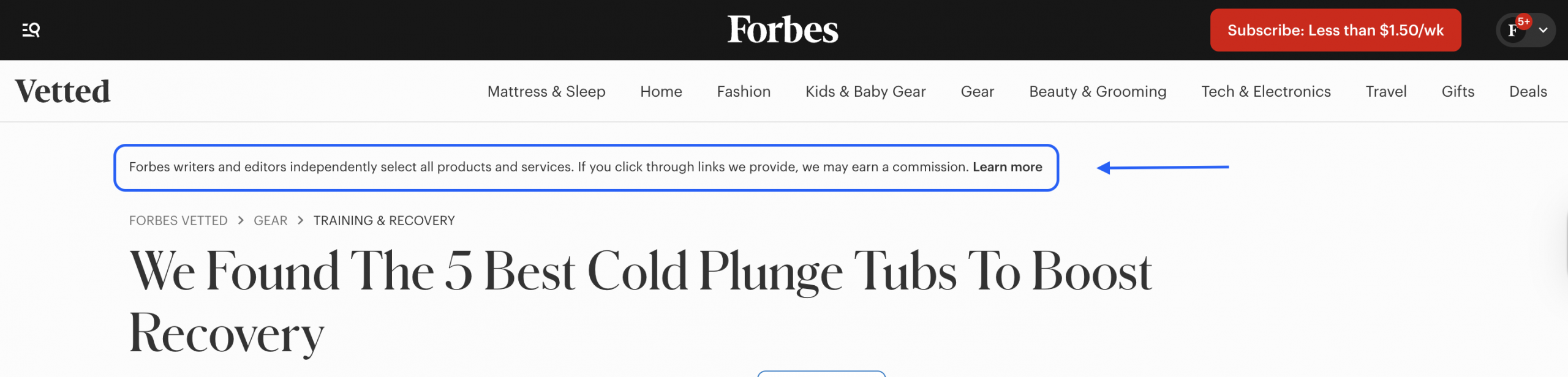
Source: Forbes
And here is PCMag:
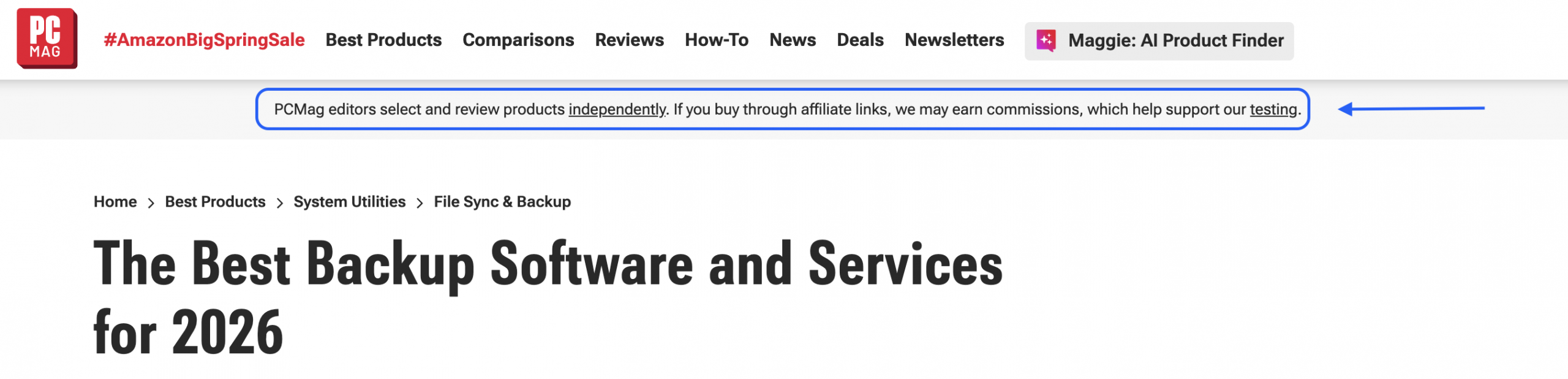
Source: PCMag
One thing is clear: their disclosure is obvious and placed right at the start of the article. And that’s what you should also aim for.
While you don’t need a huge full-screen banner for this, your affiliate disclosure can’t be buried somewhere down the page either.
It’s a very small detail. But it does matter.
How to do SEO for affiliate marketing and actually rank
By now, you understand that there is nothing wrong with affiliates as such. The only question is execution.
Still, if you focus on these four SEO tips for affiliate marketing, the whole process will become much more effective.
1. Start with commercial keywords
So, you have your niche and the products/services you want to target. That’s when many beginners make the same mistake: they start choosing any relevant keywords.
It isn’t wrong by default. In fact, you can totally do this later on.
But when you’re just starting out, you need more conversions to drive revenue. That’s why you should start with commercial and transactional search intent, not informational.
This way, you’ll target people who are ready (or almost ready) to buy.
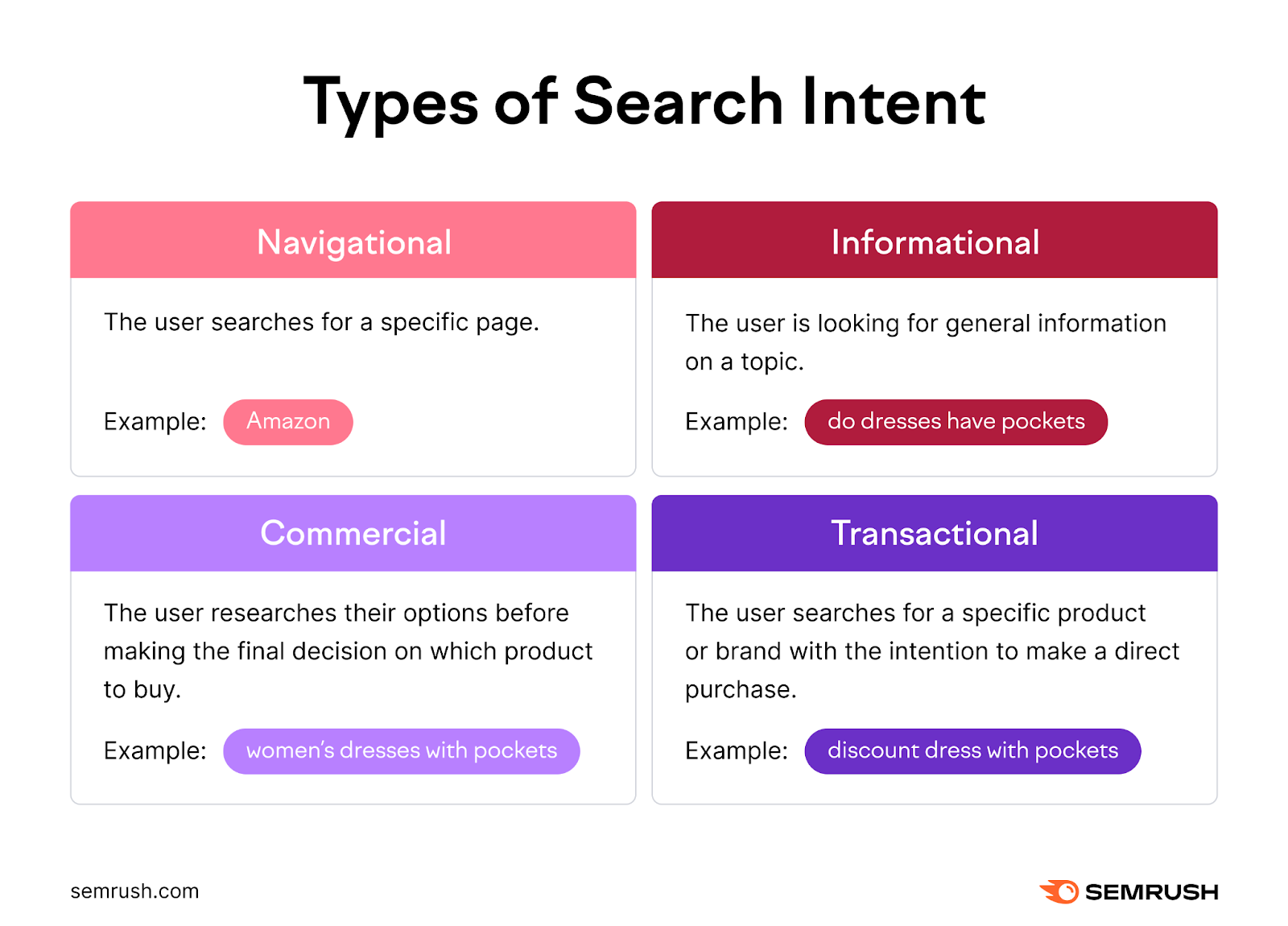
Source: Semrush
These types of keywords are usually something like:
- Best product/service for niche/process/etc.,
- X product vs. Y product,
- X product/service alternatives,
- Ss X product/service worth it,
- How to choose X product/service.
You can easily filter these out in any SEO tool you’re using.
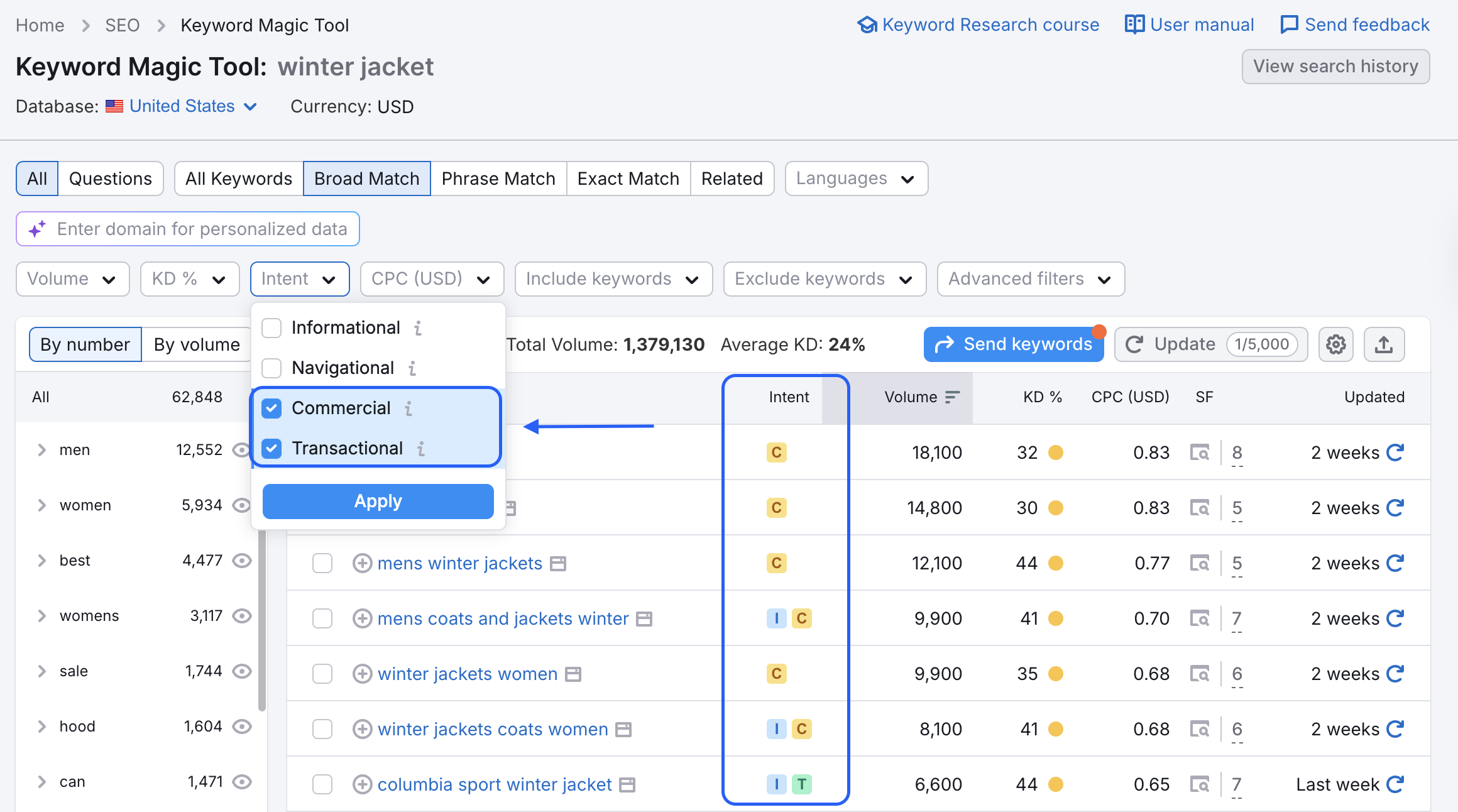
2. Build quality content that deserves rankings
The idea of affiliate marketing is to make money. Everyone understands it.
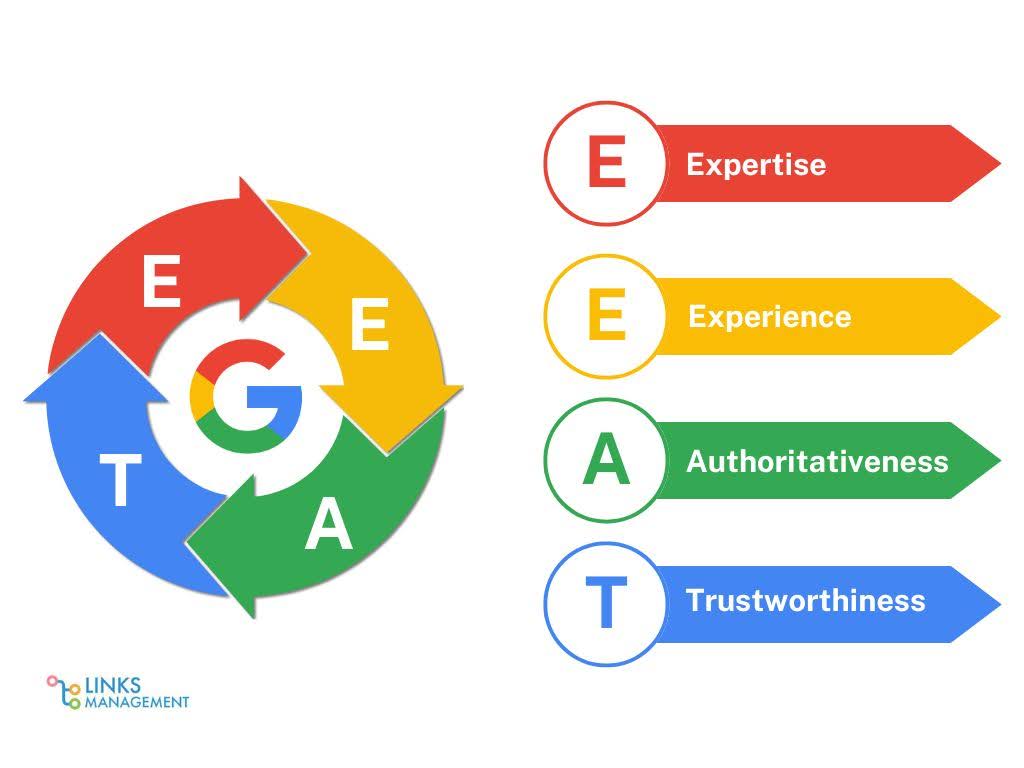
But SEO is all about providing actual value to readers. Google has the E-E-A-T policy, which stands for expertise, experience, authoritativeness, and trustworthiness.
And whether you like it or not, if you want to rank, you have to comply with this policy. Meaning that your content can’t be some thin, AI-generated stuff that tries to fool both users and search engines.
It can work for some time, but you’ll inevitably get problems with Google in the long run.
If you go and check any highly trusted sources that do affiliate SEO marketing, you’ll see that they don’t just post random compilations of random products. They go in-depth.
Let’s take the Forbes Vetted, for example, and check their Trending tab.
What do we see there?
- A mother of three writing about the best pregnancy belly bands.
- A writer covering new pet products they found at the largest annual veterinary expo in Orlando, Florida.
- Four Forbes Vetted team members testing Bricks for their phones for over a month to see whether they actually improve focus and productivity.
You get the idea. Whatever you call these, they aren’t random.

Source: Forbes
Of course, you don’t have Forbes’s brand, budget, or a giant team of writers and editors. And it’s okay. You don’t need all that to make money with SEO affiliates.
But what you do need is to try to make your content actually good.
So, as much as possible, choose more high-quality formats, like:
- Firsthand testing and original comparisons: If you can test your products, document it and take some pictures.
- Expert insight: Explain why you are a specialist in this field. Learning about dog toys from someone who owns 3 dogs makes much more sense than reading that same piece from a cat person.
- More details: Your content should be full of screenshots, pictures, pros and cons, pricing, maybe some expert quotes, etc.
3. Consider building a full funnel later on
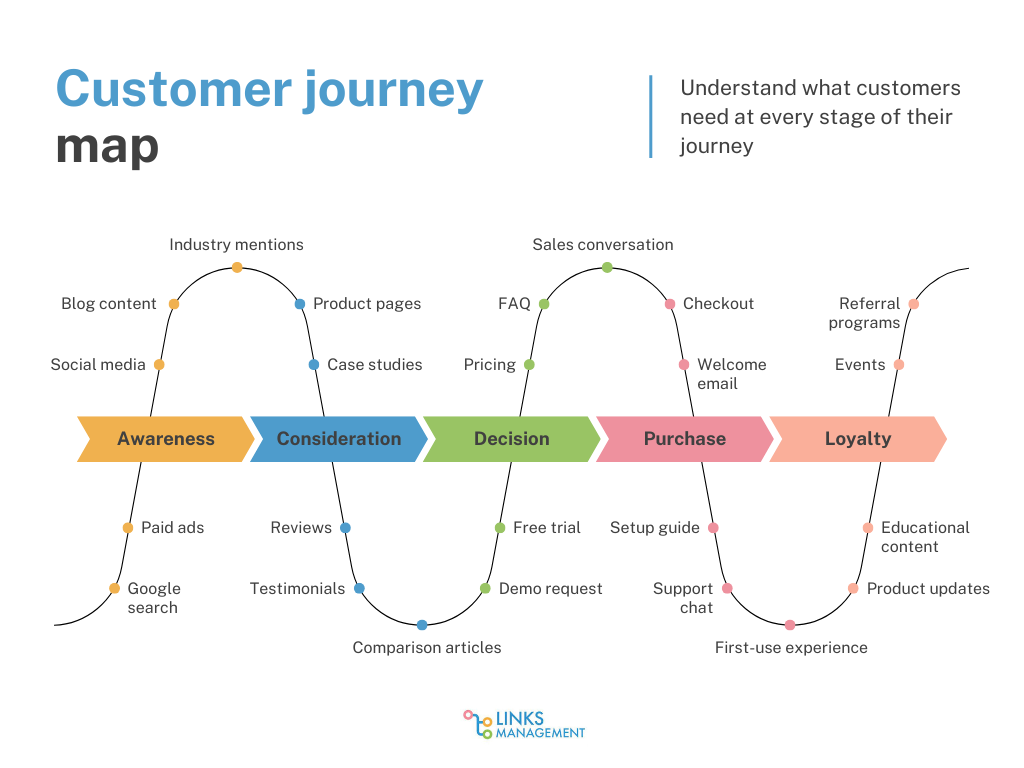
Remember how earlier we said that you should stay away from informational content keywords? Well, once you’re already getting some conversions and your affiliate business is running, it’s time to support your money-making pages with informational SEO.
This way, you’ll cover the whole customer journey, not just the Decision and Purchase stages.
But why is informational content important at all if it doesn’t directly bring any revenue?
This is a very good question. Basically, these types of posts help you:
- Build topical authority. You need it for both search engines and your readers. Because when they consider you THE voice in your niche, selling becomes easier.
- Do link building more easily. This content helps you build better internal linking for your relevant money-making pages. Plus, it has greater potential to attract natural backlinks because others are less likely to link to purely promotional content.
- Educate your audience. If you do affiliate marketing in tech or other niches that may require additional education, informational content is perfect for that.
Still, we strongly suggest doing this later on, because while it has real benefits, it isn’t the most important part for someone who already wants to generate revenue.
And even then, this shouldn’t be your main focus.
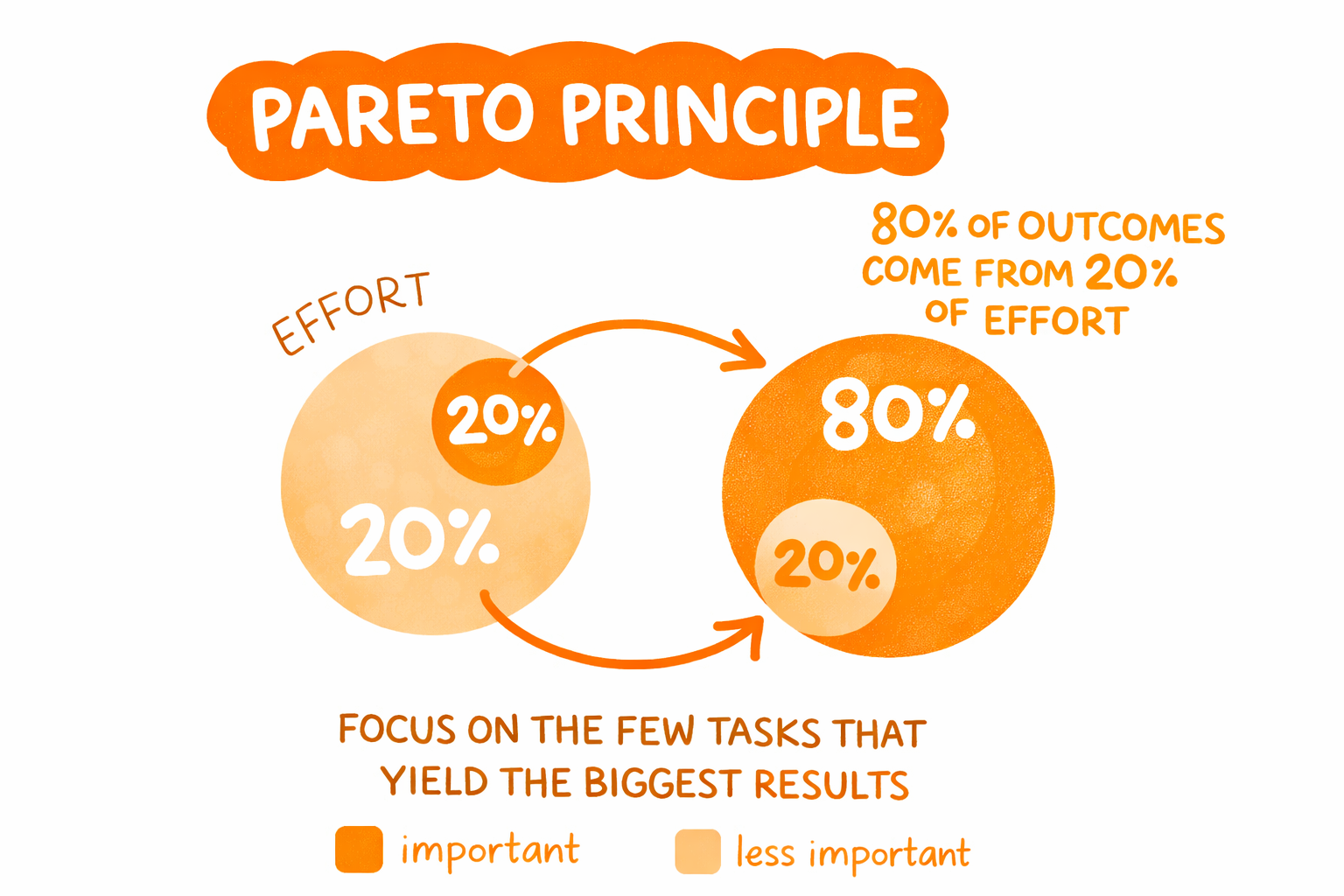
You’ve probably heard of the 80/20 rule (aka the Pareto Principle). The idea is that 20% of your effort generates 80% of the results.
And the message here is similar: your commercial and transactional keywords will usually drive most of your business outcomes. But that doesn’t mean you don’t need informational content.
4. Monitor rankings and revenue together
You aren’t just doing SEO to attract traffic. You’re doing it to make money from your affiliate marketing efforts. That’s why it’s so important to track not only your rankings and other SEO metrics, but also KPIs tied to revenue.
So, instead of simply checking how much traffic, impressions, and time on page you have, also make sure to monitor:
- Affiliate clicks: How many people actually click on your affiliate links.
- Conversion rate: How many of those who clicked converted, bringing you money.
- Revenue by page: What pages generate more revenue compared to others. Here, analyze them further to understand why.
Conclusion
Now you know everything you need to not only drive revenue with SEO affiliate marketing, but also avoid hurting your rankings in the process.
The only thing left at this point is to be patient, because while SEO is effective, it also takes time. And you don’t want to quit before it actually starts delivering results.
Related Posts

Published May 27, 2025

Published Aug 26, 2025

Published Jan 6, 2026
Published Jan 13, 2026

Published May 13, 2025
Published Oct 7, 2025
Sign up now and start a managed content placement campaign.