How to Build a High-ROI Behavioral Marketing Strategy (Step by Step)
Every single user who has ever interacted with your product generates data. And yet, most teams don’t use it enough in their behavioral marketing.
Here’s the thing: you see site visitors do something on your web page every day. Hundreds and thousands of them. Sometimes millions (okay, that’s less likely).
They click around, hesitate, come back, disappear, reappear, buy, don’t buy, buy again months later for reasons no campaign ever explains. It happens all the time, on all the platforms.
And yet, when it’s time to launch marketing campaigns, most decisions are still made in some blurry state where you “just want to see how it works”:
“Let’s send this to everyone.”
“Let’s target this audience.”
“Let’s try this channel.”
While there is nothing wrong with trial and error. In fact, it’s one of the best approaches in real life. But informed trial and error is definitely much more effective.
Besides, when you see your customer’s online behavior, you know exactly who’s interested, who’s close to buying, who’s wasting your time, and who isn’t really your audience at all. The data is sitting there, available to you, waiting to be used.
So, how exactly can you use it? And how to build a high ROI strategy based on user behavior? Let’s find out!
Contents
Before we start: What is behavioral marketing
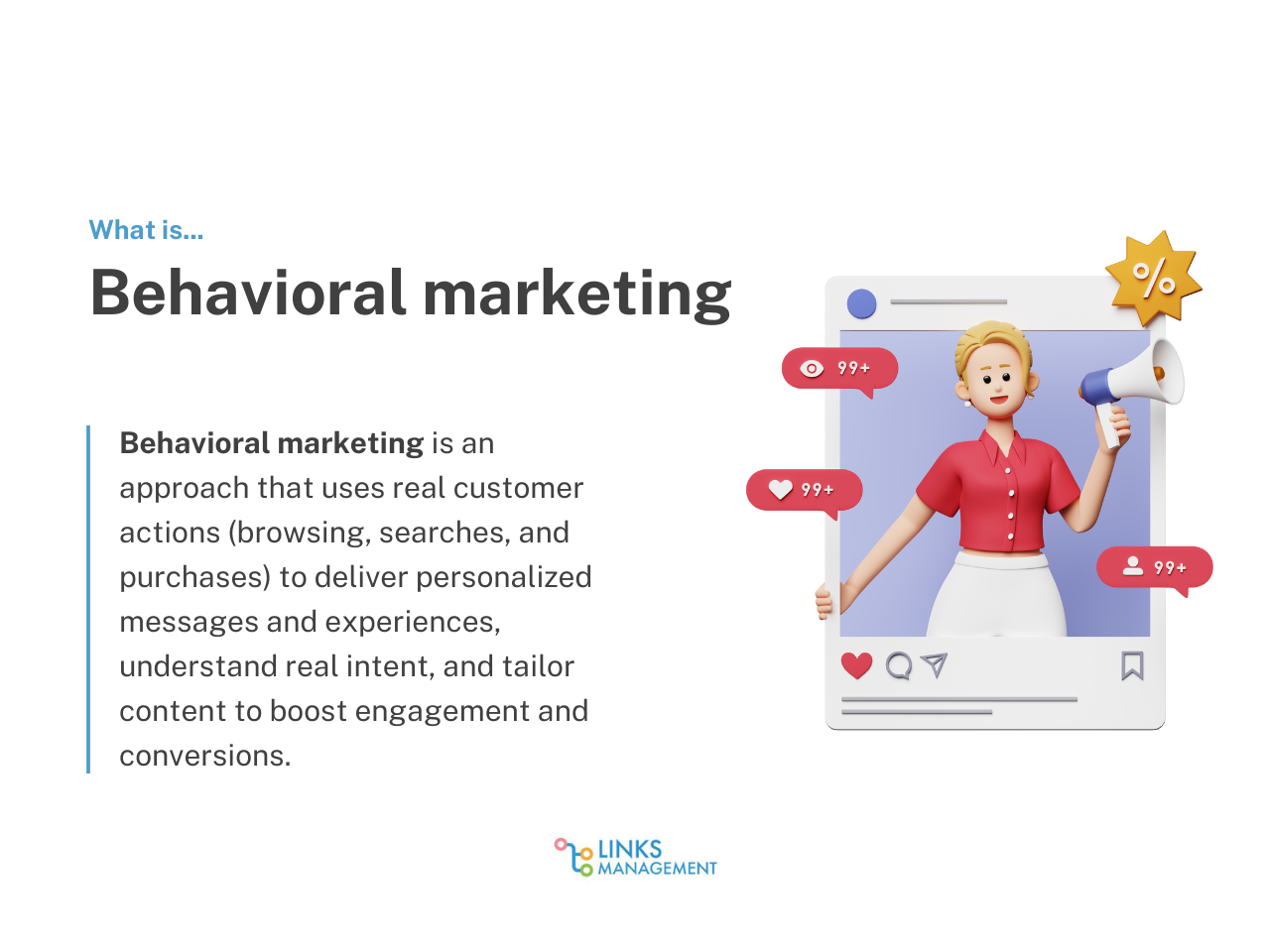
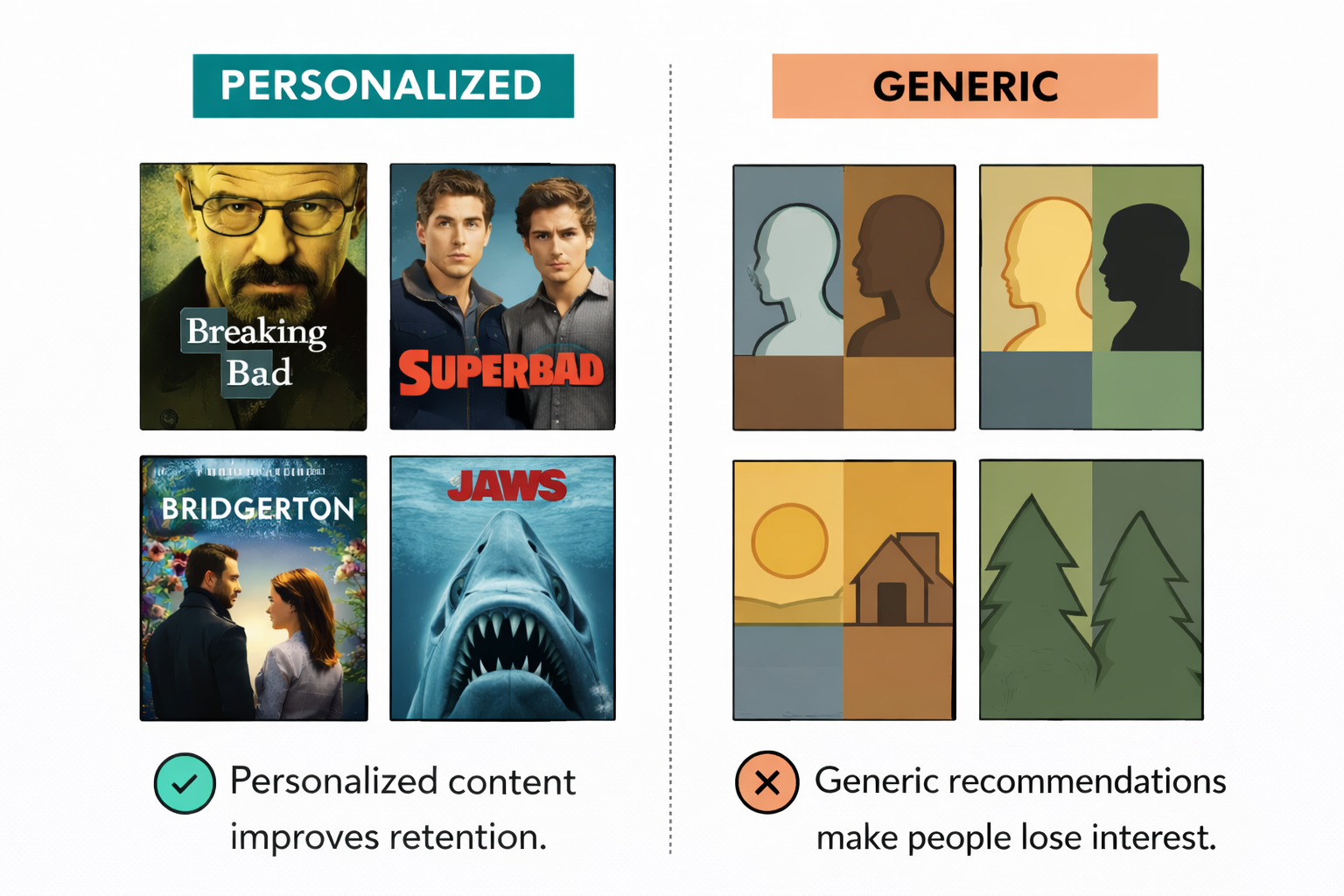
Most definitions of behavioral marketing are technically correct and practically… useless when it comes to real life (like the one in the visual above, for that matter:).
They’ll tell you it’s about using consumer behavior data, browsing history, purchase history, and so on. All to tailor marketing efforts as much as possible. Cool.
None of that is wrong.
It just doesn’t explain why it matters.
This type of marketing matters because people are remarkably consistent. Not in what they say; in what they do.
Behavior is more honest than any survey response you’ll collect.
If you look at enough data over enough time, patterns start repeating. Certain sequences of actions almost always precede a purchase. Other sequences almost never do.
Some actions predict long-term customer loyalty, others predict one-off discounts and silence.
Here are some very real examples:
- Someone can tell you they’re “just browsing.” But their behavior can tell you they’re comparing prices for the third time in two days.
- Someone can say they’re interested. But their behavior can show you they’ve already mentally left.
Behavioral marketing works because it removes interpretation. It replaces “I think” with “I’ve seen this pattern before.” Once you see patterns, timing will be obvious for you.
Overall, customer behavior data helps you understand:
- Who to talk to,
- When to talk to them,
- What to say,
- And just as important: who to leave alone.
This approach makes you realize that not all users are equal, not all traffic is valuable, not all campaigns deserve scale, and not all ideas deserve testing.
It also makes your promotion strategies much more effective and refined.
What it is not
Now that we’ve covered the behavioral marketing definition, let’s clear up some common misunderstandings that always float around.
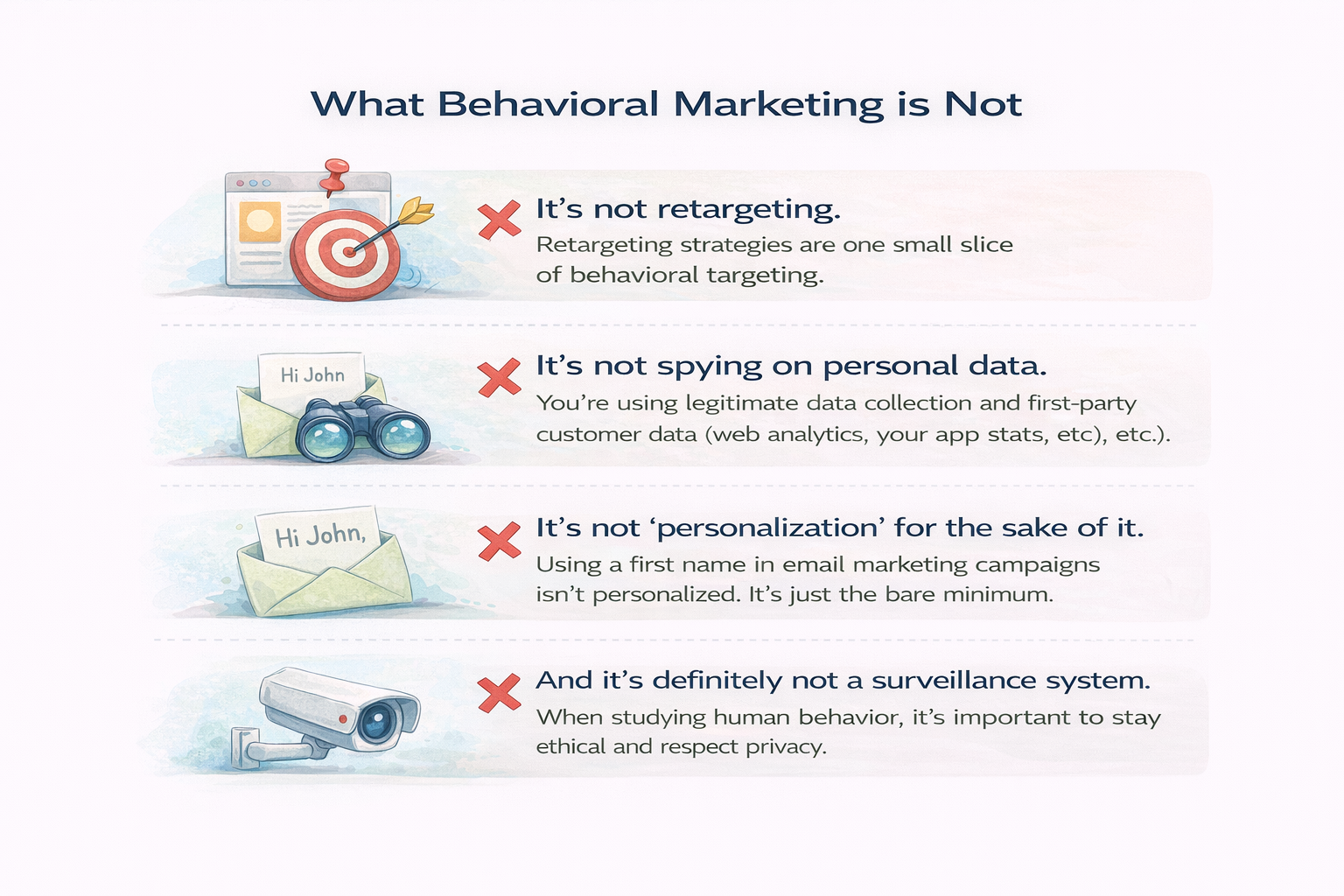
- It’s not retargeting. Retargeting strategies are one small slice of behavioral targeting.
- It’s not spying on personal data. You’re using legitimate data collection and first-party customer data (web analytics, your app stats, etc.).
- It’s not “personalization” for the sake of it. If you are using a first name in email marketing campaigns, it’s not a personalized experience. It’s just the bare minimum.
- It’s not about doing more. Good behavioral marketing usually means fewer marketing messages, but better-targeted ones.
- And it’s definitely not a surveillance system. It might sound funny, but actually, when it comes to studying human behavior in relation to certain products, it might get unethical quite quickly. We’ll cover this point later in this article.
Types you can use
There is no definite answer on how many types of behavioral marketing exist. You’ll see very different information online and in all the typical marketing books.
But from experience, you could roughly define these 7 types:
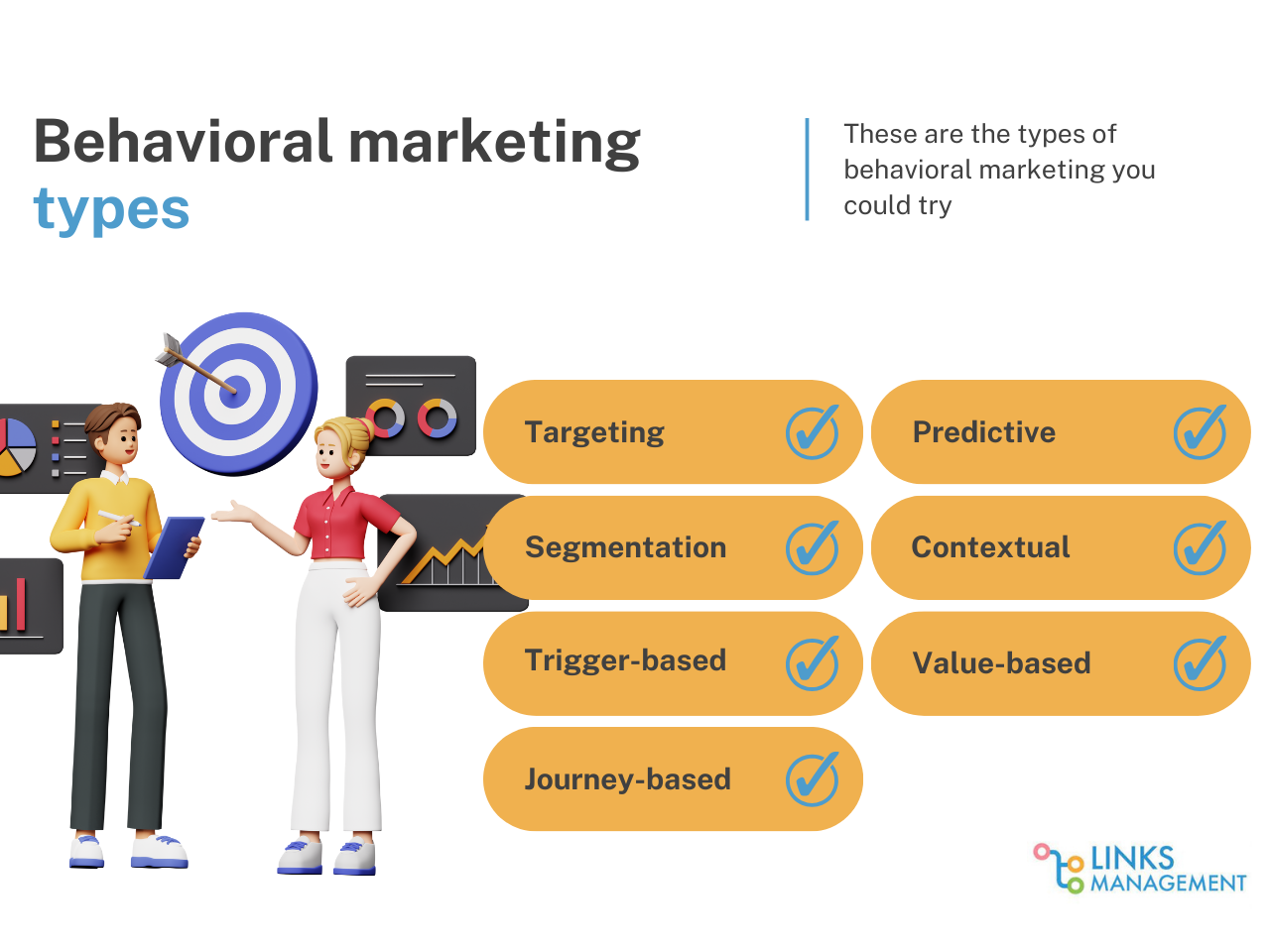
- Targeting. The obvious one. You basically show more relevant content based on users’ past actions.
- Segmentation. Instead of reaching everyone with the same message, you split your users into segments based on their common behaviors.
- Trigger-based. If your goal is high ROI, you’ll use this one a lot, since it’s often the nudge people need to finish their purchase, get more products, etc.
- Journey-based. This refers to messaging tailored to each stage of the buyer’s journey.
- Predictive. Based on the consumer data you have, you’re trying to analyze the patterns and predict what to expect from each user based on their actions.
- Contextual. Instead of only relying on actions, you also consider context (location, time of day, etc.).
- Value-based. This won’t be necessary for every business out there. But if you have very different client values, you might want to prioritize high-LTV buyers, for example.
Which type should you pick?
This will depend on your case, as all of them can work. The only difference is your objectives and how you plan on implementing behavioral marketing in general. And yes, of course, you can combine them.
Behavioral marketing examples
The number of times we’ve been faced with this type of marketing as consumers is actually uncountable. But it’s often quite invisible to non-marketers.
Most people are using big platforms like Netflix or Amazon without really understanding that what they see is sort of biased (aka targeted). Most of it is actually the result of companies analyzing our actions.
Now, let’s see some of the popular examples in detail.
Netflix
Let’s start with one of the most common ones. You might rate a show highly on Netflix, but Netflix doesn’t consider that only when recommending the next one. What it really looks at is:
- Did you finish the episode?
- Did you binge the next one?
- Did you abandon it halfway through episode three?
- Did you come back a week later?
Those are strong predictors of retention. And they are definitely stronger than, say, the preferences you shared with them.
Netflix even personalizes how the same title is visually and contextually framed. This includes:
- Different artwork (thumbnails) for the same show or movie,
- Emphasizing different characters in the artwork,
- Highlighting different genres or emotional hooks,
- Testing which visual framing increases click-through and completion.
Crazy, if you think about it.
Moreover, Netflix never offers a price for its subscription in isolation. There’s always a comparison. That’s also why most businesses do the same.
If they just offered one premium plan at $24.99, they’d lose a big chunk of their customers. But if they had, say, seven options, this would also confuse users. So, it’s always important to stick to the “sweet spot.”
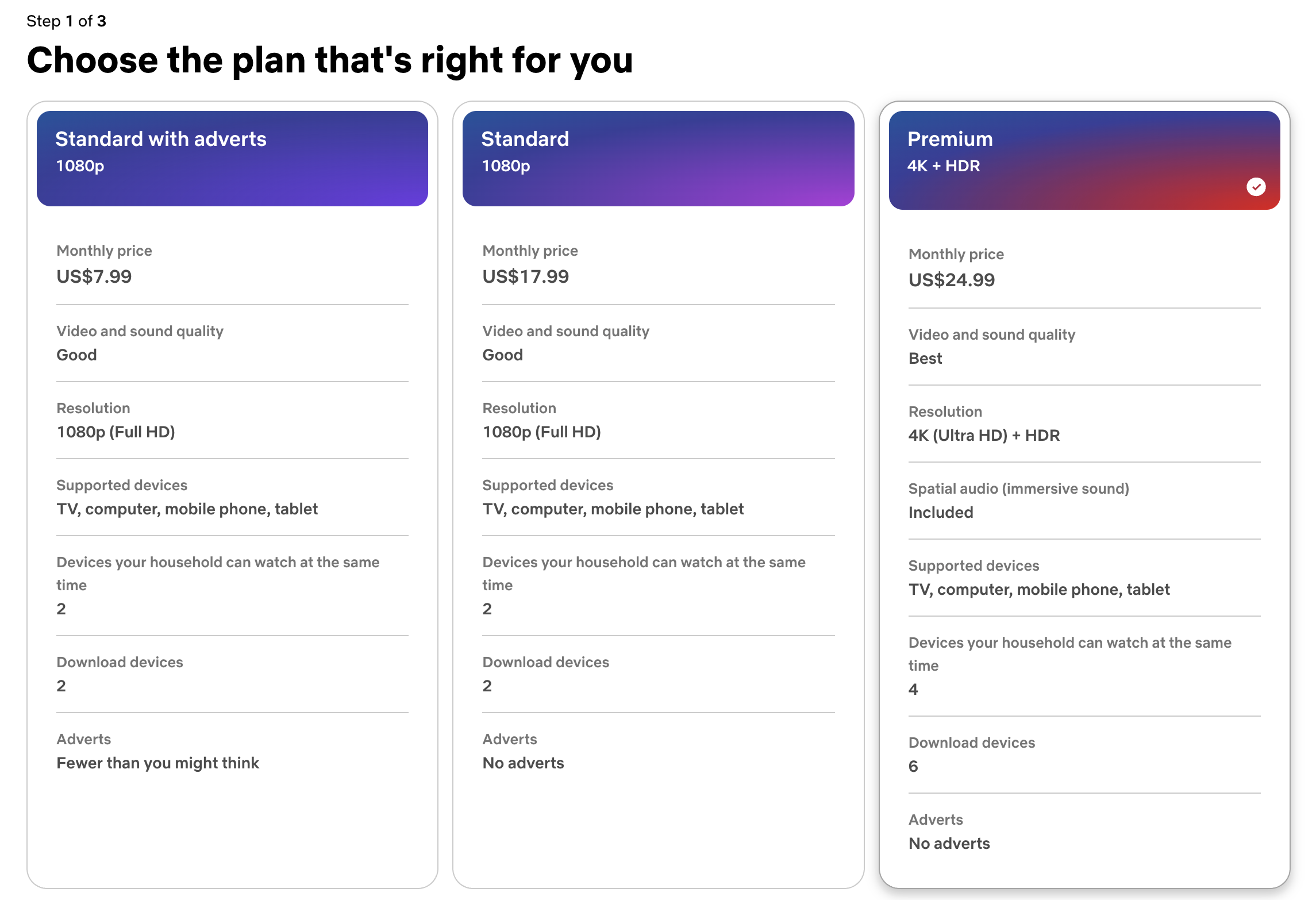
Source: Netflix
Essentially, most of the marketing tactics Netflix uses are based on user behavior. They are well aware of how people perceive the brand and each show they have to offer. And this is one of their main secrets, at the end of the day.
Booking
Most urgent marketing is fake. And most people know about it.
Booking.com is one of the few cases where urgency works in the long term because it’s tied to real market behavior.
Do you know how Booking shows that only “1 room left at this price” or that a certain number of people are viewing the property you have your eye on?

Source: Booking
That message is not global; it is definitely contextual. It only appears when:
- Demand is actually high,
- Inventory is genuinely constrained,
- The user has already shown interest (multiple views, filters applied, date checks, etc.).
In other words, urgency is not another marketing campaign that is supposed to convince people. No, it’s the response to a very particular situation.
They are also using the right trigger words at the right time. While those are extremely simple, humans are humans. And we tend to react to some phrases more than others. Just something to keep in mind.
They are also being quite honest. They don’t try to make it look like you will be left with no place to stay. So, you’ll also see messages that there are still 3 (or even 7) rooms left.
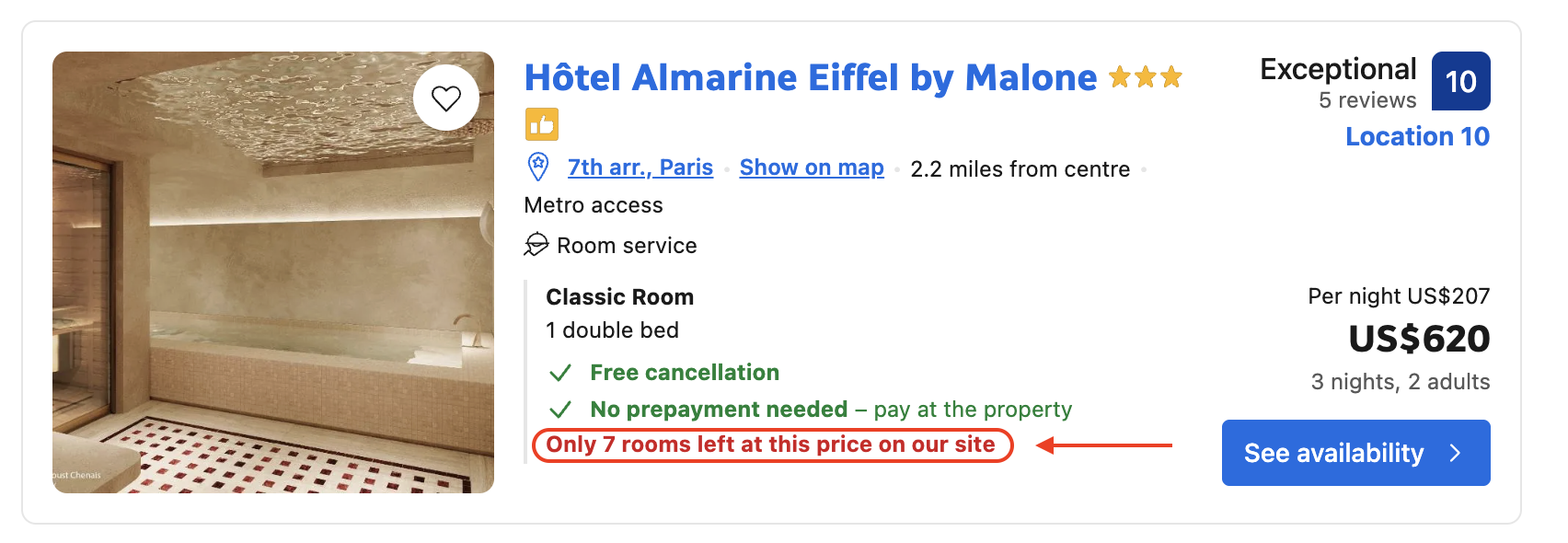
Source: Booking
Abandoned carts done right (and wrong)
Pretty much every e-commerce store sends abandoned cart emails: that’s one of the most popular trigger-based marketing approaches.
However, there is a difference between good and bad execution. It typically lies in the intent.
Bad version would be:
- One email where you describe everything with a generic copy, and give a discount immediately.
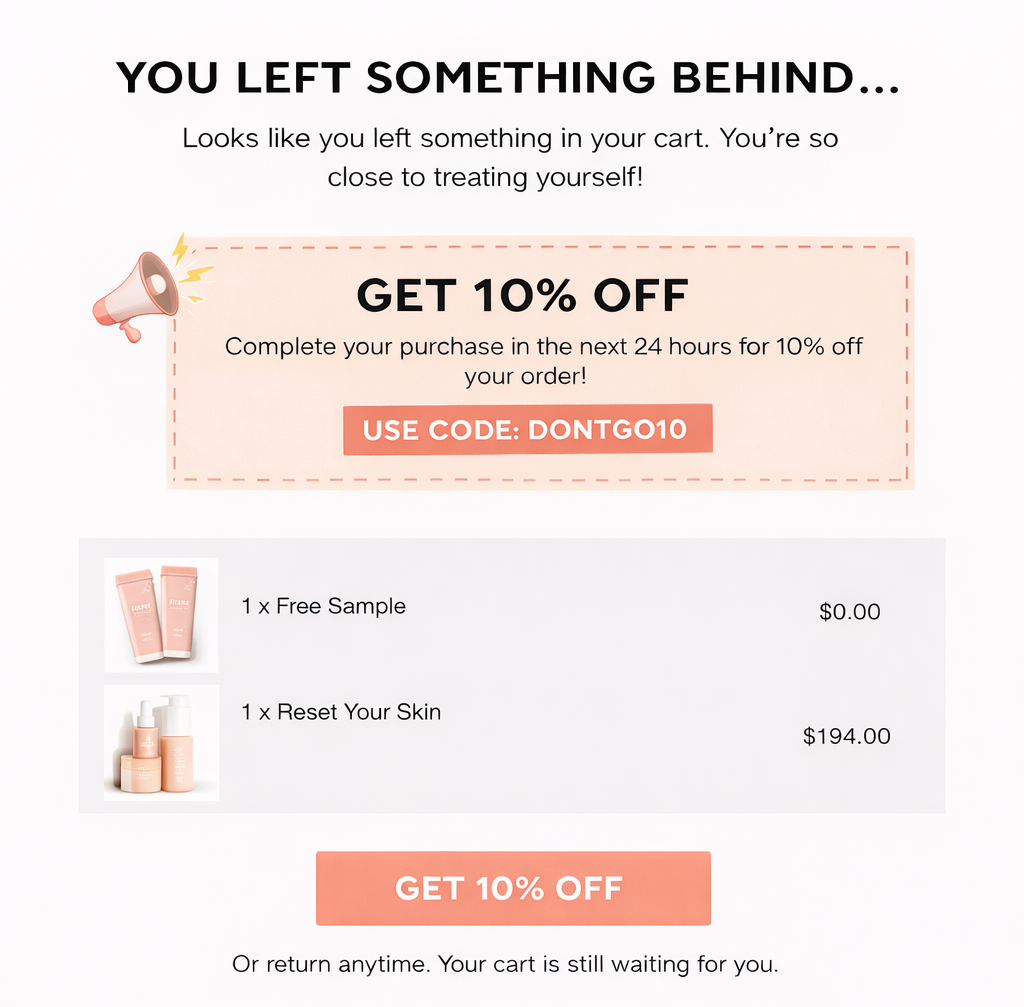
The good version is very different and more complex:
That message is not global; it is definitely contextual. It only appears when:
- First email: reminder only, maybe that would be enough for some users to come back.
- Second interaction: social proof or reassurance (you can mention shipping or sizing).
- Third comes with a special offer: Only here will you send an incentive. And not for everyone. It should only apply to the users who historically need one.
This sequence alone can double the profitability of cart recovery. Because you don’t just bluntly give discounts to everyone right away. Instead, you build a smarter way to incentivize different users.
The foundations of a high-ROI behavioral marketing strategy
The first five steps we are about to cover here are all about preparation. At first, we are building the foundation you will later use to actually implement a strategy that drives high ROI.
Step 1: Define your success
ROI sounds like a universal concept until… you try to apply it.
In theory, ROI is money in versus money out. In practice, marketing ROI depends entirely on how your business makes money and when it makes it.
- A subscription business cares about very different signals than a one-off e-commerce store.
- A marketplace thinks in liquidity and repeat usage.
- A B2B company might care more about sales velocity than immediate sales.
Many teams say their goal is “revenue,” and yet they optimize for some “sort of related things” (like click-through rate, engagement, leads, etc.). But all that is just incomplete.
Behavioral marketing forces you to pick a lane.
You have to decide which outcomes actually justify your marketing efforts. Is it the first purchase? Or maybe a shorter sales cycle? Higher lifetime value? Or something else?
There’s no correct answer, but there is definitely a dangerous one. It is pretending all of them matter equally.
But you know how it goes: once everything matters, nothing does.
Defining success, ultimately, means being explicit about which actions are worth paying attention to in your business. That definition becomes the filter for every idea that follows.
Step 2: Map the customer journey into clear stages
You might already have noticed that people (almost) never progress through the stages as they were designed (by the book). Most often, it gets really, really messy: they circle, pause, disappear. They come back through different channels with different intent.
This whole thing only starts working when you stop believing that the journey can be linear. This works the same for both B2B and B2C.
So, the main idea of this step is to observe a difference in user actions and map them all to a corresponding stage of the customer journey.
This will later help you to:
- See clearer patterns (of course),
- Know what content, additional materials, etc., each person needs,
- Understand how you can retarget each user (if needed), and so on.
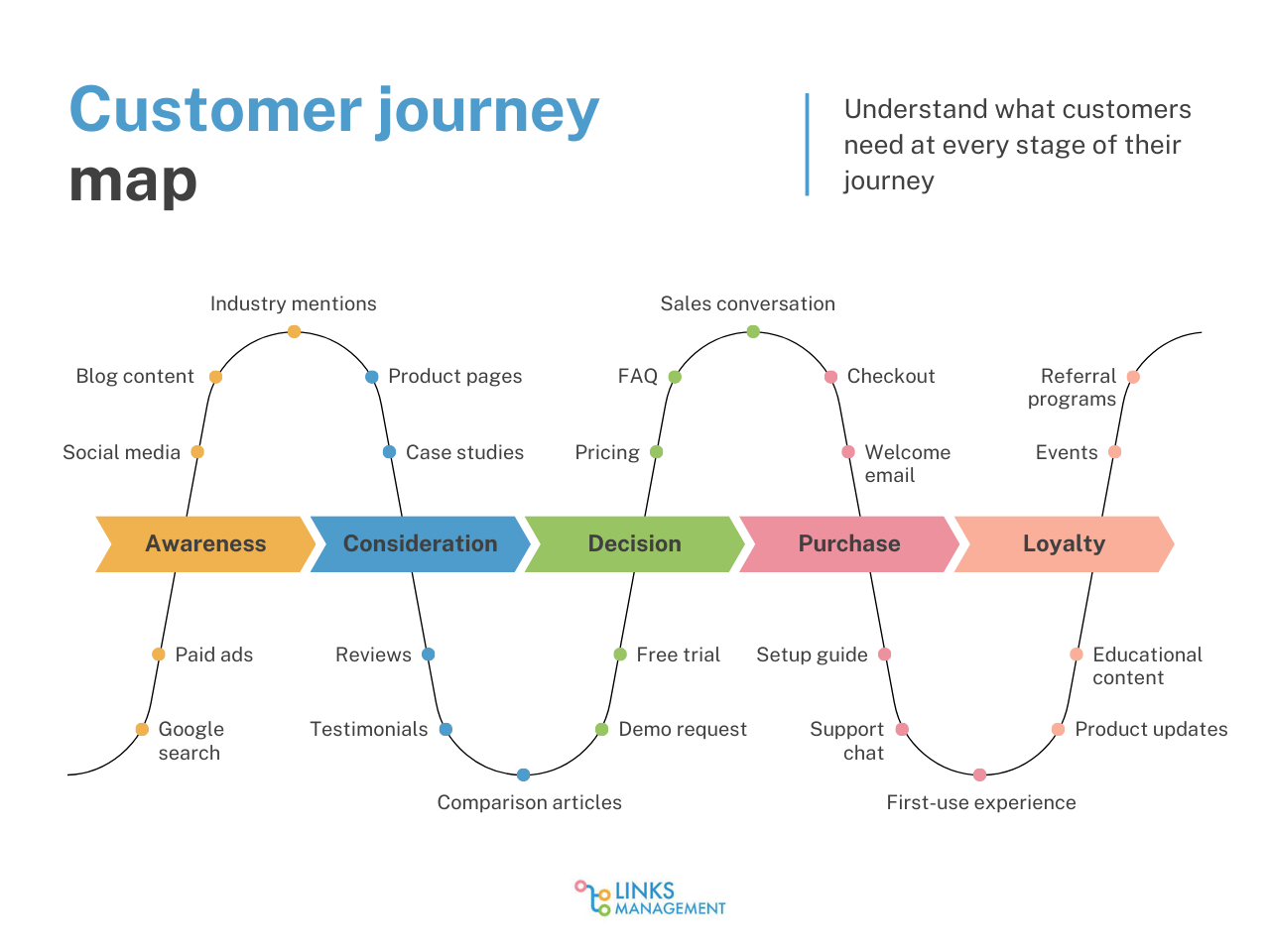
Later, all this information will become the backbone of your behavioral segmentation. Besides, it will help you a lot with refining your messaging and all the content you offer to your leads and clients at every stage.
Step 3: Understand revenue-moving actions
Every user generates some behavioral data. And even though most of it feels important, very little of it predicts the actual high ROI.
So, your job here is to be ruthless (at least a bit:).
You don’t need to be looking for actions that look good. What you need is to spot actions that consistently show up before something valuable happens.
For example, this could be a certain combination of browsing history and time gaps or something else.
The exact actions vary widely by business. But what matters is the discipline of asking the same question over and over: “When users do this, what usually happens next?”
If the answer is “nothing,” that action doesn’t deserve any behavioral marketing efforts from your side, no matter how interesting it looks. Your main task is not to get lost in this kaleidoscope of data. But instead, understand what actually matters for real, tangible results.
As much as possible, focus on a small set of actions that correlate with purchases, upgrades, long-term customer loyalty, and other truly important things for ROI.
Step 4: Create a behavior score to rank users
At some point, marketing forces you to stop treating users as a crowd.
Nope, we’re not yet in the “unethical” part that we promised to explain. And yet ranking users feels… it just doesn’t feel right. For many companies or marketing teams, admitting out loud that some users are more important than others feels off.
Still, in marketing terms, it is obviously true, but we still like to pretend it is not.
You’re answering a simple question: “Based on what this person has done so far, how likely are they to generate value for our business?”
Most of us already do this informally anyway. Like when you instinctively decide who deserves follow-up and who doesn’t. And a behavior score just makes that logic explicit and scalable.
When you do that, you will know who deserves attention right now and who is your real target audience.
The scorecard below is just an example. You can add as many relevant behaviors as you see fit for your particular case. As for the score, assign it based on the actual value of each action and how they compare to one another.
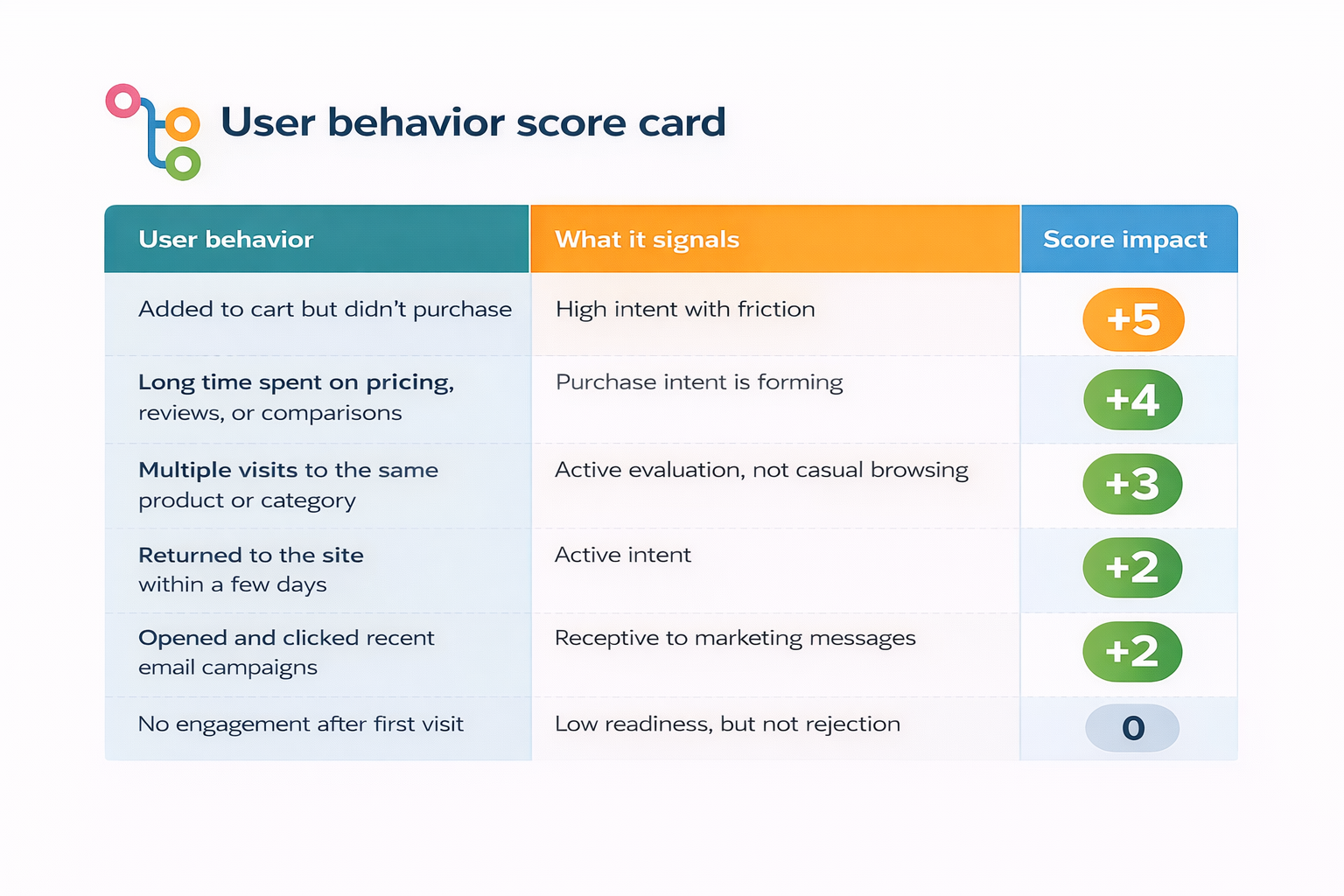
That shift itself improves ROI, because your marketing efforts are no longer spread evenly (and thin). They are concentrated where they have the highest probability of payoff.
There’s also a second benefit most people don’t talk about: a behavior score gives you permission to leave people alone.
You might giggle at this. But look, low-score users aren’t bad users. It’s just… they’re not your target customers. So, do you actually need to force messages on them? Of course, no. It’s much better to save time and energy and just let people do what they do.
While it doesn’t seem that way, this can actually improve your customer experience and long-term brand perception. Because you stop being… annoying, which can’t be bad.
Essentially, this lets you know when not to push at all.
Step 5: Find your core revenue segments and focus on them
Once users are ranked, a pattern usually becomes obvious very quickly.
Quite often, a small group of your users can drive a big part of your revenue. And it goes without saying: they usually also convert faster. This is not some big news, and surely every business knows this (at least on some level).
And that’s the segment you should be working with more. Yet, for many companies, it is uncomfortable to act on it. Because focusing on core revenue segments means:
- Accepting that not every user deserves equal marketing effort.
- Shifting resources away from “potential customers” who look good on paper.
- Looking more toward users whose way of acting has already proven something.
For some marketers, it is also about losing opportunities to find more customers, which, at this point, you might not even need. All in all, it could be tough for some.
Behavioral segmentation helps here because it cuts through optimism. And it shows that optimism might not be really justified. Essentially, instead of segmenting by who people are, you segment by what they’ve done. And this helps you clearly see the client segment to focus on.
Execution stage
This is the action stage, where everything we prepared so far has to be put into action. So, make sure you come well prepared for this part of the journey.
This is where your marketing either becomes a growth system or collapses into a pile of “interesting experiments.” Why? Because the same data, segments, and tools can lead to completely different outcomes.
The danger at this stage is, surprisingly, the abundance of ideas. Yep, not the lack of them.
Once teams start thinking in terms of behavioral segments, triggers, customer journey stages, and targeted messaging, ideas multiply. Very fast, actually! Everyone suddenly has a reason why their campaign makes sense. And on paper, most of them do.
But what you really need here is to breeze. And protect your marketing from all the unnecessary chaos. This is what the following steps will help you with.
Step 6: Do an ROI sanity check for all ideas
…and be okay with killing good ones from time to time. We mean it.
Every marketing team has ideas they love and ideas they tolerate. The problem is that affection and ROI rarely correlate.
Behavioral marketing makes it easier to generate campaign ideas, but it also makes it easier to rationalize them:
- “This targets a segment.”
- “This is personalized.”
- “This is triggered by user activity.”
All of that can be true and still… have absolutely nothing to do with the financial outcome.
The sanity check exists to answer one uncomfortable question: “If this works exactly as planned, does it bring us closer to the outcome we defined earlier?”
Not indirectly or eventually, and not in a slide-deck sense. You always have to think about how your efforts produce revenue, reduce loss, increase lifetime value, etc.
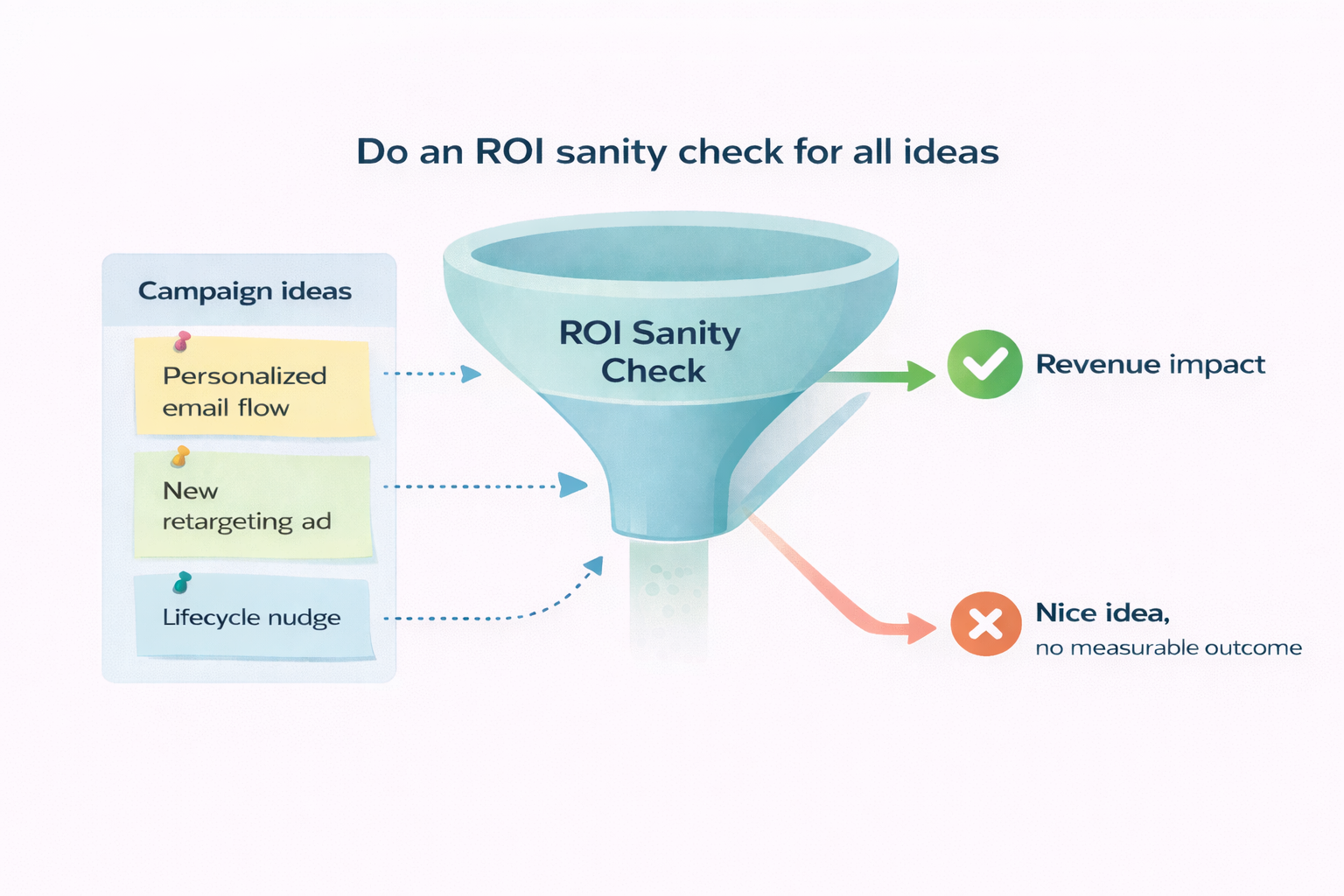
If you can’t draw a reasonably straight line between the campaign and a business outcome, you don’t have a working behavioral marketing strategy. You have a hypothesis that happens to use behavioral data.
This doesn’t mean every campaign must directly generate money.
Some things exist to support trust, educate, make your brand more visible, or contribute to long-term positioning. That’s fine, but as long as you know that’s what you’re doing.
But likely, if you’re reading this guide, your main goal is ROI. So, if you mix “nice-to-have” initiatives with revenue-critical ones without distinction, you’ll never understand what’s actually working.
Your strategy becomes more powerful when you separate:
- Campaigns designed to generate revenue,
- Campaigns designed to support the system.
Both can coexist, that’s true. They just can’t be treated the same way.
Step 7: Create a repeatable campaign structure
This is the point where many teams sabotage themselves. Not on purpose, though.
They’ve done the hard thinking (well done, you). They understand their behavioral segments, know which actions matter, and even understand how to filter ideas through an ROI lens.
And then, when it’s time to launch, everything becomes… bespoke.
- Every campaign is a “special case.”
- Every segment gets a custom flow.
- The idea becomes a mini-project.
It feels creative, right? But what’s more important (in a bad way), it also kills consistency.
A repeatable campaign structure should reduce decision fatigue. You’re essentially creating a skeleton you can hang ideas on, but definitely not a script.
At its core, a campaign structure answers the same few questions every time:
- Who is this for?
- What action triggered it?
- What decision are we trying to influence right now?
- What happens next if the user does nothing?
If you can’t answer those questions quickly, the campaign should be in the oven for a bit longer. And when something underperforms, you know where to look for the reason because the structure is familiar.
Step 8: Test your ideas for each segment
Every team loves testing, but also hates restraint.
The thing is, often, your marketing doesn’t need more tests. What it needs are better and cleaner ones.
When you test, you’re not trying to prove that an idea is “good.” You’re trying to understand why something works for one segment and fails for another.
That can only happen when you isolate your variables:
- One segment,
- One behavioral trigger,
- One channel.
Anything more than that, and you’re learning everything, but not the patterns you actually need.
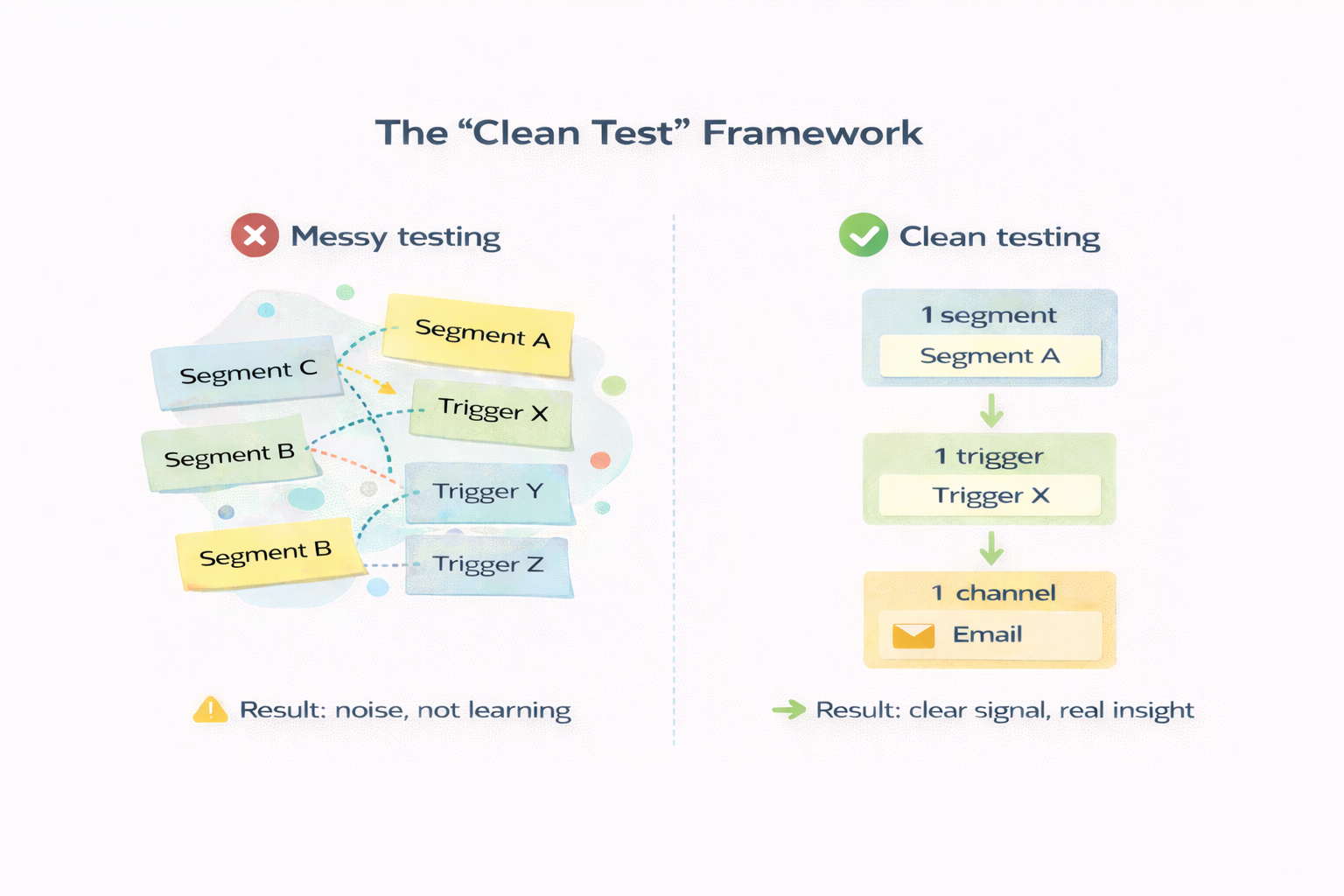
This feels slow at first, especially for teams used to delivering constantly. But it compounds. Clean tests give you clean signals and help to build confidence. And confidence reduces unnecessary experimentation.
There’s also a psychological shift here:
- You stop asking: “Did this campaign work?”
- But you start asking, “Did this outperform what we already had for this specific segment?”
That’s a much higher bar, and a much more useful one. Testing in behavioral marketing is all about slow improvements.
Step 9: Double down (or not)
Once something (or everything) you put your efforts into starts to work, you want to scale. That’s inevitable and great.
But this is also where many teams make their next mistake. And that’s a big one. You can’t actually blame them, because at this point, you want to progress even more. You feel like, “If this worked, then we should also try something new.”
Partly, the whole marketing culture we all exist in is to blame for this. But let’s get back to the problem.
When we should be protecting what works, we rush to replace it.
New ideas start piling up, and everyone wants to “improve” things. The baseline that took weeks (or months) to establish gets destroyed in the name of progress.
But do you really need more progress at this point?
Look, scaling marketing means one thing: learning how far you can push what already works. And you don’t have to break it or improve it just because it’s a new quarter or a new year.
Sometimes, you just need to let things work while they’re working.
Once you have a control version for a specific behavioral segment, your job changes:
- You’re no longer trying to prove that your approach works, but to understand why this version does.
- It’s a good moment to analyze which parts of it are fragile and can require some polishing and testing.
- Here, focus on paying attention to small details.
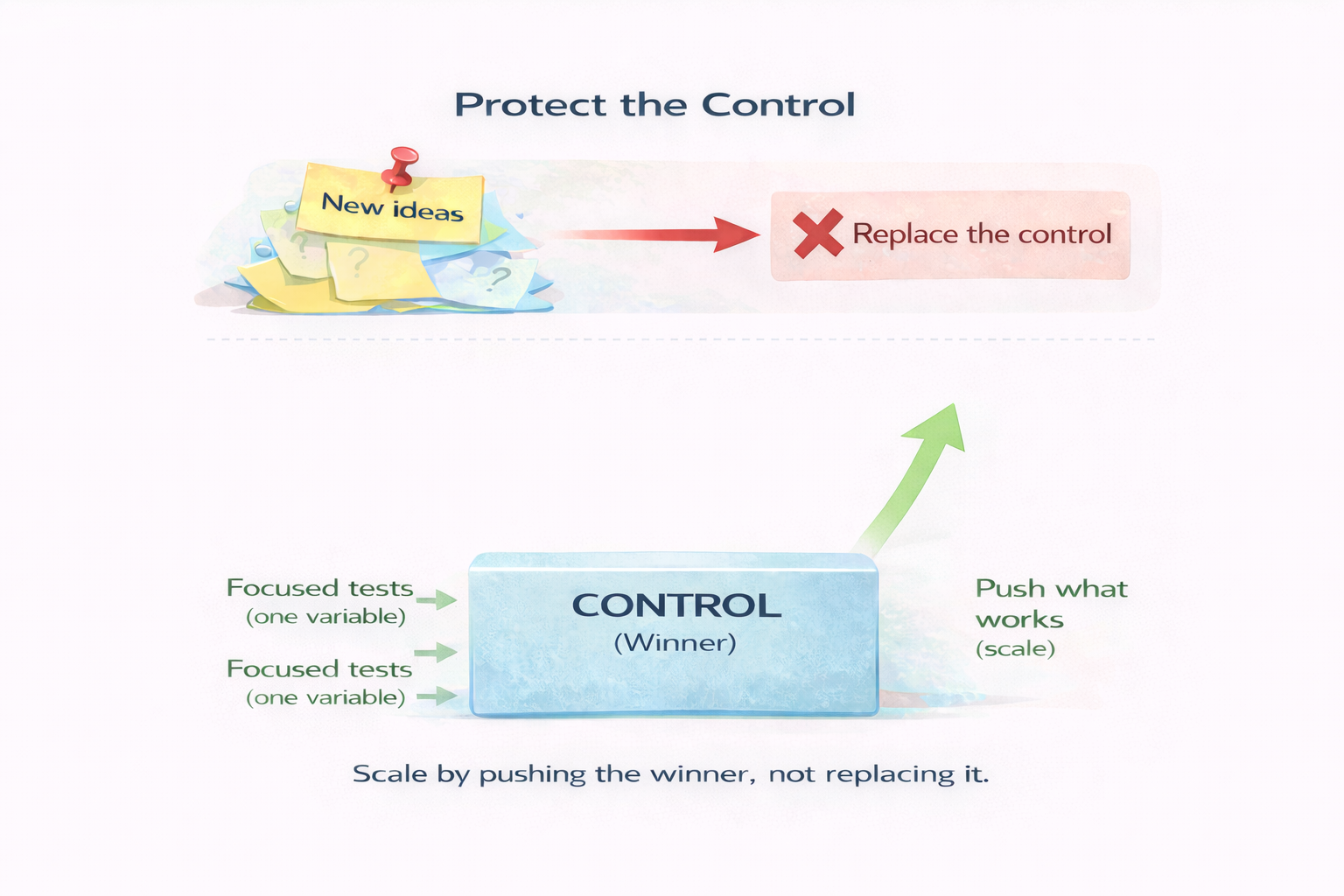
So, scaling doesn’t always mean adding more elements. It might even harm your campaign. Sometimes, some elements have to be removed in order to improve performance.
Here is a rough strategy you can use:
- First, focus on creating extremely strong control. The better it is, the more effective your marketing campaigns will be.
- Next, stop random experimentation and channel creativity into problem-solving. Do everything to improve your current control.
- Finally, run more focused tests to come up with a stronger control and shift from asking “What else can we try?” to “What’s limiting this version right now?”
- In parallel, you can try different approaches to create controls for other segments, goals, etc. But avoid throwing away what already works in the name of experimentation.
Scaling also means knowing when NOT to scale.
But some campaigns can exhaust themselves quickly, and they simply don’t need to be scaled. If your product messaging works for a certain period of time, it doesn’t mean it will be like that forever. Sometimes, you also have to let it go.
Step 10: Document your findings
It might sound too “X-filish”, but in a few months, you will thank yourself for taking the time to actually write down what worked.
Your team might change, and people who are the core of the whole process might not be there. Therefore, recreating frameworks that actually worked can be hard. Unless you have it all documented.
In that case, you will know the exact formula to create successful campaigns in the future.
As for the format, anything can work, from a Google Doc to a Notion board.
Why ethics are more important than you think for ROI
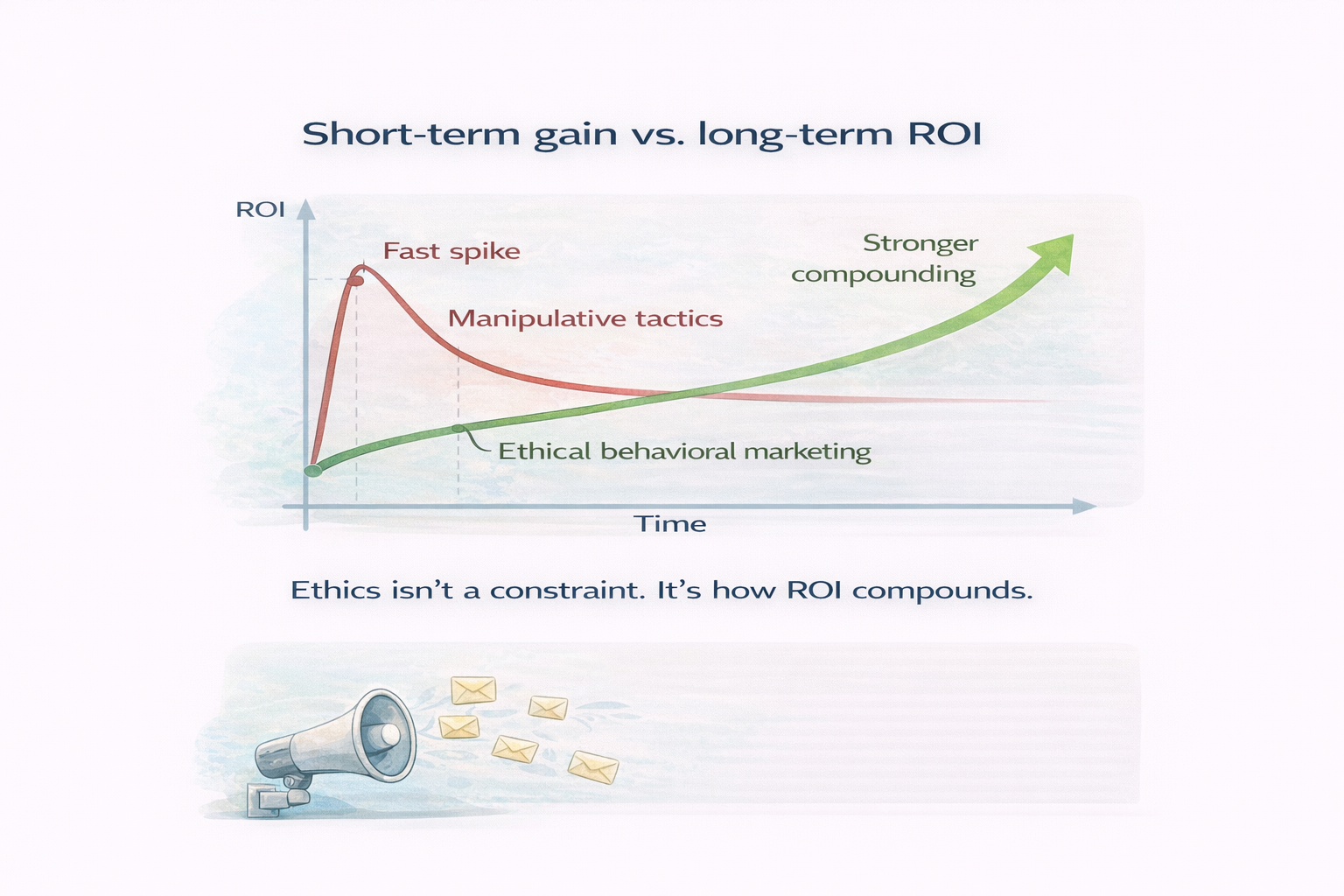
Behavioral marketing has a reputation problem. Not because it doesn’t work (it obviously does). Just because when it’s done wrong, it might feel manipulative.
Unethical behavioral marketing usually looks like this:
- Using every available behavioral data point because “we have it.”
- Overusing triggers across email marketing, targeted ads, and social media platforms.
- Treating user behavior as permission (when it really should be just a signal).
- Optimizing for clicks and completely forgetting about customer experience.
Yes, this can boost conversion rates in the short term. Yes, it can increase sales this quarter. Yes, it can bring you some positive outcomes (sort of).
But what it also does is:
- Increase unsubscribe rates.
- Reduce user engagement over time.
- Train customers to ignore your marketing messages.
- Lower customer satisfaction and, most importantly, trust.
And once trust erodes, every future campaign will be harder for you and more expensive.
You don’t need higher frequency, bigger incentives, your customers’ full search history, or more aggressive tactics. These are the things that are actively hurting your ROI. And some might even lead to legal issues.
Ethics, in this context, means an incredibly simple thing: protecting the long-term value of your customer data. It is something that people appreciate and expect from a company that they are buying from.
Today, it is the true foundation of your relationship with customers.
You can easily check whether your strategy is ethical. Ask yourself: “Is this message helping the customer make a better decision or pushing them into a faster (and more traumatic) one?”
That distinction really, really matters.
Using customer behavior data to recommend relevant content, suggest products based on purchase history, nudge them at the right customer journey stage, and generally seem nice, not fishy… that’s ethical and effective.
But using behavioral targeting to:
- Manufacture false urgency,
- Exploit anxiety or insecurity,
- Follow users obsessively across digital marketing channels
… is very far from being ethical.
The irony is that the second approach often performs worse over time, even though it looks “smarter” on dashboards.
Customers may not understand your behavioral marketing automation logic, but they will definitely feel when something is off. And as you understand yourself, they won’t stay too long after that.
Conclusion
Behavior-based marketing is something that can help you understand your people and give them exactly what they need at any given time. Isn’t this what every business dreams of?
If you do everything right, you might end up with an actual high ROI mechanism that will work for a very long time. Follow this guide and don’t forget to adjust every step to your unique niche or market.
FAQ
Why does behavioral marketing work?
It works because it is based on real data and actual users’ actions. These reveal customer preferences way more vividly than any surveys. That’s why it is so effective.
What are the most effective behavioral marketing tactics?
There are many tactics that work well for one company but turn out much less efficient for other businesses. So, you have to test a lot to understand what makes sense for you.
Overall, the most effective strategies include:
- Behavioral marketing segmentation based on customer journey stages,
- Targeted messaging triggered by high-intent actions,
- Product suggestions based on purchase history,
- Retargeting strategies focused on intent,
- Email marketing campaigns driven by purchase behavior.
What are the benefits of behavioral marketing?
Behavioral marketing, when done right, leads to a better understanding of your target consumers, higher customer satisfaction, better user experience and engagement, and higher ROI.
The key is to remember that it has to be ethical in order to work in the long run.
Related Posts

Published Aug 26, 2025

Last updated May 8, 2025 | Published Apr 22, 2025

Published May 27, 2025

Published Dec 9, 2025

Published Jun 17, 2025
Published Jun 10, 2025
Enter URL & See What We Can Do Submit the form to get a detailed report, based on the comprehensive seo analysis.