How to Find and Hire a Digital Marketing Agency You Can Actually Trust
There comes a moment in every business when you look at your marketing efforts and think, “Okay… something’s not really right.”
Sooner or later, you’ll catch yourself thinking: “Should I hire a marketing agency?”

This thought usually arrives right after one of three events:
- You see a competitor explode online.
- You try running your own campaigns, but they just waste your budget without bringing any quality leads in.
- Your CEO asks why your “simple marketing activities” are taking 47 hours a week.
Here’s the thing, though: most businesses don’t actually know what they’re hiring an agency for.
Often, when we think of “digital marketing,” we get some blurry, half-formed ideas. Some companies want better landing pages. Others paid ads that don’t set their money on fire. And some… just want someone else to deal with the stress.
That’s why so many companies end up with the wrong agency partner.
Well, can you really blame any business out there? Once you type “marketing agency” in Google search, you’ll get thousands of colorful promises. All these choices are truly overwhelming. But when you know exactly what you need, it gets easier.
So, let’s fix all that confusion once and for all and explore when you really need to hire a digital marketing agency and how to find it.
Contents
- Decide if You Even Need to Hire a Marketing Firm?
- Agency vs. Freelancers vs. In-House vs. Hybrid
- Where Can You Find Some Good Options?
- How to Hire a Marketing Agency in 11 Steps
- Step 1: Review your current marketing and define your goals
- Step 2: Look for trust signs during your agency selection process
- Step 3: Understand their pricing and model
- Step 4: Make the first contact and check how they respond
- Step 5: Prep for the intro call to ask the right questions
- Step 6: Analyze what they say during your call
- Step 7: Review proposals and contracts in detail
- Step 8: Check whether it’s a good marketing agency with a pilot test
- Step 9: Prioritize quality onboarding
- Step 10: Protect the partnership with detailed feedback
- Step 11: Know when to walk away
Decide if You Even Need to Hire a Marketing Firm?
Look, not every business needs to outsource marketing in the first place.
And unfortunately, you won’t solve every problem you have with an external team. After all, a marketing agency is not a magic button that fixes every weakness in your marketing strategy and makes you more visible than ever.
But it is definitely a great solution for several specific situations.
Which ones? Let’s see:
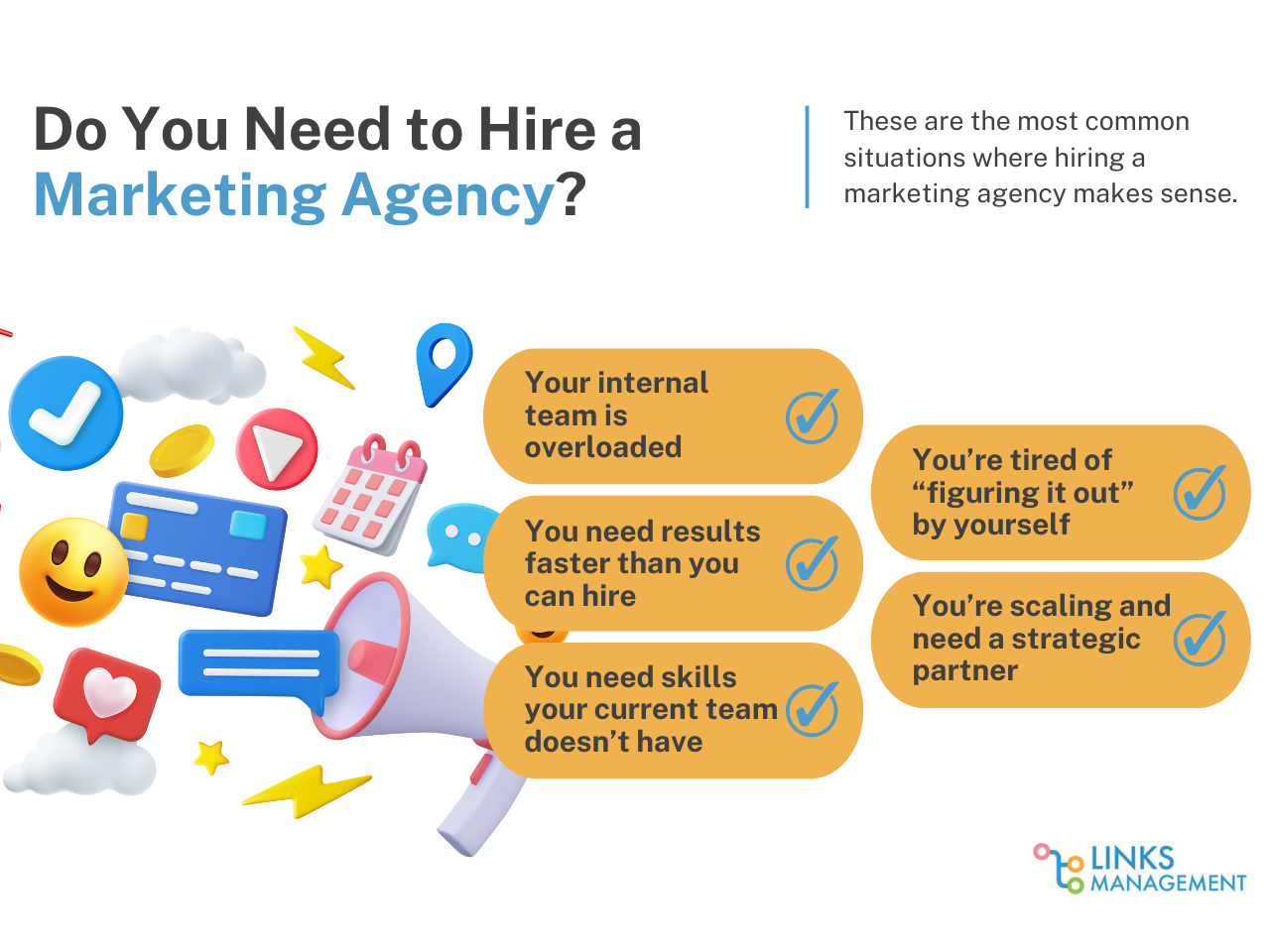
Your internal team is overloaded
If you only have one or a couple of marketers on your team, they physically can’t handle everything.
So, if you want to create an omnichannel strategy with content operations, social media marketing, paid ads, web design, and proper funnels, you need a whole team.
And this is where a digital marketing agency can be extremely helpful. And often outsourcing one is much more cost-effective than building a full in-house team.
Besides, you can scale up or down at any time.
You need results faster than you can hire
Good marketers are not cheap, and finding the right talent takes months. Sometimes, even more than that.
But if you need more traffic or a successful campaign in the next quarter, the right marketing agency can give you an entire team next week.
Sure, it also takes time to find the right firm. Still, it’s a bit easier with all the customer reviews and case studies they have online. Your usual candidates won’t have it simply published on a website.
You need skills your current team doesn’t have
That’s probably the most classic example. Most companies get some external help when they “lack” something specific:
- Complete search engine optimization or technical SEO,
- Pay-per-click expertise,
- Complex advertising campaigns,
- Marketing collateral production,
- Paid advertising on multiple platforms,
- Multiple outreach experts, etc.
A full-cycle agency will have all types of specialists. But you can also find the one that focuses on your particular task, which is often even better. You’ll basically get a quick “amplification to your team”.
You’re tired of “figuring it out” by yourself
Many small businesses waste money doing DIY Google Ads, experimenting with different platforms, and trying to understand why their traffic dropped after yet another Google update.
But without proper experience, achieving great results is, well, really hard. So, sometimes, when your marketing is becoming stressful, it’s time to bring in a professional team.
That’s one of the quickest ways to make all your efforts more strategic.
You’re scaling and need a strategic partner
When you aren’t sure where your expansion will take you, you can outsource marketing before thinking about a full-scale in-house team.
A good marketing agency will provide a clear direction and a strategy to help you achieve your scaling goals.
You can make them your short-term partner or even continue working with them if the collaboration is really effective.
Agency vs. Freelancers vs. In-House vs. Hybrid
Before you commit to a marketing agency, you need to understand where it fits among other alternatives.
Agencies can be incredibly useful, that’s true. But sometimes, a freelancer or an in-house hire is actually a smarter and more cost-effective option.
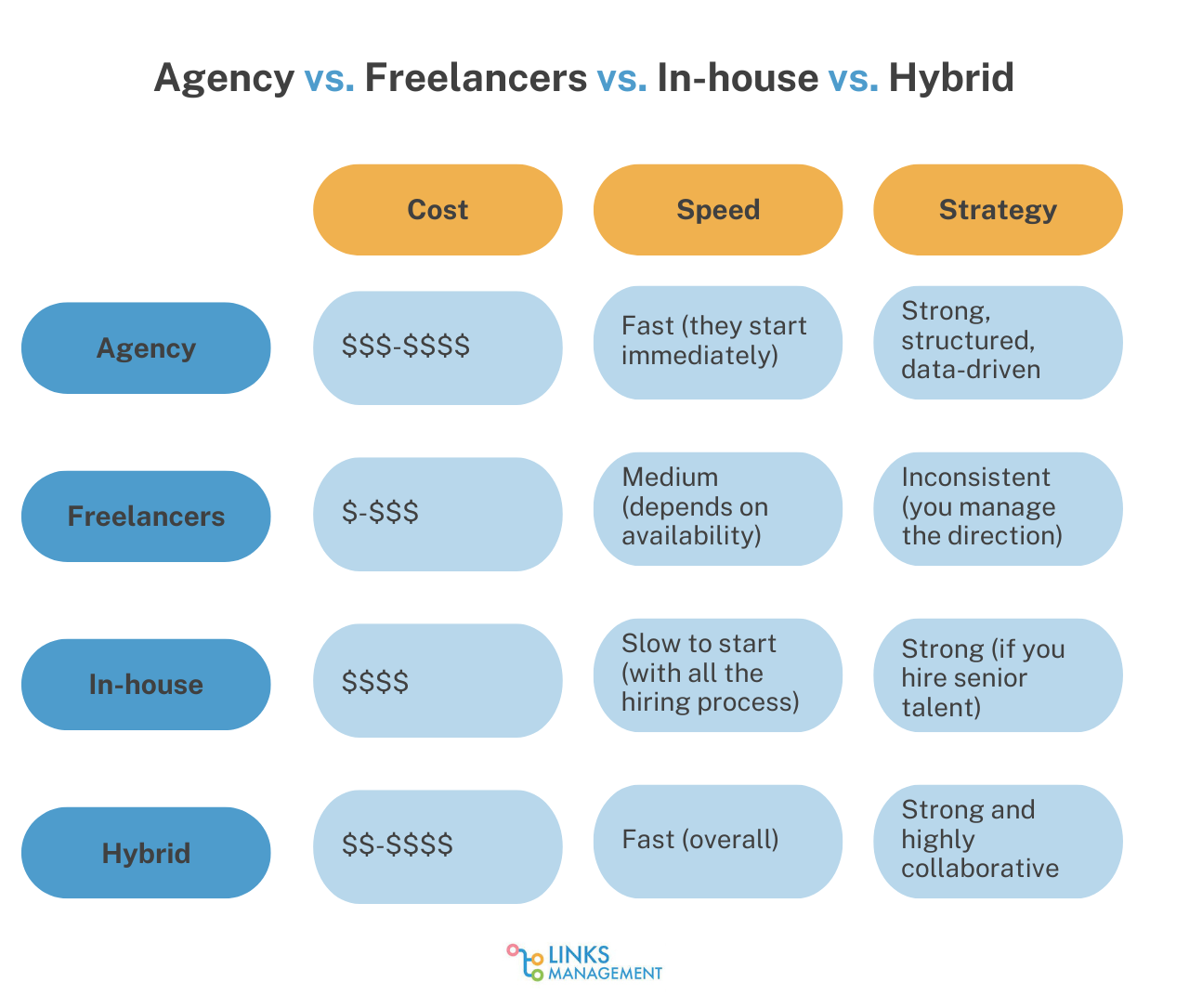
Overall, you have four main solutions when choosing who will be responsible for your marketing processes:
- Agency: This is a topic of our blog post today for a good reason. It is a very popular approach, simply because you can outsource everything without actually being too involved. But the toughest part is to find an actually good one.
- Freelancers: This is a simpler and often cheaper version of outsourcing your marketing work. Basically, you can test the waters by hiring one person to see how a particular type of marketing works for you. But often, you’ll spend more time managing freelancers.
- In-house team: Of course, ideally, we all want to hire a hyperqualified digital marketing team and cover all our needs internally. Yet, it doesn’t always work. Hunting the best talent, knowing what you need from the start, getting people in every region, and financing it all is definitely easier said than done.
- Hybrid: This one is probably one of the most popular approaches. You’d often see many businesses having someone in their in-house marketing team, but also getting a couple of freelancers here and there or hiring a PR agency on top. This is an approach that balances most pros and cons.
Now, let’s compare all these models:
Checklist: Which model should you choose?
To make things easier for you, we’ve created a checklist. Just answer “yes” or “no” to the following statements:
- We need multiple marketing services (SEO, PPC, content marketing, SMM, web, etc.).
- Our internal team is overloaded or too small.
- We need measurable results quickly.
- We need specialized skills we don’t have in-house.
- We want a cost-effective alternative to hiring multiple employees.
- We want less stress and more structure.
- We need transparent reporting and clear KPIs.
- We want to scale without rebuilding our whole marketing team.
- We have a marketing budget we can commit to for at least 3-6 months.
- Someone on our team can coordinate with the agency and handle approvals.
- We want a partner who brings a clear strategy, instead of managing multiple freelancers.
If you answer “YES” to:
- 7+ statements: An agency could be a perfect solution for you.
- 4-6 statements: The hybrid approach could work better for you. You’ll still keep control, and an agency will do some of the work. This way, you can mix and match based on your current team’s skills and workload.
- 0-3 statements: Hiring freelancers or keeping it in-house is a better solution for you. You don’t really need an agency yet, and that’s okay. You need independent specialists or a dedicated internal marketer for your specific needs.
Where Can You Find Some Good Options?
Searching for “marketing company” or “digital marketing agency” on Google basically shows you… the companies with the biggest SEO and ad budgets.
Of course, it doesn’t mean that their services aren’t good enough. Not at all.
After all, they got their rankings up, so they likely know what they’re doing. Just don’t mistake visibility for credibility.
A simple search online in Google and AI search engines helps you understand:
- How agencies describe their marketing services,
- Whether their marketing materials are high-quality and thoughtful,
- How well they explain their approach to digital marketing,
- If they offer the specific services your team needs.
Essentially, all these search results are a great first step. But don’t make it your only step. Instead, also use these approaches to find a marketing agency:
Use communities where clients share their experiences
If search shows you what agencies think about themselves, online communities show what their clients say about them.
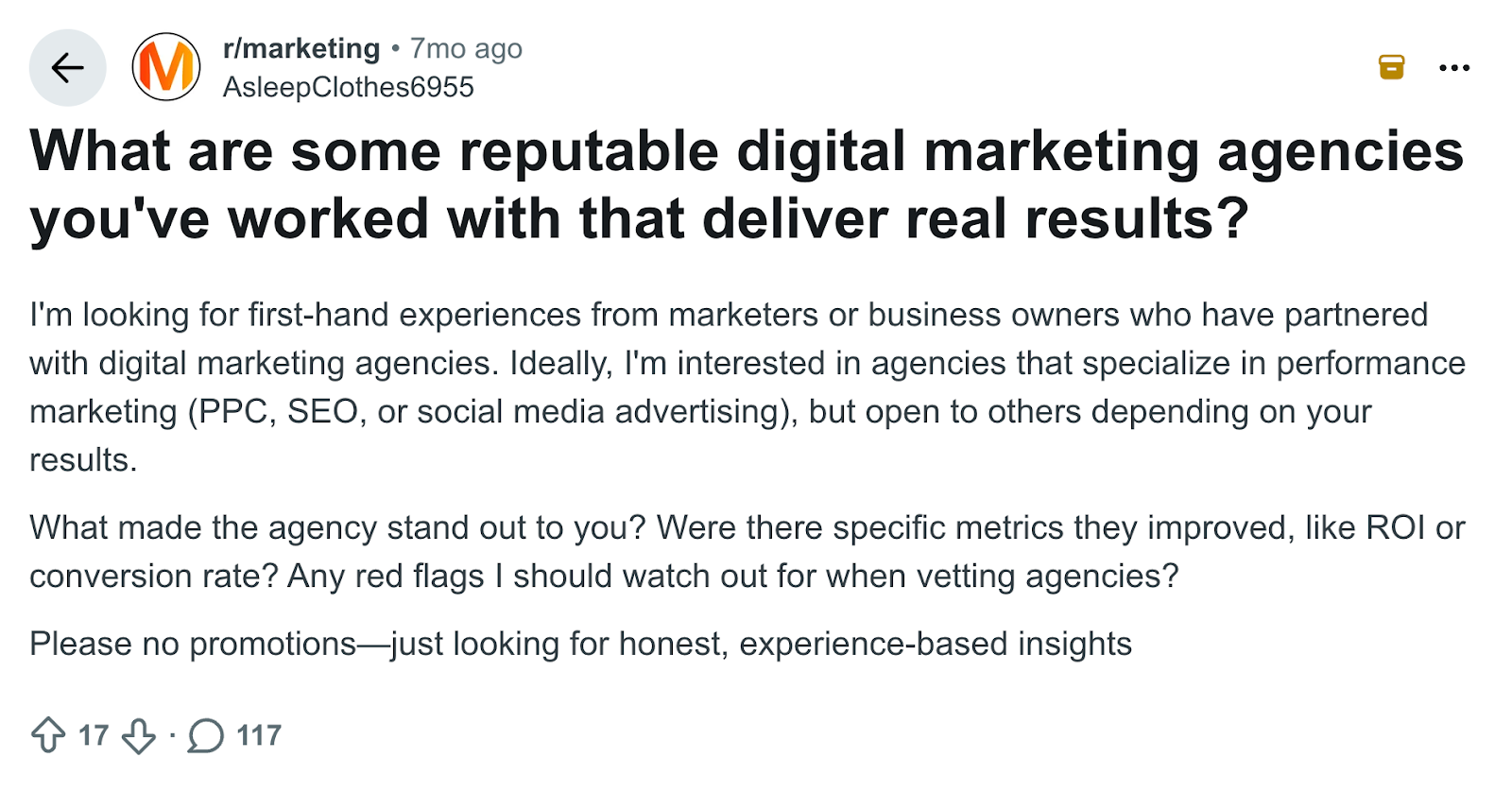
Reddit (e.g., marketing, small business, PPC, SEO, analytics, etc., subreddits), Slack groups, and professional Facebook groups work perfectly here.
Source: Reddit
All these, plus industry forums, are extremely helpful because people are being honest, especially on Reddit. They aren’t afraid to share what they really think, helping you understand which agencies:
- Delivered actual growth,
- Kept clear communication and regular meetings,
- Respected budgets and timelines,
- Struggled with high turnover or a lack of specialized skills, etc.
This is where you’ll learn the realities of working with an agency. And that’s what you need most.
Partner directories for verified specialists
Partner directories could be one of the most reliable ways to find real expertise. In every industry, you have some tools that you already use. And many of them have databases of verified partners that can deliver some related services.
Why is this something you could trust?
The thing is that big companies that create parent networks vet potential businesses before adding them. So, these agencies typically have good industry experience.
You can search through the Google Ads Partners Directory:

Source: Google
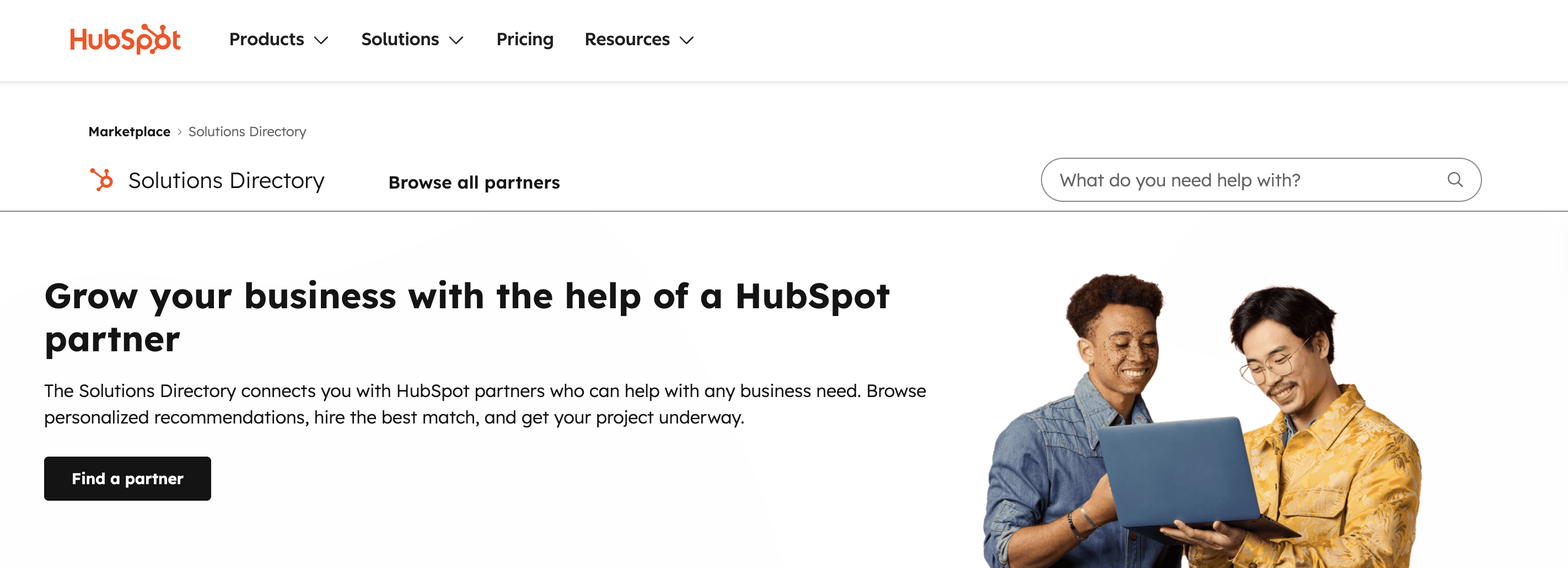
Another option is the HubSpot Solutions Directory:
Source: HubSpot
You could also try Shopify Partner Directory or any other tool you use and trust:
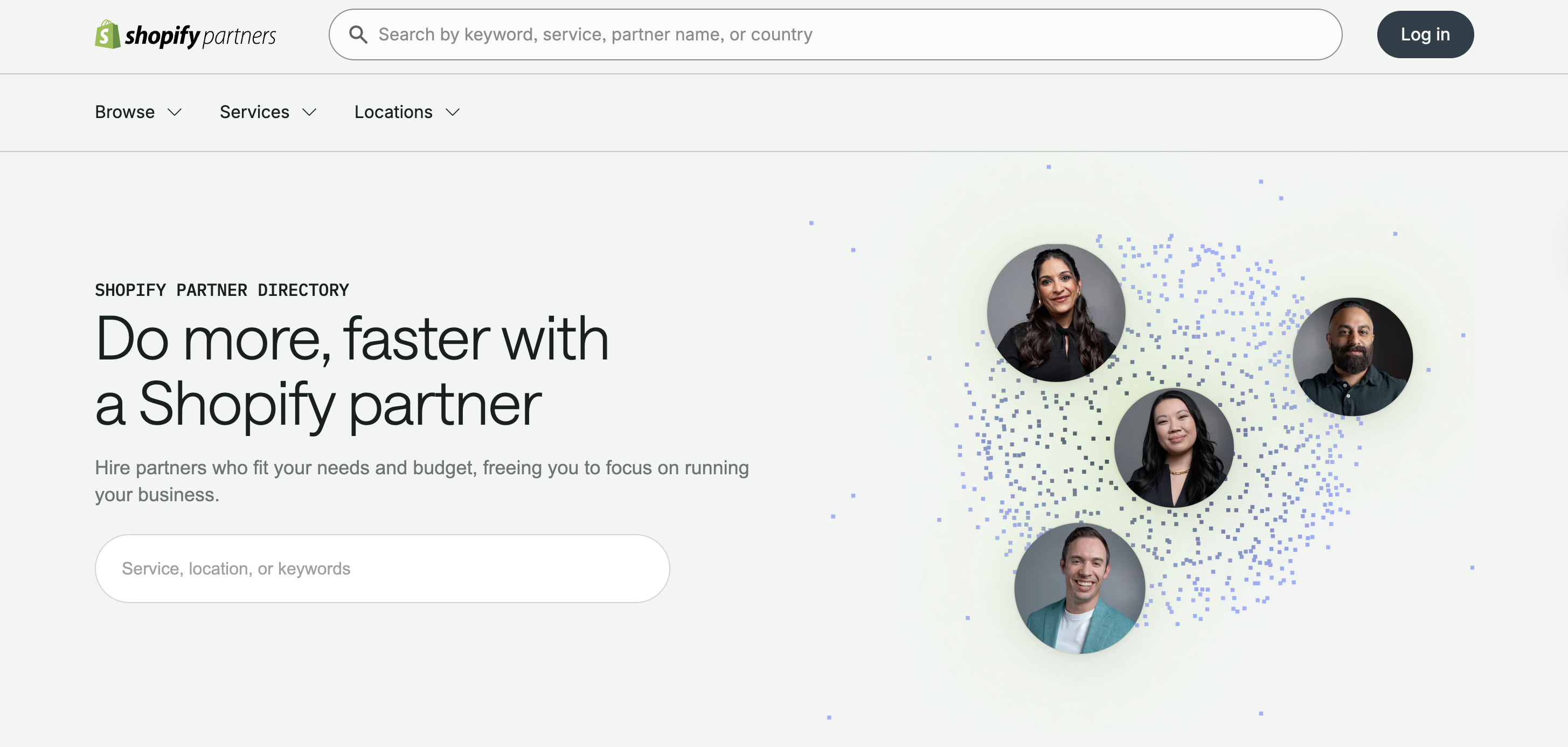
Source: Shopify
Industry review sites
Clutch, G2, and Capterra get a lot of criticism because, yes, some businesses treat them like Yelp. They only invite their happiest clients. Fair.
But here’s what these platforms are good for:
- Understanding a company’s size,
- Seeing their typical clients,
- Reading detailed, multi-paragraph reviews,
- Checking whether they’ve actually delivered significant results
And overall, if you see dozens of great, verified reviews, it’s still a good sign, even if the company specifically asked their clients to review them. The trick is just not to fall for a single glowing review.
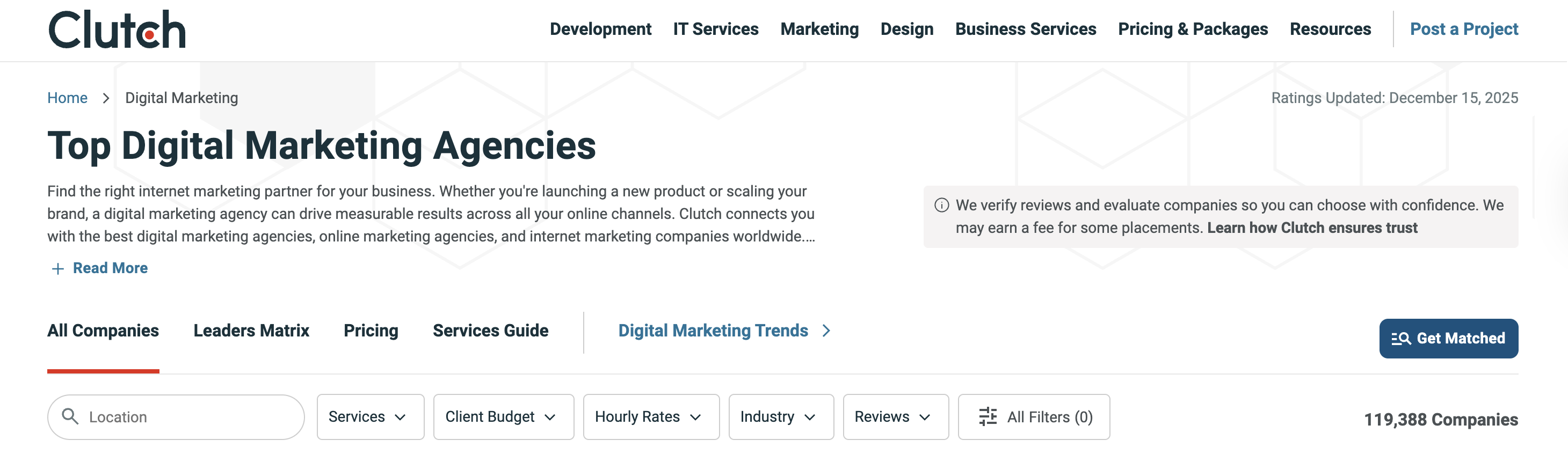
Source: Clutch
A good strategy is to look for patterns across 10-30 reviews:
- Do clients praise the same account manager?
- Are the results discussed with real numbers?
- Do multiple industries mention reliability, clear communication, etc.?
- Do you see your industry mentioned?
Use your own network
Quite often, the recommendations you really, really trust come from people in your own environment:
- Consultants you’ve worked with,
- Founders in your industry,
- Business partners,
- Or even past colleagues.
They can tell you what marketers actually supported them and helped achieve their business goals.
These conversations reveal patterns that you’ll never see in case studies. After all, nobody writes about response times or the ability to collaborate with an existing internal team.
So, ask people around in person or via DMs, or even write a short LinkedIn post to find someone in your broader professional network.
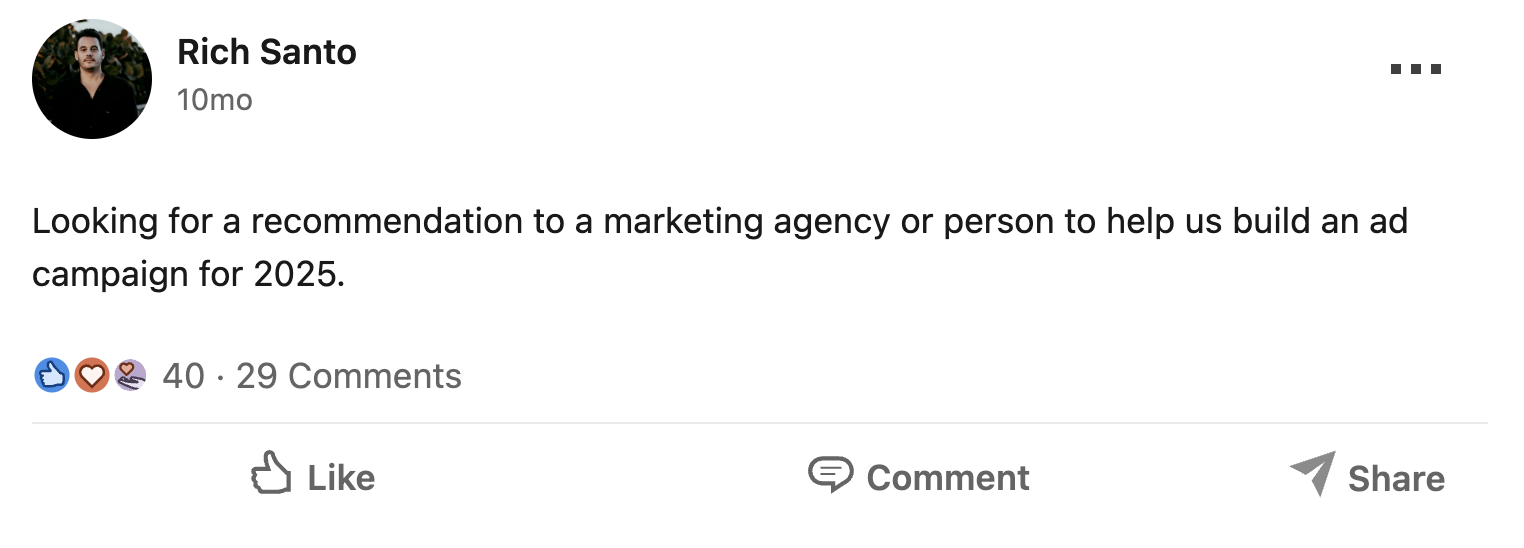
Source: LinkedIn
How to Hire a Marketing Agency in 11 Steps
Choosing a marketing agency is an important decision. Because it will definitely affect your revenue, lead acquisition, brand image, and tons of other factors that will determine how well your business grows over time.
And because most agencies look good on paper, the real work is learning how to separate what looks cool from what actually matters.
For this, we have these 11 steps that will help you make a better decision.
Step 1: Review your current marketing and define your goals
You have to start with a quite basic thing. Before you get into comparing potential agencies, get a grip on what’s happening inside your own system.
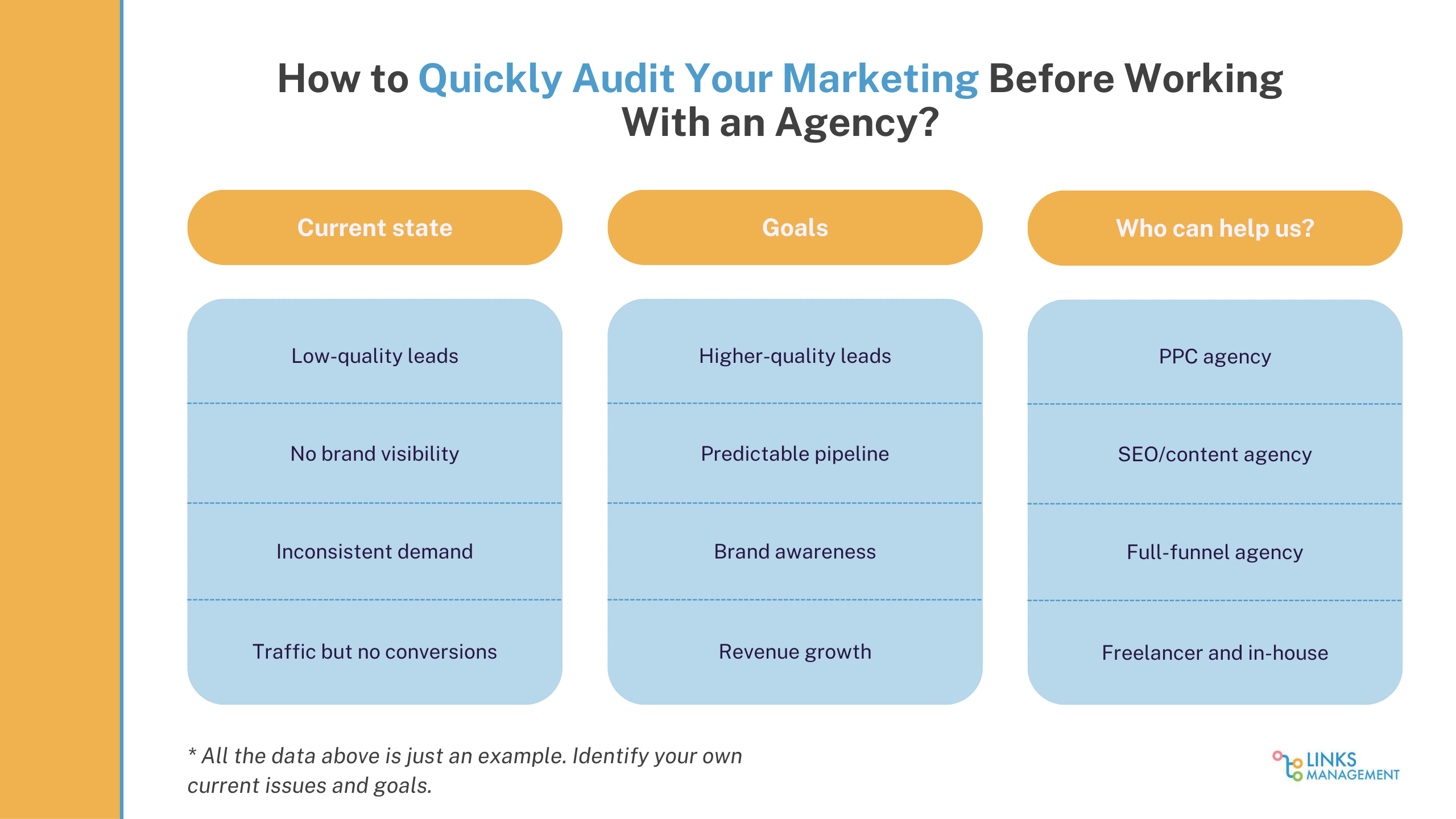
That means taking a real, sober look at what’s already working, and what you’re trying to fix. Spend time understanding your actual situation:
- Are your leads low-quality?
- Is your brand invisible?
- Do you have decent demand but zero consistency?
Analyzing this helps you avoid costly mistakes like hiring a content marketing agency when what you need is a PPC specialist. Or vice versa.
The thing is, when your goals are clear, agencies stop looking like interchangeable bundles of services. Instead, you clearly see which ones fit your direction and which one doesn’t.
If you aren’t sure what you need, you can also find full-cycle marketing firms and schedule intro calls with them to hear their suggestions based on your niche, company size, goals, regions, audience, etc.
You can use the simple approach below to quickly assess your marketing situation:
Step 2: Look for trust signs during your agency selection process
Someone might say that good agencies don’t try to impress you first, but they try to understand you. Well… one doesn’t exclude the other, right?
When we talk about trust signals, they go beyond their publications in fancy media or the big clients they worked with. Sure, these are good signs. But try to review the following as well:
- Case studies with real numbers (preferably in your niche),
- Mentions on Reddit or industry communities.
- Any certifications or partnerships that show their expertise.
- The copy on their website: what do they focus on, and what’s their unique approach?
Take your time to understand whether they actually know what they’re talking about. Of course, you can’t know for sure how it will be in real life, but it’s a great first step.
And pay special attention to any content where you can see actual measurable outcomes.
But it will also depend on what you’re looking for in an agency.
If you want something that wins commercial awards and the budget isn’t an issue, you could work with someone like Ogilvy or McCann.
And in their portfolio, they won’t really tell you about “130% more SEO conversions” or “210% increase in organic revenue.” They will tell you a story instead.

Source: McCann
Step 3: Understand their pricing and model
At first glance, you might think pricing is about affordability. But no, pricing tells you way more than just “it is within your budget”.
All agencies structure their work differently, and the pricing model you choose will affect your whole collaboration. It might not feel like that at first. Still, it is true, and you’ll see why below.
There are several ways agencies can structure their pricing.
Let’s see the main models and consider their pros and cons from the client perspective:
- Monthly retainers. This is a very common option, as it has clear costs and works really well for long-term collaboration. But it can be restrictive if your priorities and tasks change. Besides, if you don’t get clear deliverables, it might even feel expensive.
- Packages and “à la carte” options. This one basically means that you need a particular service and you choose it either as a pre-arranged pack or mix-and-match different ones. It gives you flexibility, but it can also lead to a lack of real strategy.
- Project-based scopes. These are really clear. They are especially good if you want defined timelines and budgets. But often, the issue is that as soon as your project ends, the progress stops. Still, it’s perfect for some one-time things like seasonal campaigns.
- Hourly. This one is really flexible, but it’s extremely hard to predict the final cost. So, make sure to ask for some estimates beforehand.
- Performance-based. This model helps you incentivize your agency to give you better results. But it might be hard to actually define the performance for some tasks, like content marketing, for instance.
- Hybrid. This one often gives you just enough flexibility, as you typically pay a moderate monthly fee and a bonus based on performance. It incentivizes your marketers and still gives them some stability.
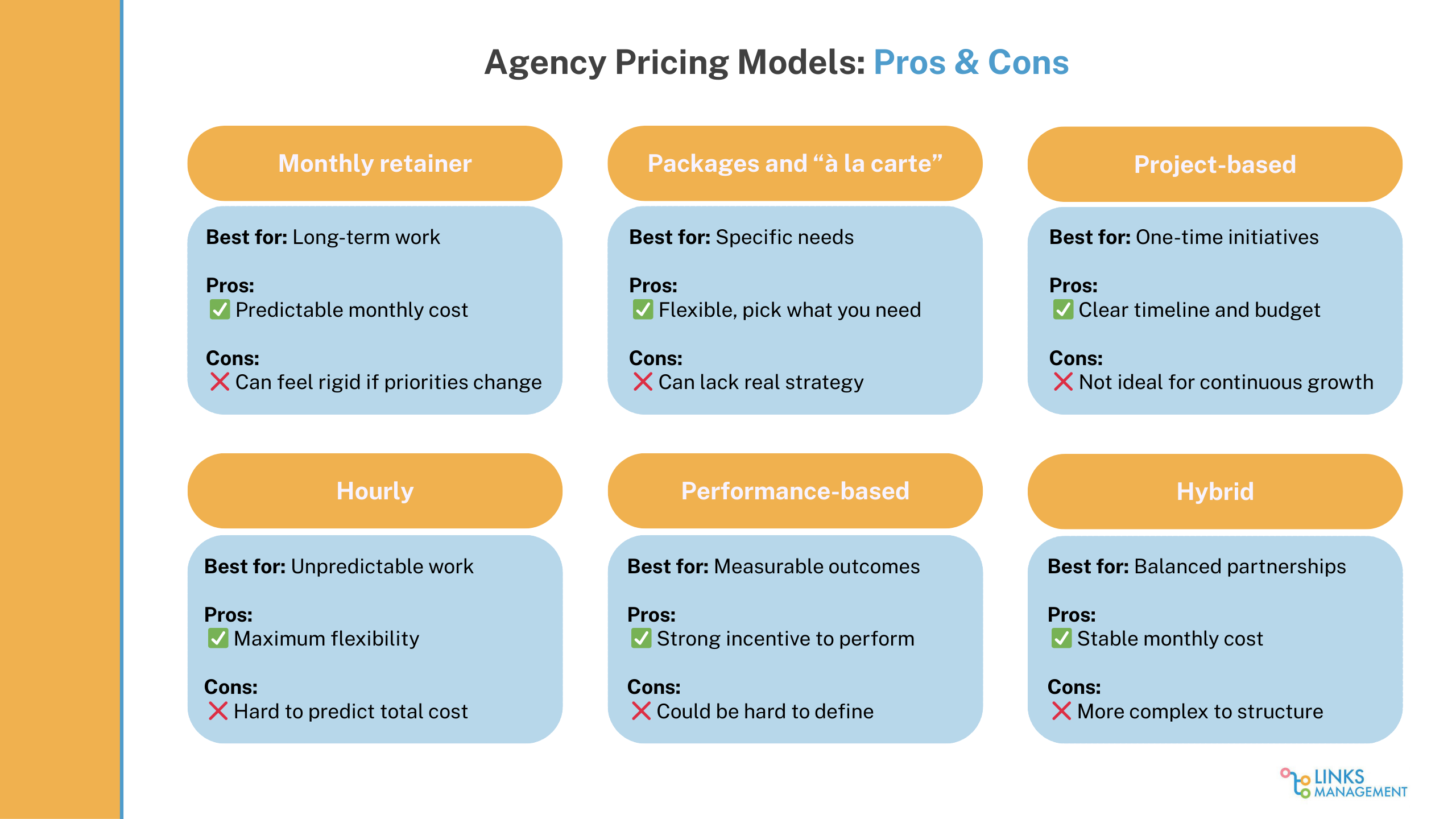
At this stage, you have to figure out whether the model matches the outcome you want to achieve and the way your team works. If the pricing strategy incentivizes the wrong behaviors, you’ll feel it within the first month, for sure.
So, it’s really important to understand what you can expect from each type of collaboration. Often, you can also talk it through with a company and choose an alternative model. But they might not agree to that.
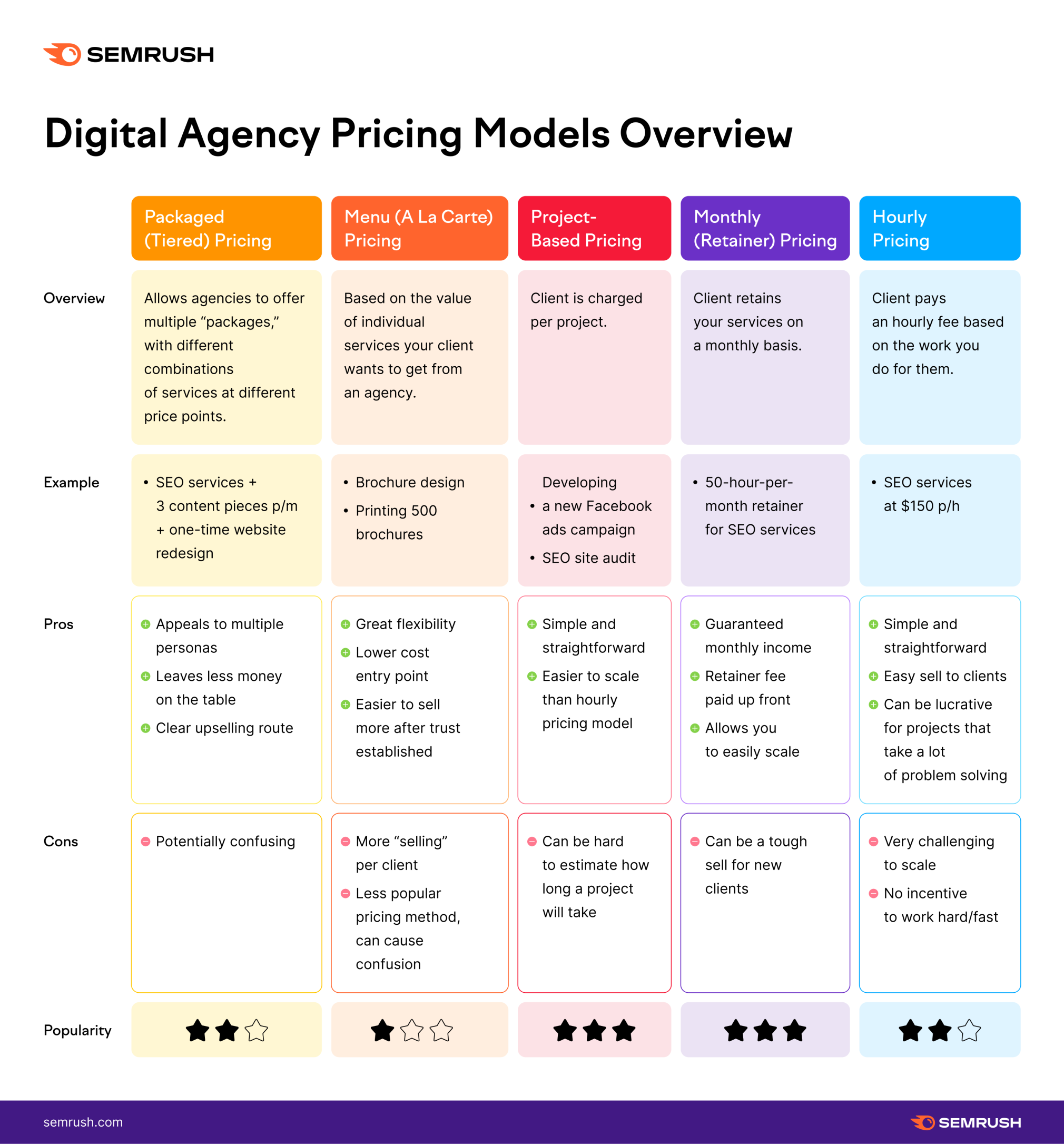
From the agency perspective, the benefits and downsides are, of course, different.
But it might be valuable to understand why they choose one option over the other. As it isn’t the topic of this guide, you can review a small summary in the visual below:
Source: Semrush
Step 4: Make the first contact and check how they respond
Your first interaction with a potential agency is more meaningful than you might think. It shows:
- How they communicate,
- What they prioritize,
- How they react to questions,
- How seriously they take inquiries.
If you reach out and get a generic reply three days later, well… you know. Most likely, that’s not them “being busy”. That’s a preview of how slow they’ll be once you’re a client.
We’re not saying it’s enough to judge whether this agency is a good match or not, but… it’s already something to pay attention to.
Also, notice whether they ask clarifying questions before scheduling a call. It will show you how proactive they are, and if they even bother to make your first meeting more personalized.
A more intuitive advice, but still an important one: watch if their tone matches what you’d expect. Sure, it won’t be anything defining at this stage (at least not before the call). But it can already give you an idea of whether you could click.
This early exchange helps you trim your list quickly. The best agencies tend to show their professionalism very early. So, just observe and take notes here.
Note: For some companies, the intro call is just the moment to get to know you. So, they might ask you questions and prepare something personalized after. This will depend, but you’ll definitely feel the difference between them “not caring” and them “having a different approach”.
Step 5: Prep for the intro call to ask the right questions
Most intro calls fall into a predictable pattern: you ask about pricing, they show you a case study, you nod, everyone smiles, and nothing truly useful is happening.
Avoid that at all costs.
The best questions are not about cost or awards. Surprised? They’re actually about workflow, accountability, decision-making, and execution.
These things reveal whether the agency can:
- Plug into your internal team and support your marketing strategy.
- Handle your day-to-day marketing activities.
- Do all these things without creating more work for you.
Here are a few helpful questions you can actually ask:
- “If we start tomorrow, what does week #1 look like?” This would show you if they have a defined onboarding process, or if they’ll improvise later.
- “How do you measure success within the first 30 days?” You’re checking if they operate with metrics or “intuition”:)
- “Who will be working on our account, and what’s their actual involvement?” You need names and roles. This helps you spot the high-turnover, low-expertise setups. Truly great creative agencies have pretty stable teams and know who does what.
- “What inputs do you need from us every week?” If their answer is “not much,” that’s… right, a red flag. Effective digital marketing requires being on the same page with sales, product team, customer support/success, key stakeholders, etc.
Once you know these things, you can set clear expectations and turn your collaboration into something actually effective.
Step 6: Analyze what they say during your call
This is the “moment X” that will define everything.
First of all, check whether you feel comfortable with them.
Yes, comfortable. The human factor is extremely important. They might be the best experts out there, but if you don’t match, it just won’t work in the long run.
Next, analyze if they ask questions that show they’ve done this before.
Not just surface-level things like “What’s your target audience?” because that’s way too basic for a serious digital marketing agency. Rather, look for something like:
- “How does your sales cycle look from first touch to close?”
- “What have you tried already, and why do you think it didn’t work?”
- “Are there any compliance limitations we have to be aware of?”
These kinds of questions signal that the agency knows what matters and can actually deliver that.
And last but not least, listen to their suggestions for your particular brand.
This is another important factor to see if you click:
- You should feel that they’ve done their research (at least basic).
- It has to be clear that they understand your industry and target audience.
- They have to feel proactive, suggesting some personalized tactics, giving some great examples, etc.
Step 7: Review proposals and contracts in detail
Once you finish the first round of conversations, usually, the proposals start arriving… and this is where you can get burned. For real. A proposal is not just a summary of your chat. It’s a test.
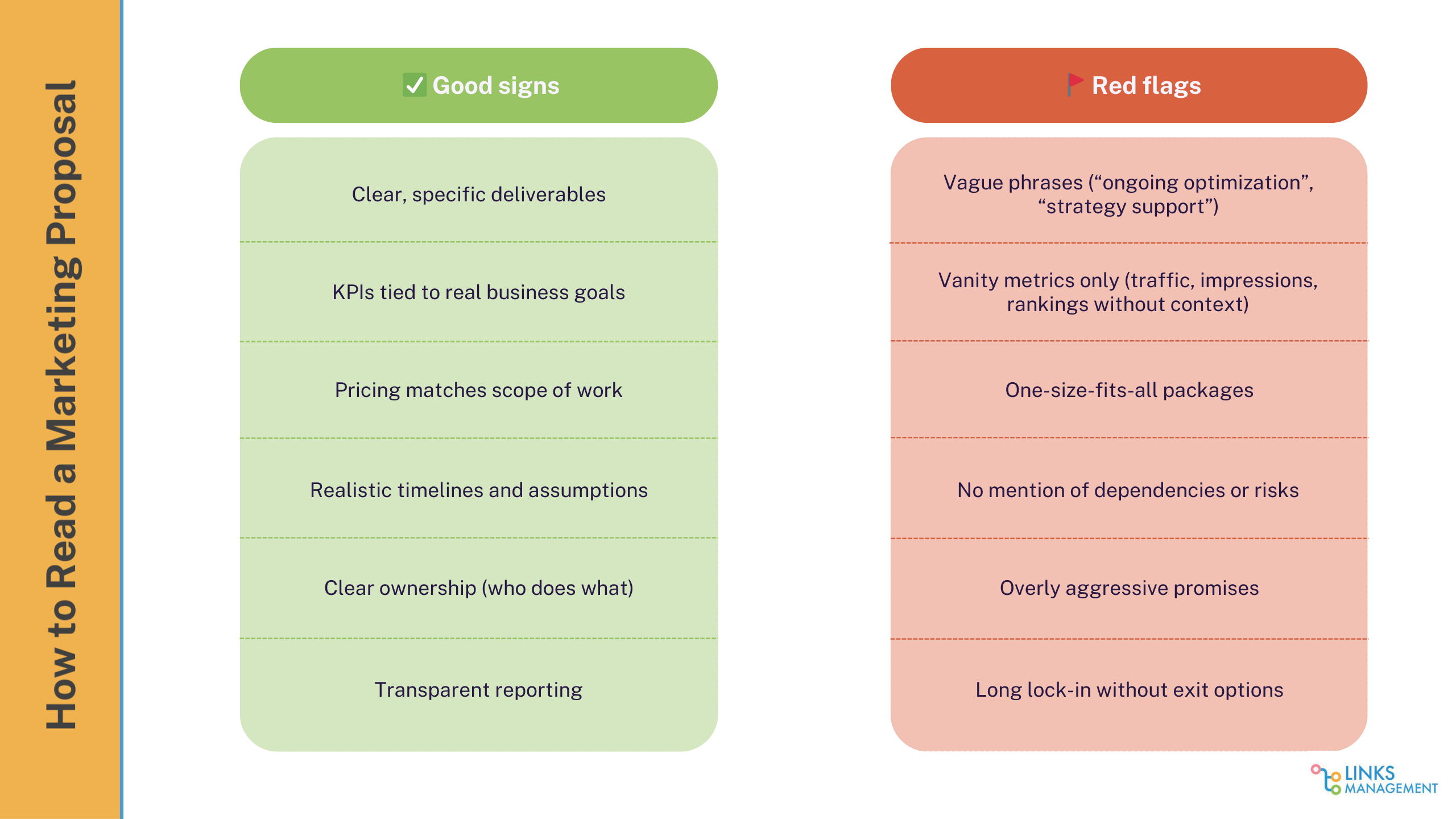
A test that shows if the agency actually understood your goals and knows how to achieve them. Read it slowly and look for signals of maturity:
- Are deliverables specific, or do they hide behind vague language? “Content support,” “strategy consulting,” “monthly optimization,” and “campaign management” mean nothing unless they’re clearly defined.
- Are KPIs tied to realistic search rankings, performance metrics, or conversions? The KPIs they suggest have to be directly connected to your objectives. Otherwise, there is no point in tracking them.
- Does the pricing model match the work? Some digital marketing agencies over-package simple tasks into retainers. Others underprice, planning to upsell later. So, just keep an eye on the actual value.
Step 8: Check whether it’s a good marketing agency with a pilot test
A good agency should welcome a pilot. Why? Because confident teams know that once you see how they work, you’ll stay.
No matter whether you work with an SEO agency, PR team, PPC specialists, or content marketers, 60-90 days are enough to see at least the initial results.
So, offer to start with a trial to see how it goes.
A 60-90 day pilot lets you see the company’s real behavior. It also protects you from many unpleasant surprises. This way, six months later, you won’t realize that your marketers are great at landing pages and paid ads, but terrible at content marketing and search engine optimization.
During the pilot, pay attention to these things:
- Execution speed: Do campaigns actually go live on time? Can you rely on their promises? And other similar things, depending on the services you need.
- Reporting: Do they have transparent reporting or just forward screenshots from Google Search Console with no explanation? Are they tying their marketing initiatives to your business goals? Do you understand what they’re doing and why?
- Communication quality: Can you get regular meetings? Is chat communication timely and clear? Do you feel in the loop?
Sure, no agency can transform your company in 60 days. But you should see real movement. Maybe more traffic, better search rankings, or early signs of a successful marketing campaign.
Start with one or just a few marketing areas (PPC, SEO, social media, or content creation). Don’t go for everything at once, because it will be much harder to track. If the partnership works, expanding later is easy. But if it doesn’t, you won’t lose too much money.
Step 9: Prioritize quality onboarding
The pilot, as you understand, was just the test drive. But onboarding is the actual commitment. And it’s absolutely essential when you hire a marketing company.
This is when your internal team and the outsourced one work to be on the same page. You build the foundations that will support the next year (or even years) of marketing efforts.
Onboarding should include:
- A strategy session. You should walk away with clarity on your marketing plan. A good team connects its activities to your sales cycles, margins, messaging, etc.
- Access setup. Analytics, ad accounts, CMS, CRM, social media platforms, web design tools, and everything else in between. It might take you weeks to figure out the technical details. So, it’s important to talk it all through from the start.
- Roles and responsibilities. Your team should know exactly who the account managers are, who approves what, and how communication flows between the two sides.
- A 30-60-90 day timeline. This should outline campaigns, landing pages, optimization cycles, SEO activities, etc. It doesn’t have to be fixed. Of course, you’ll tweak it later on. But you need at least some direction from the start.
- Documentation. Share brand guidelines, tone of voice approaches, competitive landscape, product details, pricing constraints, and any other relevant previous marketing activities.
Step 10: Protect the partnership with detailed feedback
There is always a chance you might treat agency relationships as “set it and forget it.” But does marketing work that way? Not really. Especially not when you’re scaling.
Regular feedback makes the relationship way more productive. It also prevents frustration from getting the results you didn’t want or no results at all.
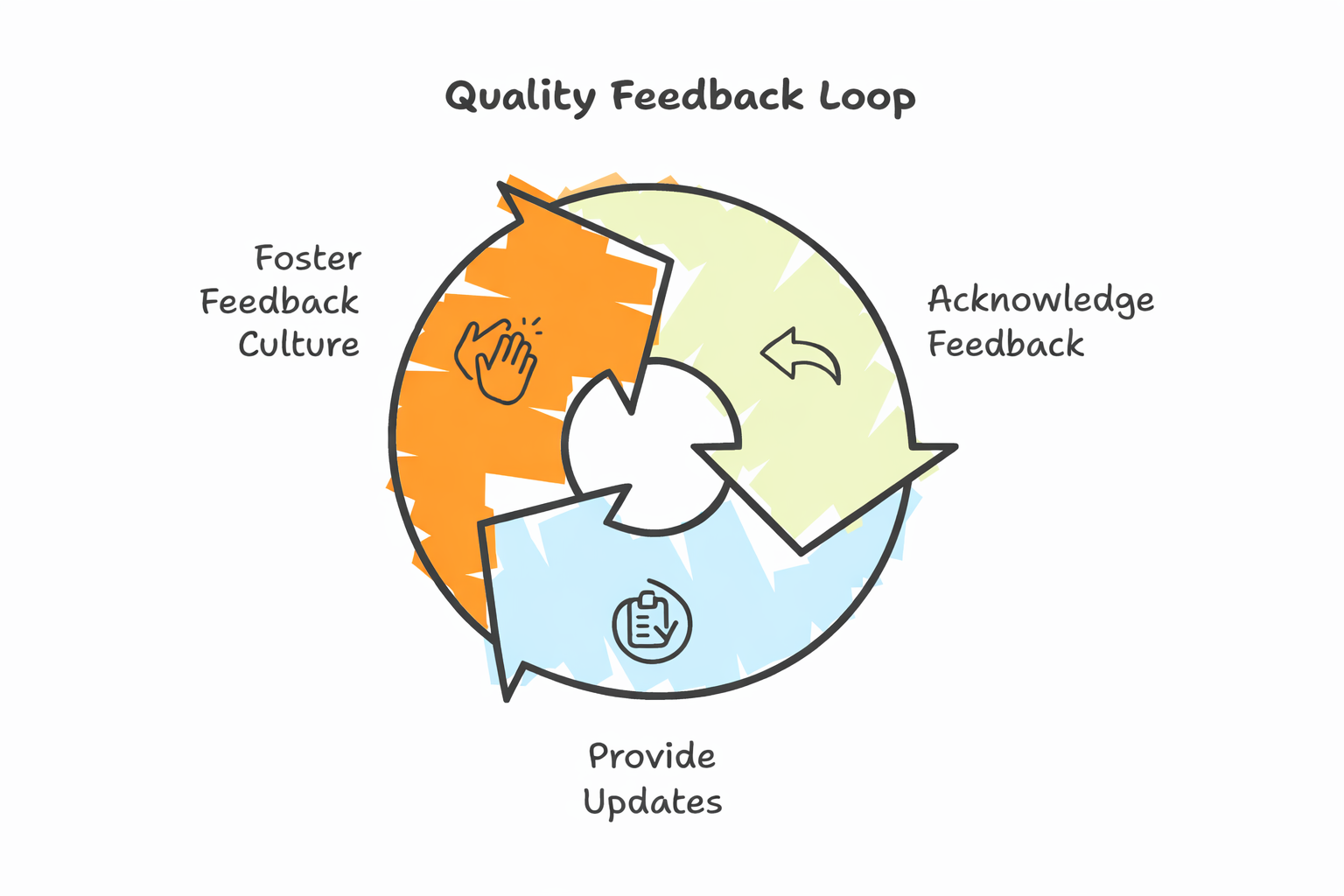
Use simple monthly (or even weekly) feedback loops:
- What’s working well?
- What needs more attention?
- What changed internally that they should know?
- What obstacles are slowing things down?
- What promotion strategies need improvement?
Most professional outsourced teams don’t need micro-management. But what they actually need is context. When you share it, you’ll get substantially better results and much less stress.
Step 11: Know when to walk away
Sometimes, no matter how good an agency is, it just… isn’t working. Not a match, as they say. That’s normal. What matters is recognizing it early and not wasting six more months hoping it fixes itself.
It might be just a feeling, but sometimes, you get to see actual red flags.
Here are some of them:
- You’re doing more project management than they are. If you’re constantly chasing updates or reminding them of deadlines… well, you’ve basically hired yourself.
- They avoid numbers. If every question about performance somehow leads to vague talk, you should just stop it right there.
- There’s no strategic plan. If every problem is solved by “posting more,” “boosting a publication,” “trying a new channel,” or “we’ll see,” most likely, they don’t really have a vision behind their everyday activities.
- Work quality declines after the first month. You stepped into a classic agency trap. You meet the A-team during sales, and work with the C-team during delivery.
- They’re allergic to feedback. If every comment is met with defensiveness or excuses, you’re not dealing with a truly expert approach that can get you where you want.
Of course, it takes time for another team to understand what you need and test a couple of things here and there. But usually, you can clearly see whether they’re trying hard and when they just don’t really care.
Conclusion
Hiring a marketing agency often comes down to finding a real partner who will care about your goals as much as you do. That’s definitely not an easy task. But it is much more doable after reading this guide.
If you take the time to assess your needs, research real client experiences, and ask proper questions, you’ll spot the right agency much faster.
And even if it doesn’t work on the first try, don’t worry! Things like that happen. The most important part is not to give up.
Related Posts
Published Sep 30, 2025
Last updated May 12, 2025 | Published Feb 11, 2025
Published Jan 6, 2026

Published May 27, 2025

Published Aug 26, 2025
Enter URL & See What We Can Do Submit the form to get a detailed report, based on the comprehensive seo analysis.