Benefits of Link Building: Why Backlinks Still Matter for SEO
Even if you’re an SEO newbie, you know that you need to build backlinks. But why is it necessary? And do they still matter in the age when everyone is talking about AI search?
These questions are legit, and you aren’t the only one asking them.
That’s exactly why in this guide, we’re going to cover:
- SEO and business benefits of link building.
- And why they matter more than ever for AI visibility.
Contents
- Before we begin: What is link building?
- 9 key link building benefits
- Beyond SEO: Why link building is important for business
Before we begin: What is link building?
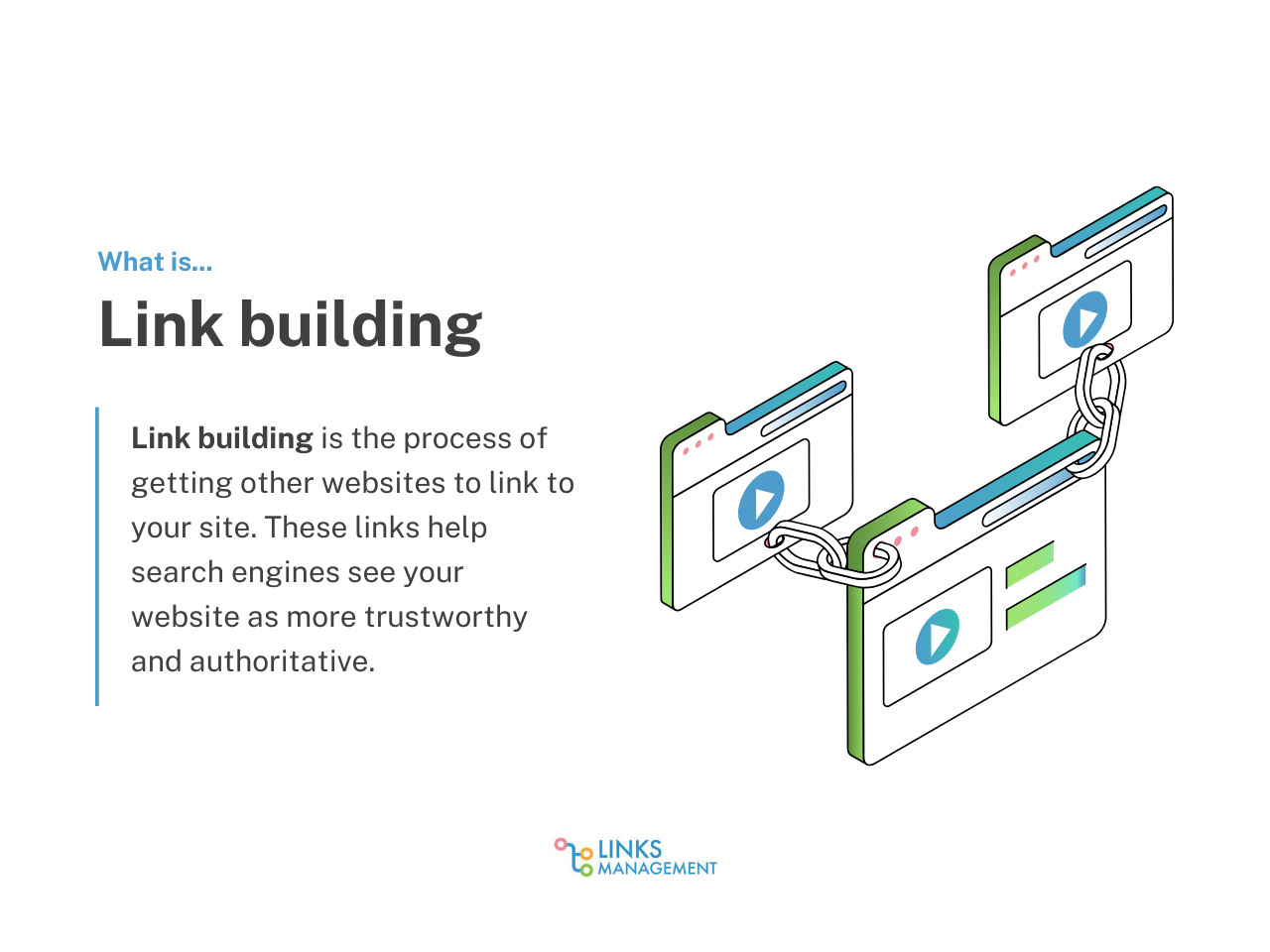
Link building is one of the most important parts of search engine optimization. It refers to a set of tactics that are aimed at getting backlinks (external links to your own website).
Why does it even matter?
When a reputable page links to one of yours, search engines consider it a signal of trust. Think about how you choose sources for your content:
- If you see a report by Gartner, you think it’s credible (pretty much by default).
- But if you saw the same stats by www.somerandompage74937.com, most likely, you wouldn’t mention it, let alone link to it.
That’s why backlinks are important: they pass link equity (juice) from one page to another. And with enough high-quality external mentions, even www.somerandompage74937.com can become one of the high-authority sites.
However, backlinks are different.
A single link from a credible page can be worth more than dozens from low-authority sites. Besides, mentions from spammy pages or PBNs don’t help at all. On the contrary, they can harm your site’s backlink profile and credibility.
That’s exactly why a good link-building strategy focuses on a few things:
- Earning links from reputable websites,
- Placing them on niche-relevant web pages,
- Getting mentions that make sense to people and search engine crawlers.
9 key link building benefits
Before we jump into the benefits, we have to make one thing clear: link building is not a “tactic” or an additional SEO goal. It’s more of an infrastructure.
The thing is, you can:
- Publish the best blog post in your industry,
- Optimize it perfectly for relevant keywords,
- Have great UX and solid internal linking,
- But… still struggle to rank.
Why does that happen? More often than not, you’ll face a situation like this because your site lacks authority. Search engines don’t only evaluate what is published, but also who publishes it. And if Google doesn’t trust you yet, ranking high will be nearly impossible.
With that said, let’s break down the most important link building benefits you can expect:
1. Improves organic search rankings
Rankings in SERPs are probably the most obvious benefit of link building, but it can also be misunderstood sometimes.
Yes, backlinks help you rank higher in search results. But how they do that matters, too.
Basically, search engines use these mentions as a sort of “proxy” for trust. If many relevant websites point to a specific page, it signals that:
- The content is useful,
- The page solves a real problem,
- Other website owners are willing to “vouch” for it.
This way, each quality link passes equity to your page. And the more high-quality backlinks you earn, the stronger that page becomes in the eyes of search engines.
Let’s say there are two blog posts targeting the same keyword: “How to choose the best CRM for small businesses.” Both are well-written, use relevant keywords, and generally look good.
But why does this blog post rank on page #1?
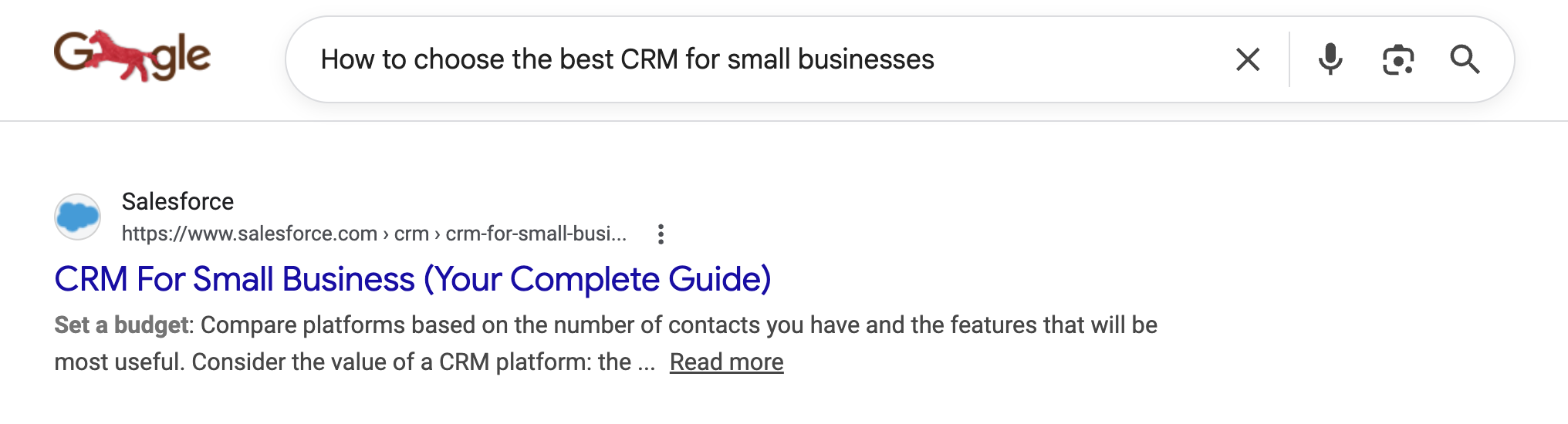
And this one ranks on page #14? Is it that much worse? Not really.
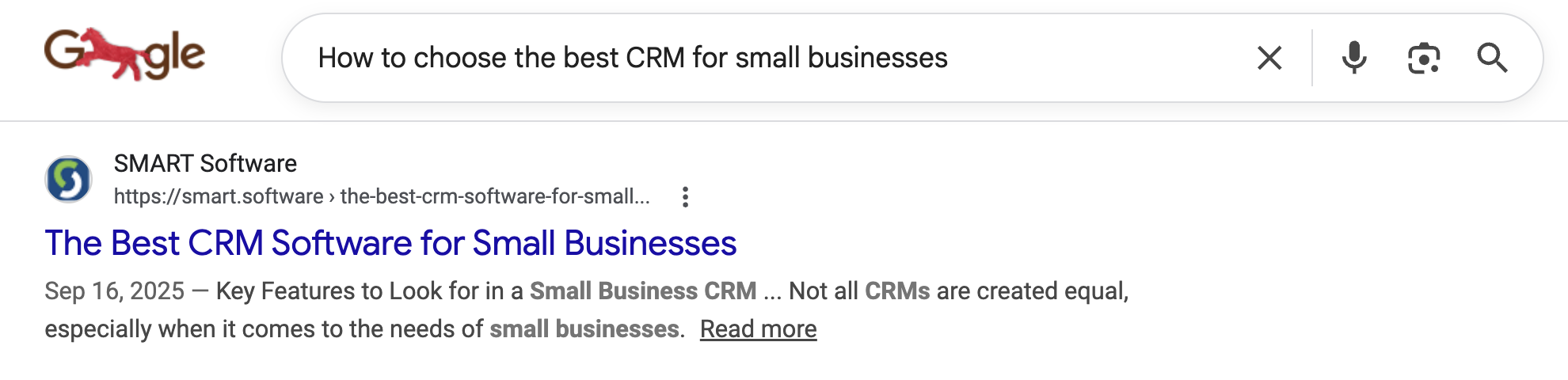
When you run each of these through an SEO tool, it all becomes obvious:
Salesforce’s DR is 92, and this page alone had 568 backlinks.
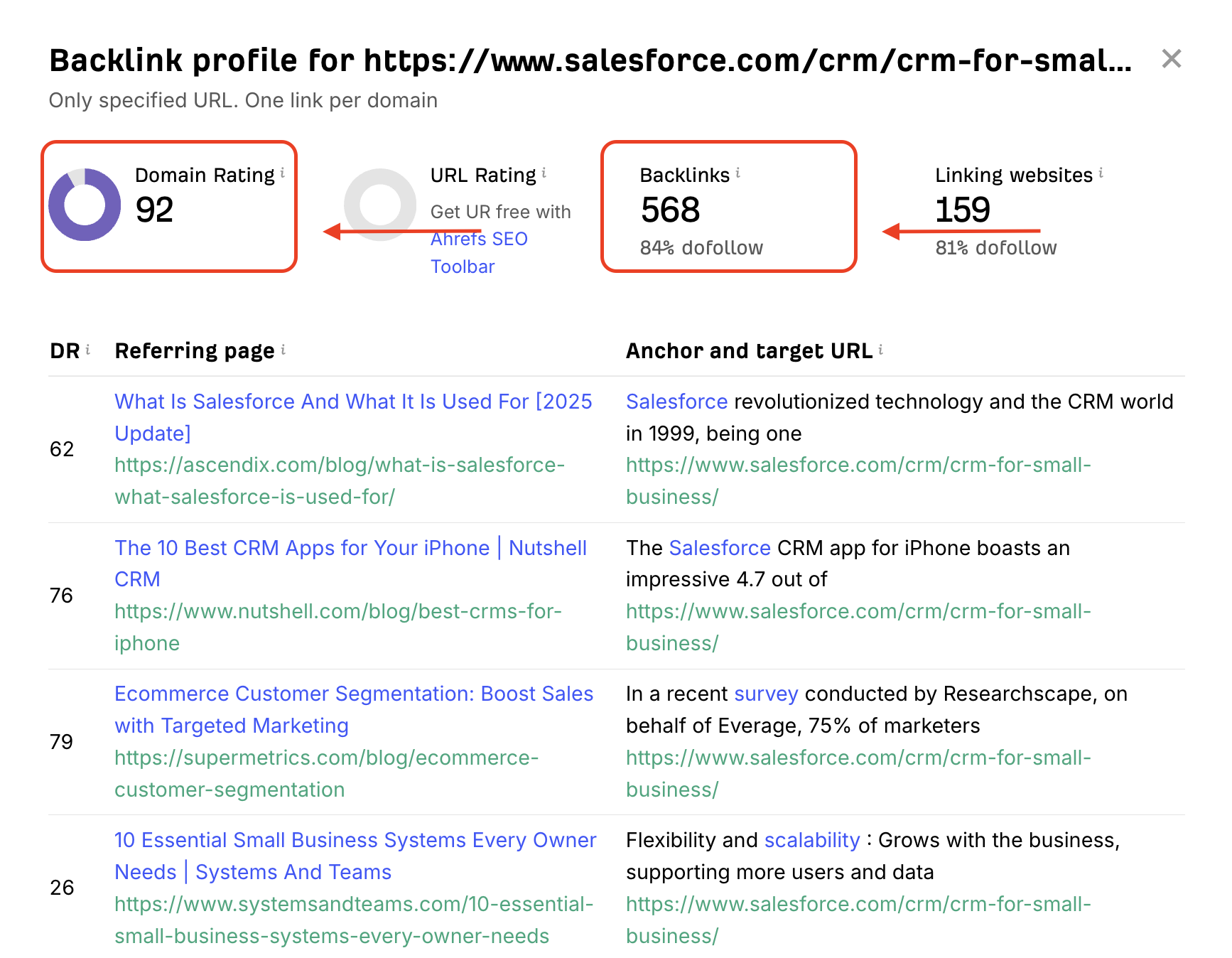
Source: Ahrefs
And the SMART Software’s blog post has 0 backlinks, and the website’s DR is 10.
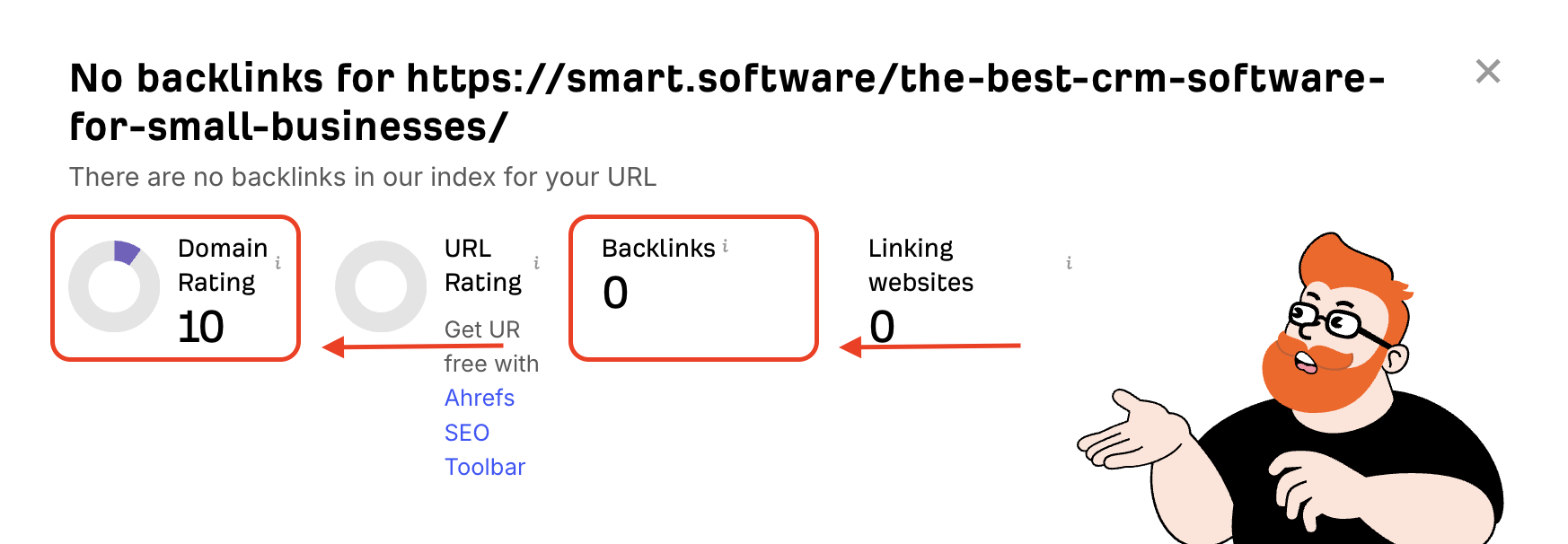
Source: Ahrefs
That’s just one example. But a page with more backlinks and higher DA/DR will almost always win. Why?
Because search engines have to rely on something when “assigning” a particular spot in search results for each page. And one of the major factors they count on is the backlink profile.
That’s just one example. But a page with more backlinks and higher DA/DR will almost always win. Why?
Because search engines have to rely on something when “assigning” a particular spot in search results for each page. And one of the major factors they count on is the backlink profile.
2. Builds domain authority
We’ve already touched on this one in our previous example.
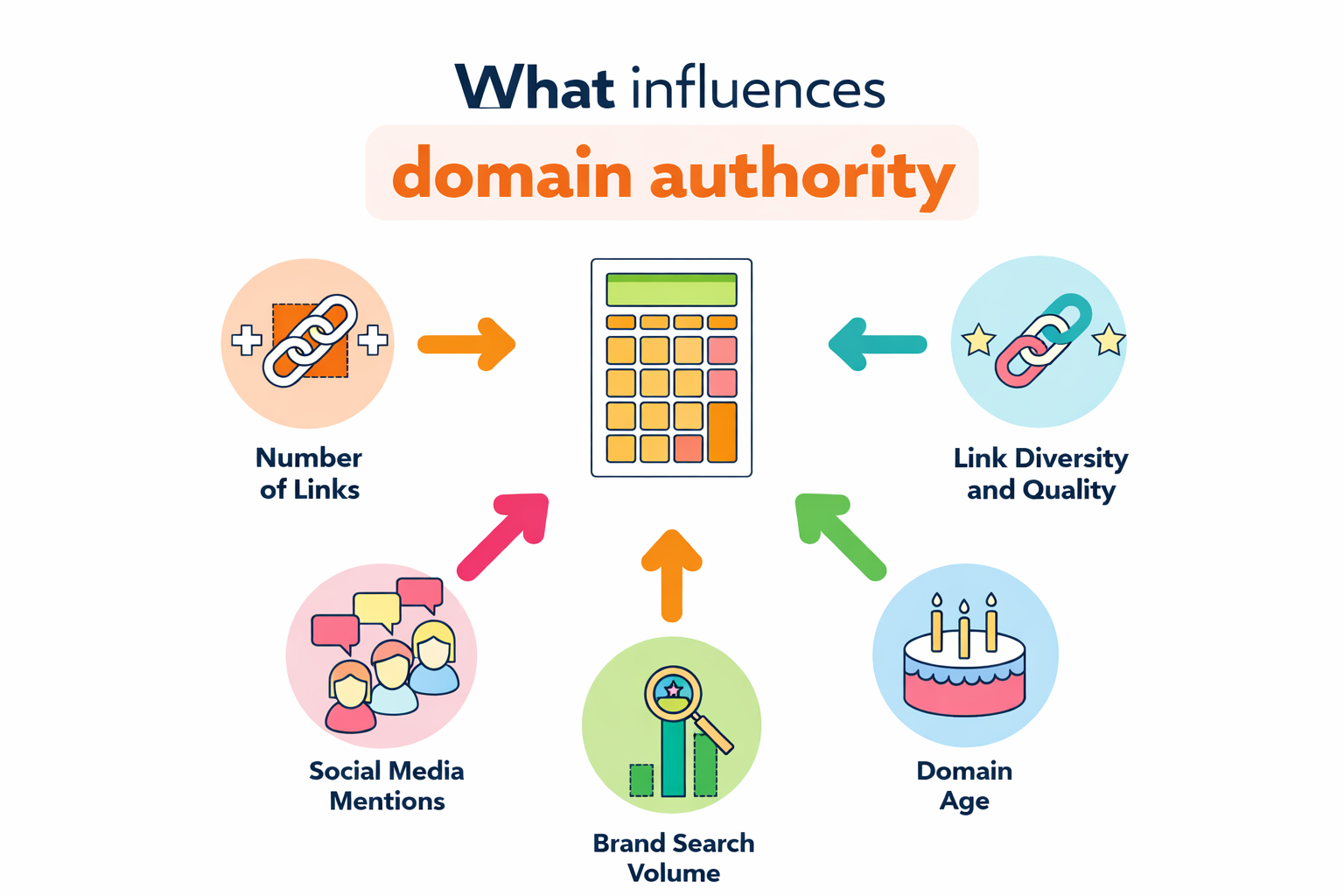
But the thing is that your domain authority largely depends on the quality and the amount of referring domains. That’s another reason why link building is so important for any website.
Search engine rankings are essentially short-term wins. But if you manage to establish decent domain authority, you get more long-term advantages.
When people talk about “strong websites,” what they usually mean is that the site has high DR/DA/AS (different names for domain authority). Because this almost automatically means trust and credibility. And that trust comes from external mentions.
As your website earns more high-quality links from reputable sites, your authority increases. Over time, search engines begin to treat your entire domain as more reliable.
That means:
- New blog posts rank faster,
- You can compete for more difficult keywords,
- And your content generally needs fewer backlinks to rank in the first place (this depends on who you compete with, though).
In other words, links sort of “lift” your entire site.
That’s why a brand new website, with very few inbound links, will always perform worse than the one backed by years of link building. Even if it publishes better content, the one with more external mentions will rank better.
Why?
Because that website “with experience” has already proven itself across thousands of web pages pointing to it. Search engines trust it without doubt (or at least with less doubt).
This is why link building works over time. Authority, once earned, doesn’t disappear when you stop building those external mentions.
If you rely on page-level optimization alone, every new piece of content will be a battle you are unlikely to win. Seriously. But with a strong domain:
- Your rankings are more likely to improve,
- Topical clusters will perform stronger,
- And future link building efforts will get easier.
Plus, website owners with higher domain authority also attract more natural links because their content is already visible. It’s like a flywheel:
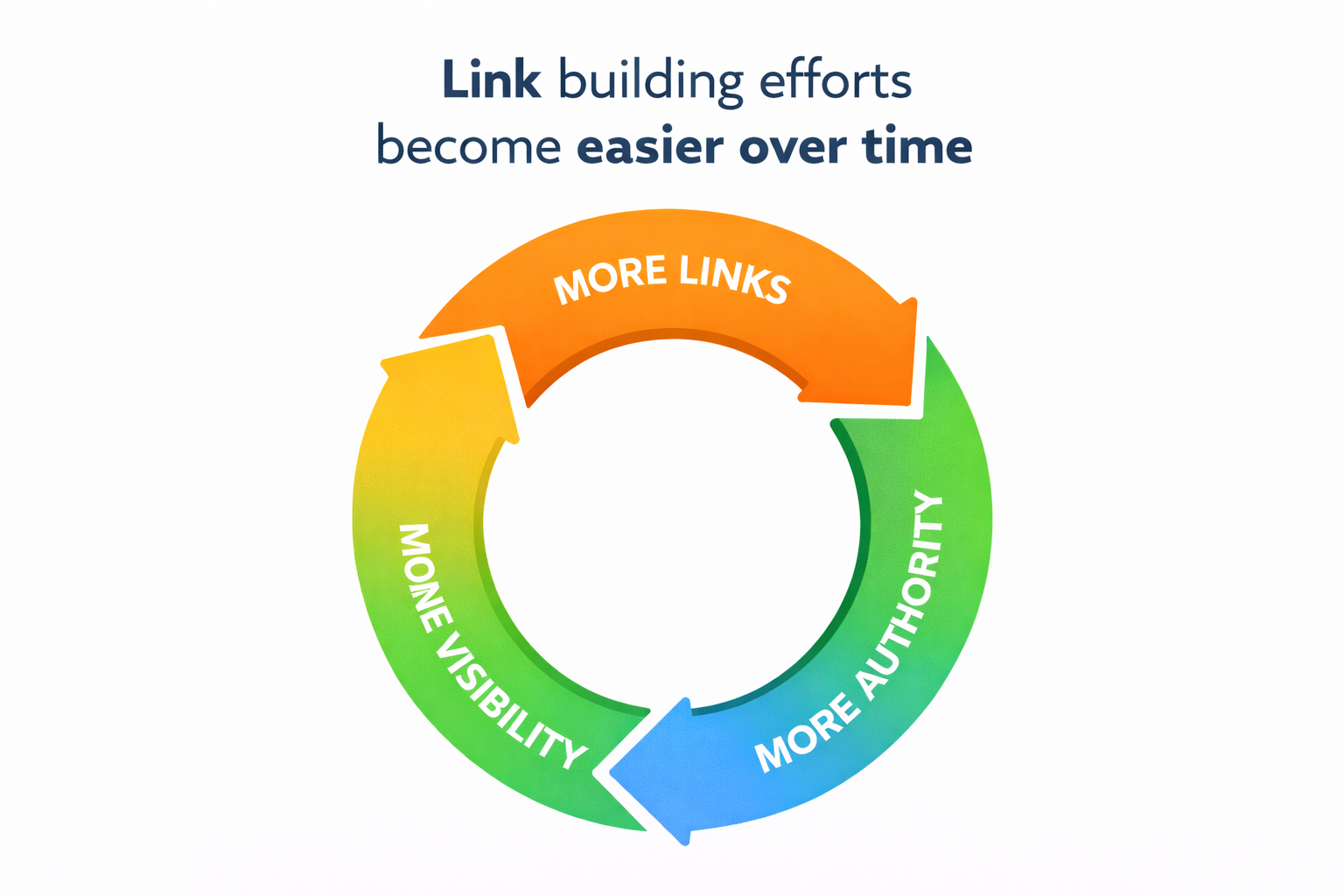
And if you start spinning that flywheel, competing with other brands won’t be that tough anymore.
3. Helps you rank in AIOs and LLMs
Traditional search engines and LLMs don’t work the same way. But often, they still trust similar signals. LLMs like, for example, ChatGPT don’t rank pages the way Google does. Instead of this, they:
- Learn from massive amounts of content,
- Identify which brands and pages are referenced more often,
- Weigh credibility based on how often and where a business is mentioned (often, relying on user-generated content much more).
So, the more online mentions you have, the more AI visibility you get. Now you see why, in the era of LLMs, link building is even more crucial.
AI mostly relies on external mentions. That’s why the overlap between AIOs mentions and the top 10 search results is only around 20%, according to the Semrush study. And with ChaGPT, it’s usually even lower.
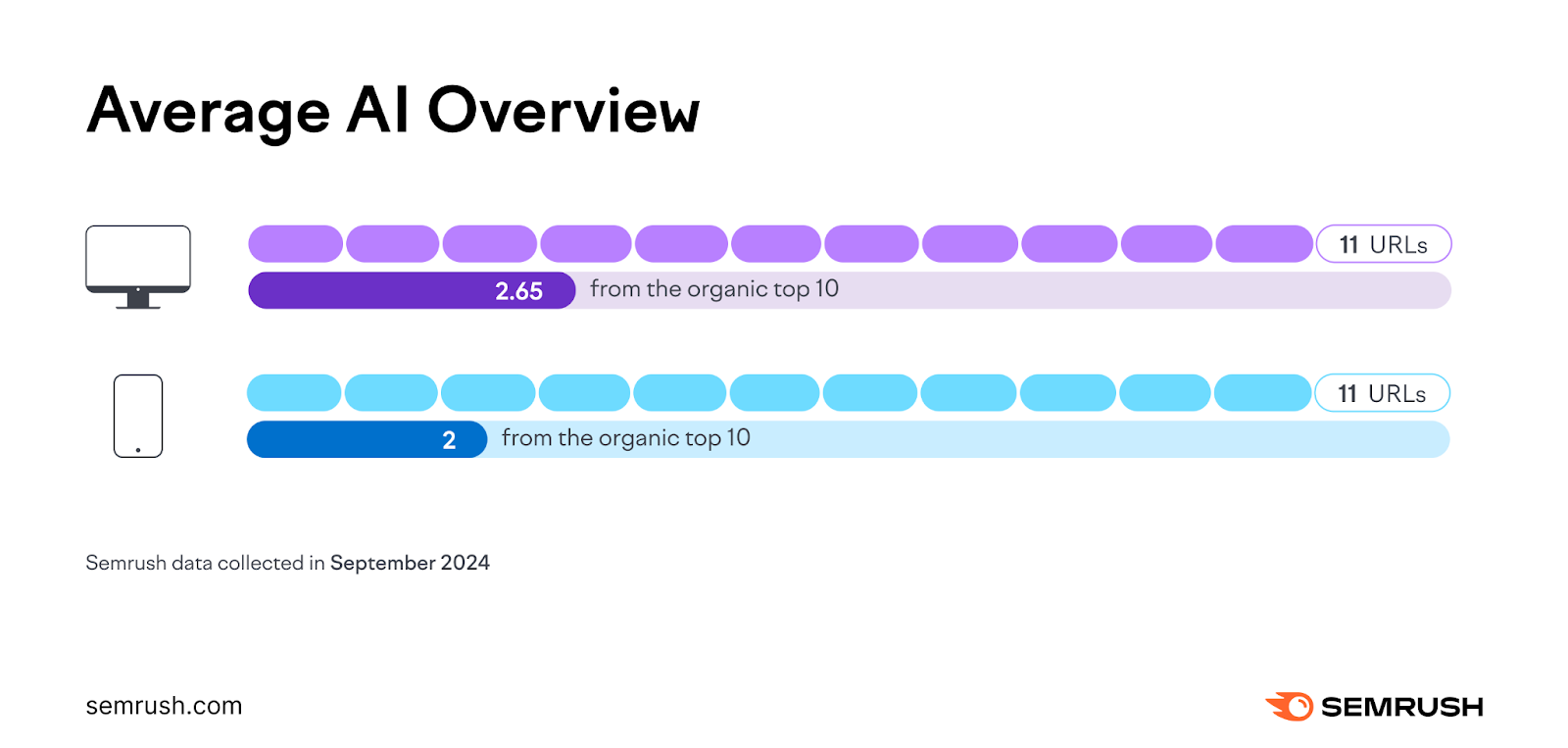
Source: Semrush
That’s why your brand has to appear across the web, in:
- Listicles like “X Best Tools” (ChatGPT loves these),
- High-quality guest posts,
- Social media and forums (including Reddit and Quora),
- High authority websites in your niche (of course).
LLMs, essentially, notice patterns. If many reputable websites or even just people on forums and socials mention the same brand, that brand becomes “safe” to recommend for them.
Now, this brings us to the next point.
These days, rankings don’t tell the full story anymore.
Some brands barely rank in organic search results and have almost no non-branded keywords. And yet, they show up in AI-generated recommendations.
Why?
Because they have thousands of inbound links from authoritative sites and list-based articles. The LLM doesn’t care that they rank #78 for a keyword. The most important thing is that other websites consistently validate these brands.
So, if you want to rank in AI search, your goal should be better online visibility. That’s where you need links and even unlinked mentions from popular web pages that often get cited by AI:
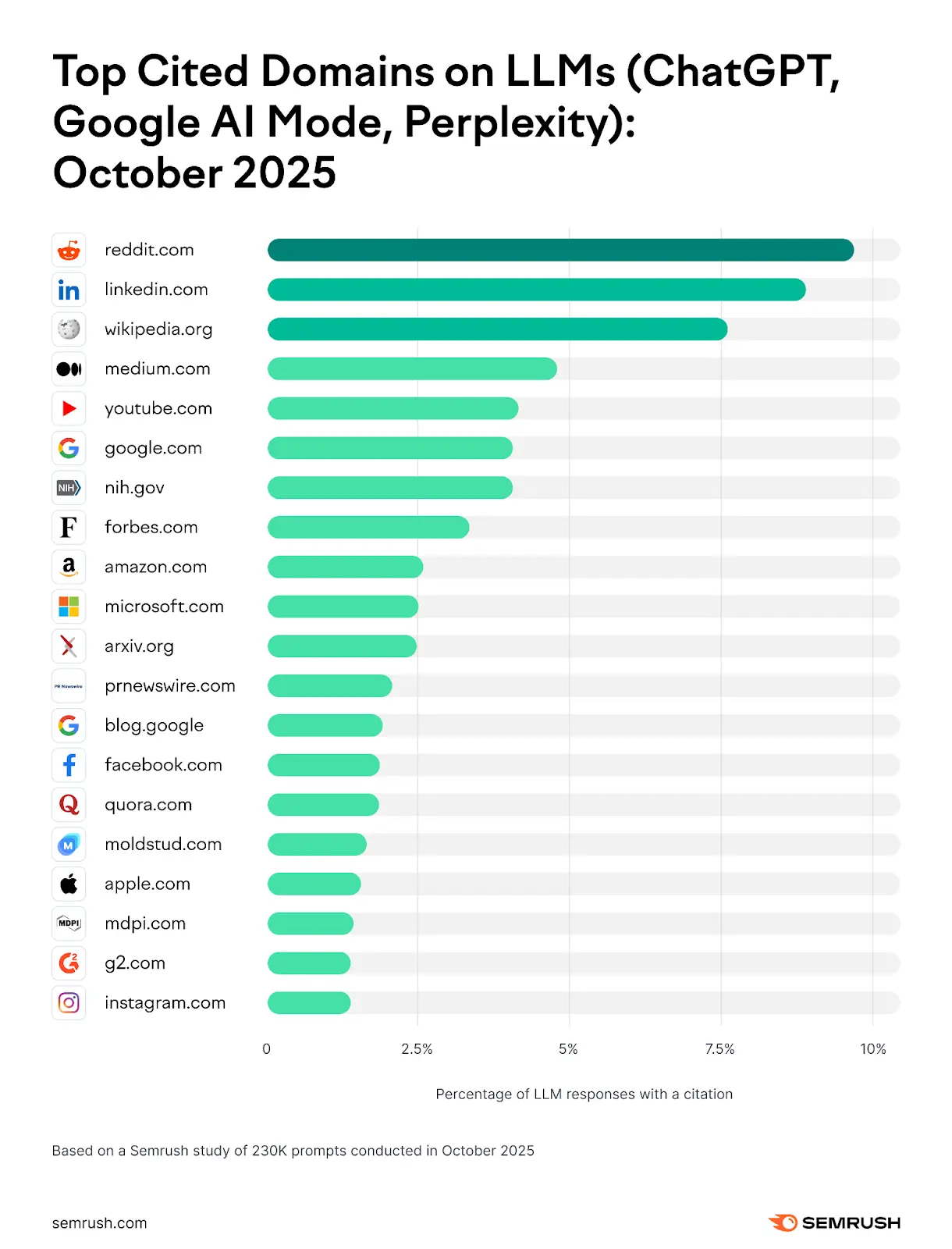
Source: Semrush
And this type of strategy will affect AI Overviews, LLM recommendations, and, yes, the overall online visibility beyond search results.
4. Compounds over time
One of the most underrated benefits of link building is how it compounds. The thing is, a backlink doesn’t expire.
If a reputable website pointed to your blog post three years ago, that link still passes equity. And it will continue supporting your backlink profile for the time to come.
Sure, any website owner can remove the URL, or the website might lose its quality. But the compounding effect is still impressive.
Because if you take ads, for example, as soon as you stop paying, the clicks vanish.
But with link building and SEO in general, the situation is different. You build those external URLs, your brand authority increases, and your search engine rankings improve. Most importantly, the traffic keeps coming, even if you pause your link building campaign.
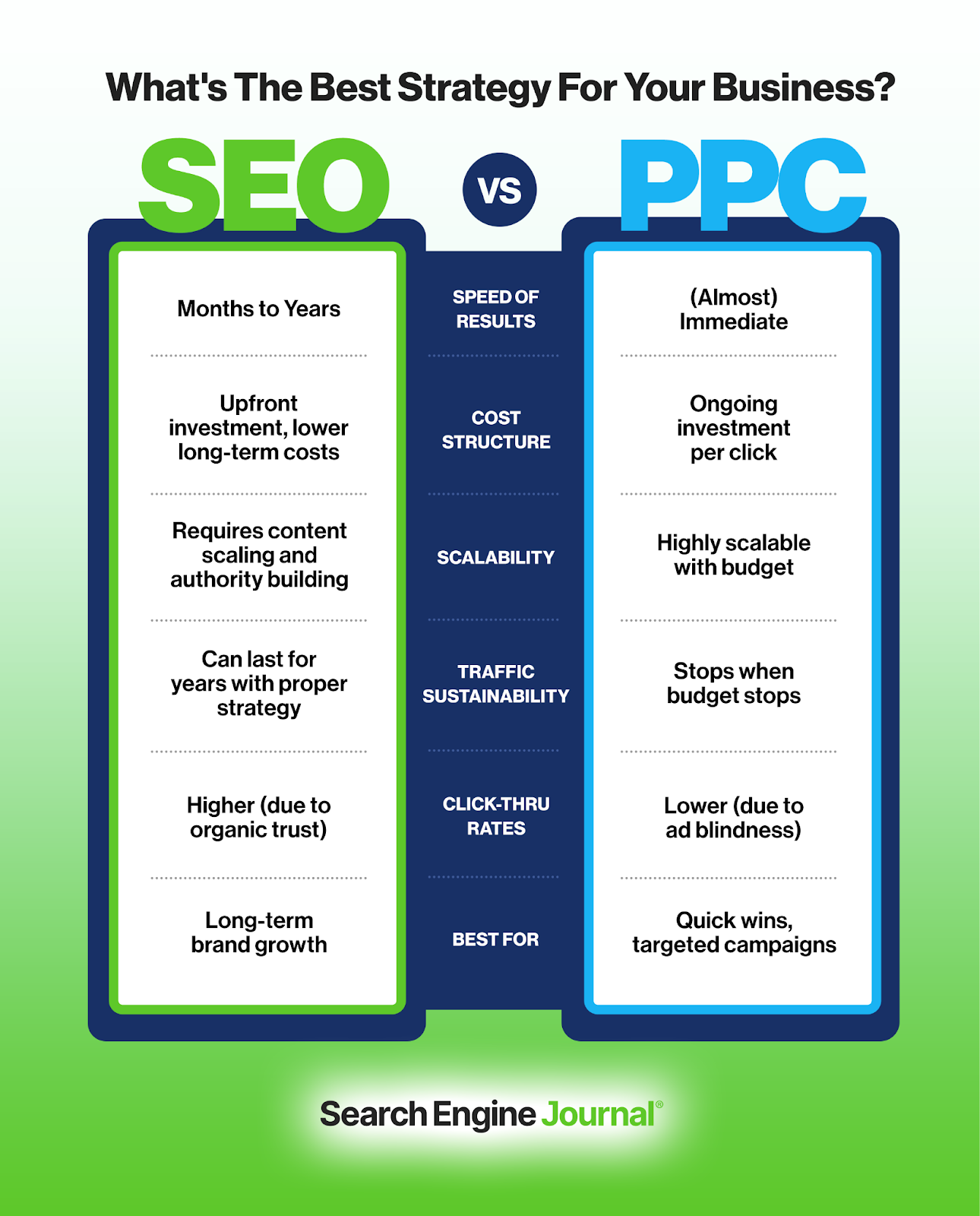
Source: Search Engine Journal
Essentially, each new quality mention:
- Strengthens your existing web pages,
- Gives more “power” to the future content you post,
- And allows internal links pointing from that page to transfer more juice.
Let’s say you ran a campaign a year ago and earned many high-authority links from high-quality guest posts. Even the blog post you publish a year after that will feel some great effects, like faster indexing and often better rankings.
So, even though SEO takes months to work, its effects are really long-lasting.
5. Makes crawling faster
One of the most typical ways for search engine crawlers to find new pages is to follow internal and external links. But what if a page has no URLs pointing to it? Things get slower. Sometimes, it could take days or weeks to find these new pages.
But when a page gets linked from another site (especially a high-authority one), things are different. It sends a strong signal that the page has some trust. When a reputable site mentions your page, crawlers already visiting that site follow the URL.
This is especially powerful when you are launching new web pages. Or, for example, publishing time-sensitive content.
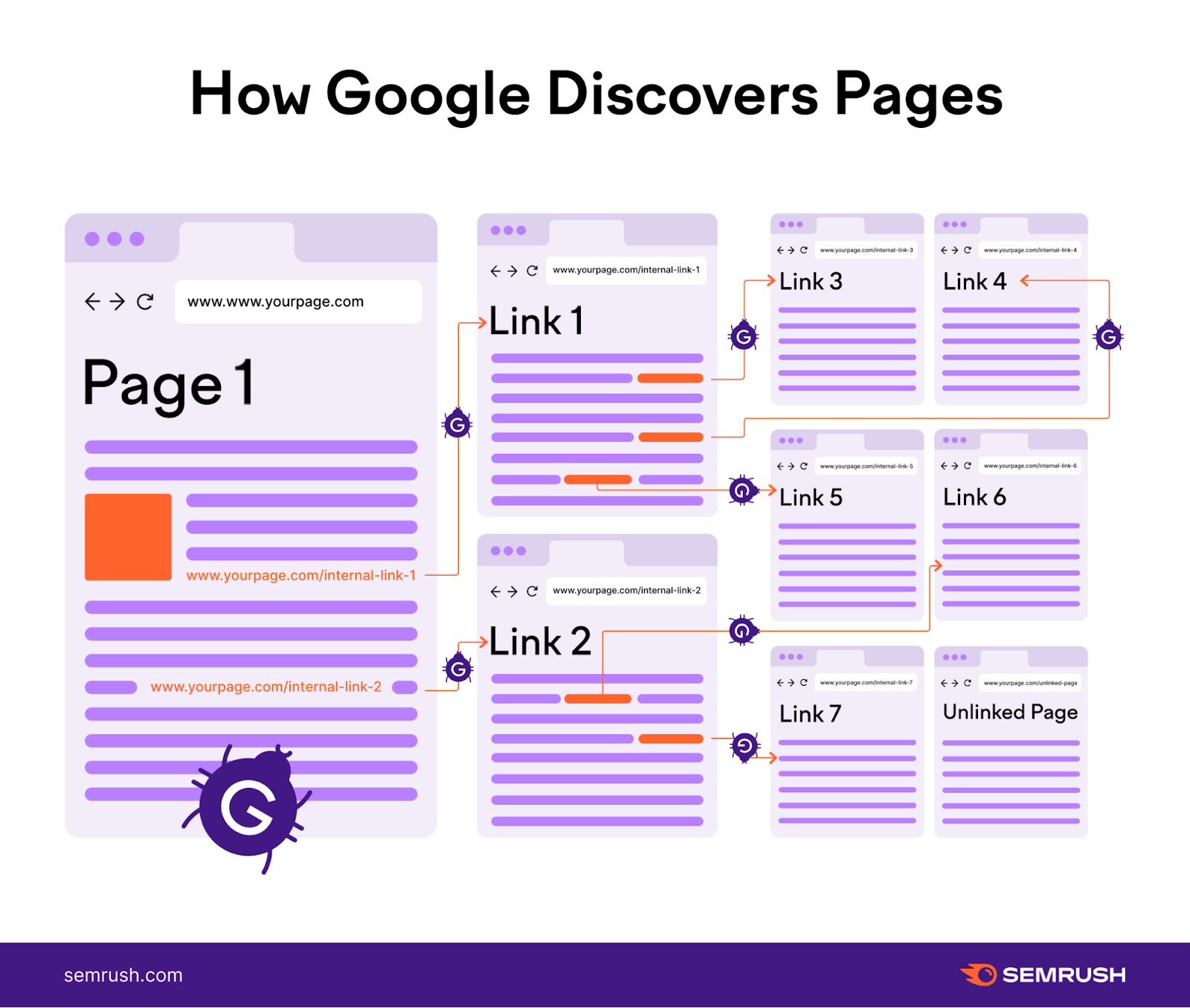
Source: Semrush
6. Contributes to your topical authority
Search engines don’t look at the page thinking, “Is this content good?” That’s just not how they operate and evaluate things. They ask, “Is this website strong and has authority on this topic?”
And links, as you might have guessed, play a massive role in answering that question.
But how do they shape topical authority?
When your website earns relevant backlinks from other sites in your niche, search engines start “connecting the dots. If you consistently get mentions from industry blogs or authoritative sites covering your topic, then it all makes sense for Google.
Your site will be associated with X (aka your topic). And that association matters.
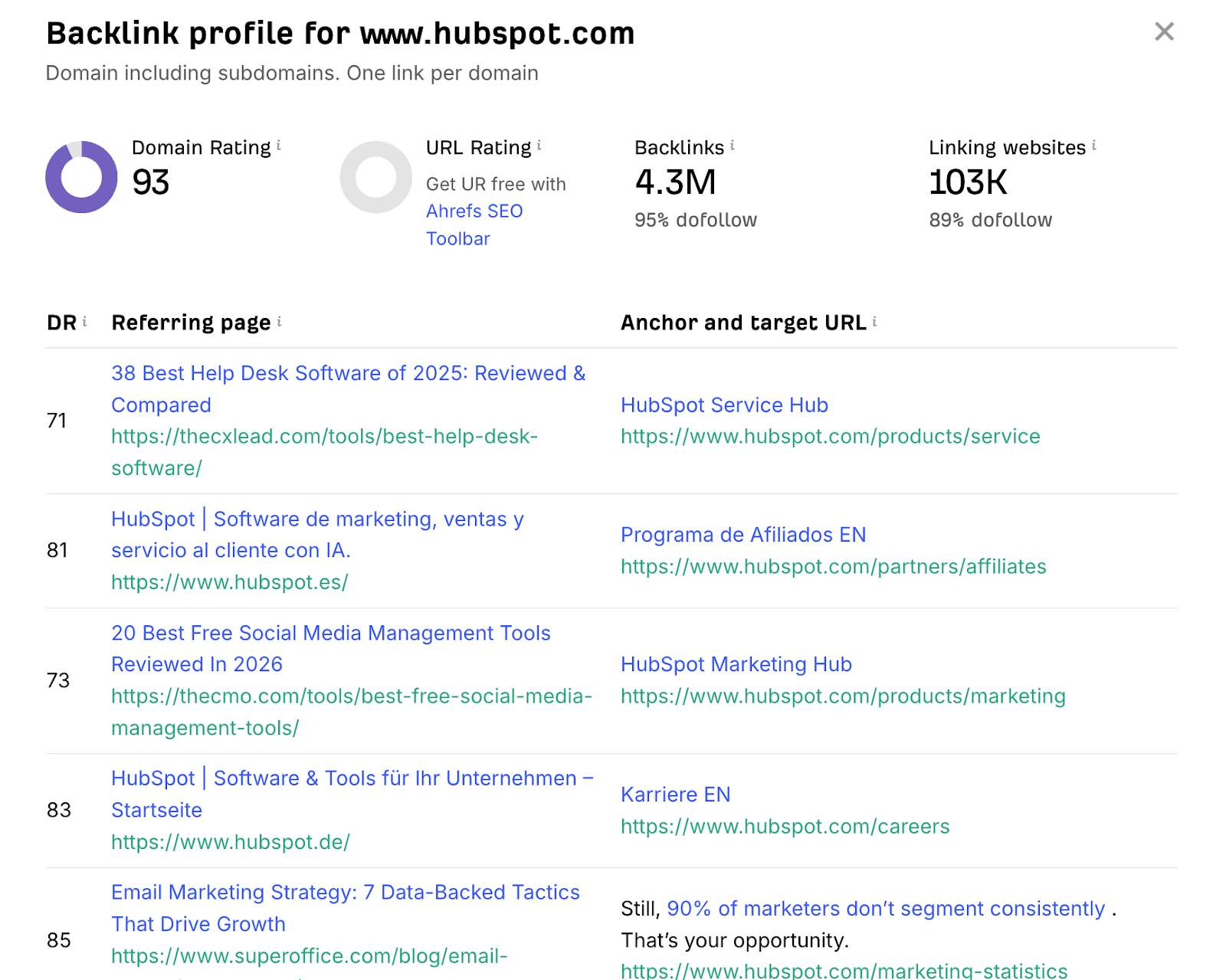
For example, HubSpot consistently earns inbound links from SEO blogs, marketing publications, SaaS growth resources, sales-related pages, etc. Over time, this trains search engines to treat HubSpot as a marketing authority at the domain level.
Source: Ahrefs
So, relevance can’t be underestimated in link building.
A single mention from a huge but irrelevant site can help a little. But if you take a relevant website with similar metrics, your results will likely be much better.
This is why a solid link building strategy always prioritizes:
- Relevance (Do they write about the same thing?),
- Contextual placement (Does our URL make sense in the context?),
- Alignment with your target audience (Does this website have our target audience?).
In other words, you are building topic-level credibility across the web, which often results in the snowball effect. And SEO is extremely effective to help you build a clear image for your brand and turn you into an industry leader.
7. Builds trust and credibility
Links influence algorithms, and… people’s perception.
Of course, no user thinks “this site has good backlinks.” But when they see that reputable websites link to you, of course, that’s another sign that you’re trustworthy. You could even call it a part of behavioral marketing that influences perception.
Search engines want to rank pages they feel confident about. Links from reputable sites just reinforce that trust. They tell search engines:
- This site is legitimate,
- This content is safe to recommend,
- This brand is not shady.
So, if you take any niche and google a related keyword, you’ll mostly see the brands you already know. Because search engines also “know” them.
Let’s double-check this. What sneaker brands can you remember right now? Nike, Adidas, Puma, New Balance?
Well, guess what the first two results are for “sneakers”?:)
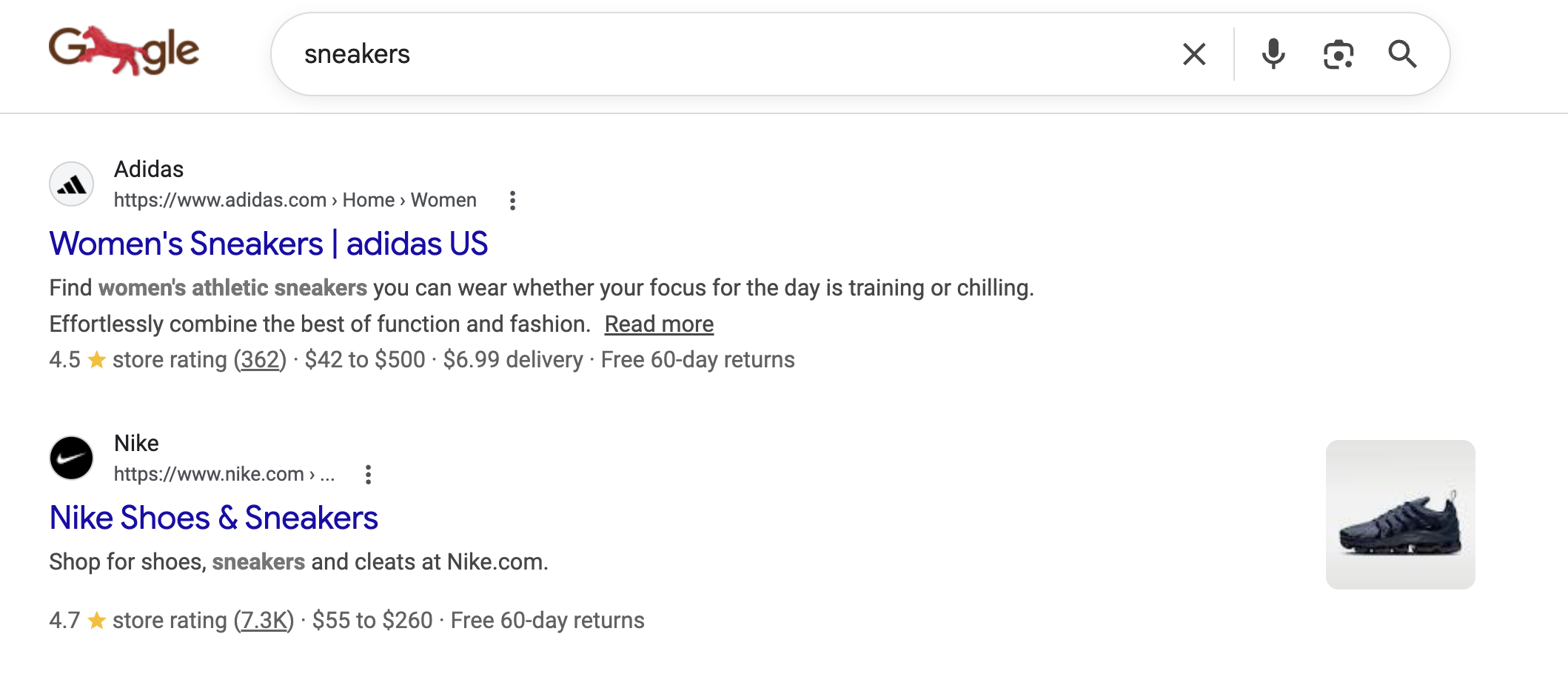
This is especially important in competitive or sensitive niches where credibility matters most. But overall, when building any brand, you have to work on your credibility, not only for SEO but also for your consumers. And links help here. Still, when it comes to spammy backlinks, what do you think they signal? Yep, they don’t add any more trust.
8. Drives referral traffic
Before we get into this really popular benefit you see everywhere, we have to highlight one thing. Not all backlinks drive referral traffic. In fact, most don’t. And that’s okay because most people get most of their backlinks for SEO, not lead generation.
It really makes sense if you think about it.
Many external mentions live deep inside blog posts, and often those don’t really get much organic traffic themselves. So, if you expect every link building campaign to flood your site with visitors, you’ll be nothing but disappointed.
But when do you still get referral traffic?
Often, when you:
- Are a regular contributor to a very relevant resource.
- Appear high up in a listicle (e.g., X best SaaS tools) with good traffic.
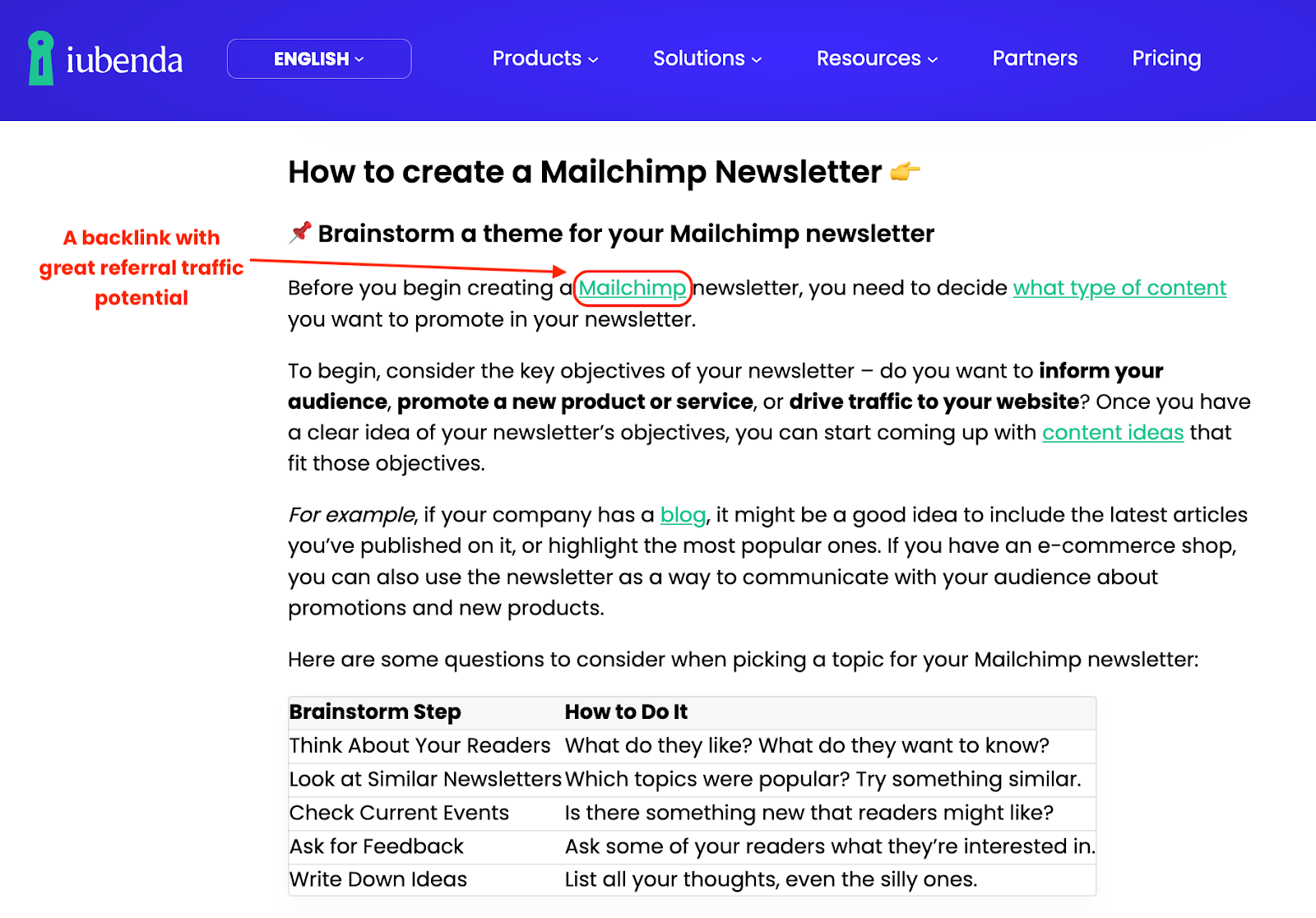
- Publish a tutorial of your product on a website that has your target audience. For example:
Source: iubenda
If you get traffic from these pages, often, those will be some of the highest-quality visitors you’ll ever get.
When someone clicks that URL and lands on your site from another article, they’ve already been pre-qualified. They:
- Know why they’re clicking,
- Understand (at least roughly) what they’ll find on the linked page,
- Trust the website that sent them your way.
That’s what is often referred to as “trust transfer.”
For example, if a well-known industry blog mentions your product inside a thoughtful breakdown of tools, users don’t arrive as cold traffic. They already have a clear intent, because they’re already thinking about solving a specific problem.
And yes, your brand has been framed as a possible solution. Importantly, framed by someone they already trust. That’s very, very different from someone stumbling onto your site through a search query.
This is why referral traffic often converts better than organic traffic, even if the volume is lower.
And while referral traffic shouldn’t be the primary goal of a usual link building campaign, it’s a meaningful side effect of doing it correctly. Just try earning mentions from pages that real people actually read.
9. Makes it easier to rank future content
We often think about backlinks very narrowly: a URL points to a page, and that page ranks better. End of story.
Well, at this point in the article, you know that’s not how search engines evaluate websites.
As your site earns more high-quality backlinks from authoritative and relevant sources, search engines:
- See your entire website differently.
- Crawl it more frequently and index new pages faster.
- And, most importantly, assume a baseline level of trust before they look at a new piece of your content.
That’s already a big difference, right?
When you publish new content on a site with a strong backlink profile, you’re no longer asking search engines to “take a chance” on you.
You already have credibility, and you can rely on it.
This is why established websites can publish a new article and see it rank high relatively fast. And newer sites struggle to get noticed at all. It’s not necessarily because their content is better. It’s mainly because their past link building efforts have already done the heavy lifting.
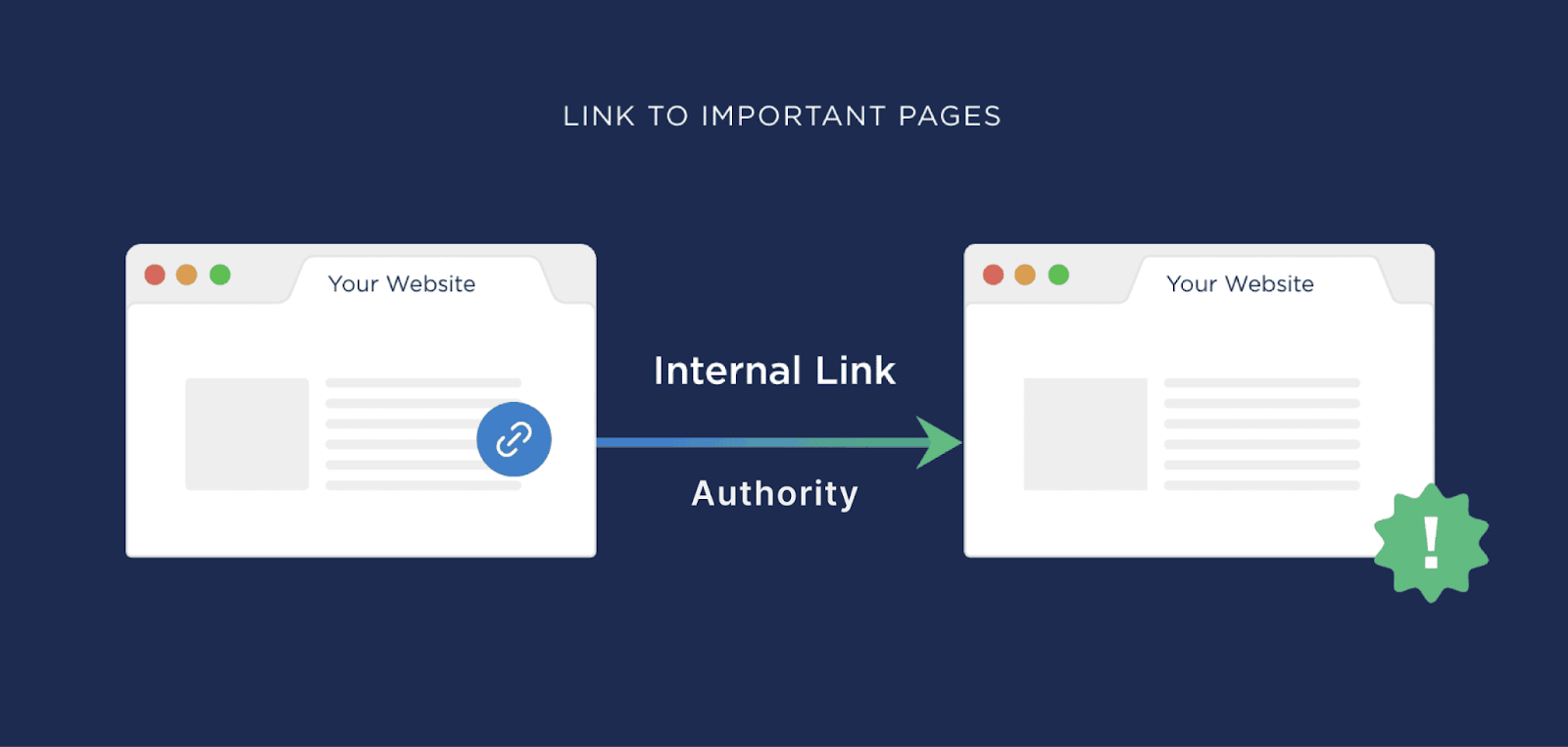
Besides, pages that already have strong backlinks can pass equity to new content through internal links.
Source: Backlinko
That means one well-linked page can help multiple newer pages perform better, even if those don’t yet have external links of their own. And over time, you will have a network of reinforcing pages where authority flows across your site.
Link building compounds just like no other SEO tactic can.
Essentially, you’re improving today’s rankings, but also doing something for your future. You’re helping rank the content you will only have tomorrow. If you have that foundation in place, SEO will often be way more predictable.
Beyond SEO: Why link building is important for business
It’s easy to talk about link building purely in SEO terms. But that framing is not really complete.
Link building is not something you do to please search engines alone. When done properly, it becomes a business growth mechanism that affects how people discover and perceive you.
So, what are some of the main business benefits of link building that you can expect?
Lower reliance on paid ads
Paid ads are simple:
- You spend money, you get attention.
- Once you don’t spend anything, the attention disappears.
The problem is that many businesses slowly slide into ad dependency without realizing it. And this is where growth becomes tied to budget. Any pause in spending is more than risky. It simply means that you won’t get any traffic at all.
But SEO and link building change that.
When your site earns high-quality backlinks from reputable websites, you’re building an asset that works whether you’re “investing” in it or not. Pages continue to rank, and your brand continues to be mentioned, no matter what.
Neither website nor brand authority resets at the end of the month.
So, what is happening in the long run? Right, there is less dependence on paid channels and less pressure on your business as such.
We aren’t saying that PPC is bad. It’s a great channel that works well for particular needs. But relying on this channel alone isn’t the best business decision.
Stronger brand visibility
There are many ways to define brand visibility. But today, let’s talk about “contextual” visibility.
You see, when your brand appears in industry blogs, people start associating your business with something very particular. That’s the “context” we are talking about. And that’s very different from a banner ad or a sponsored post.
The nature of these mentions is different. Because if your brand appears as a suggestion from a reputable source:
- It’s not an interruption like a banner ad.
- It puts you inside conversations, so you don’t have to run around shouting your brand’s name everywhere.
Even when users don’t click, something still happens. Your name becomes familiar, and people learn about your positioning. You start to be like “one of the known players” in the space.
That familiarity pays off later, during searches or buying decisions.
This is especially important in B2B and SaaS markets that have longer sales cycles and higher checks. Here, you rarely (read as “never”) see someone just learn about a brand and convert. They have to trust you first.
More PR and partnership opportunities
One of the least-talked-about benefits of link building is how it almost forces you to build relationships. Why? Well, because to get placements on reputable sites, you need to:
- Talk to editors,
- Learn how to pitch well,
- Collaborate with content teams,
- Negotiate placements,
- Understand what other websites actually want.
In other words, whether you want it or not, you’ll start to build a network.
Over time, that network will become valuable, even if it has nothing to do with SEO. For example, a plain link exchange conversation can become a co-marketing opportunity. You never know what door you might open with that.
This is how PR actually works: through ongoing, mutually beneficial relationships.
Conclusion
Backlinks still matter for SEO. Even in a world changed by AI, they still carry value.
SEO will keep changing, and AI will reshape how people discover information. But one thing is unlikely to disappear: the need for external validation. Not only are we (aka humans) programmed to look for it, but also, as it turns out, search engines (and LLMs) are too.
Link building is one of the few ways to provide that validation and, therefore, establish trust. In the end, it’s nothing but a long-term investment in authority that pays off across channels, way beyond search results.
Related Posts
Published Jan 20, 2026

Last updated May 20, 2022 | Published Sep 10, 2015
Published Apr 1, 2025
Published Sep 16, 2025
Published Jul 17, 2025

Last updated Mar 27, 2024 | Published May 18, 2015
Enter URL & See What We Can Do Submit the form to get a detailed report, based on the comprehensive seo analysis.